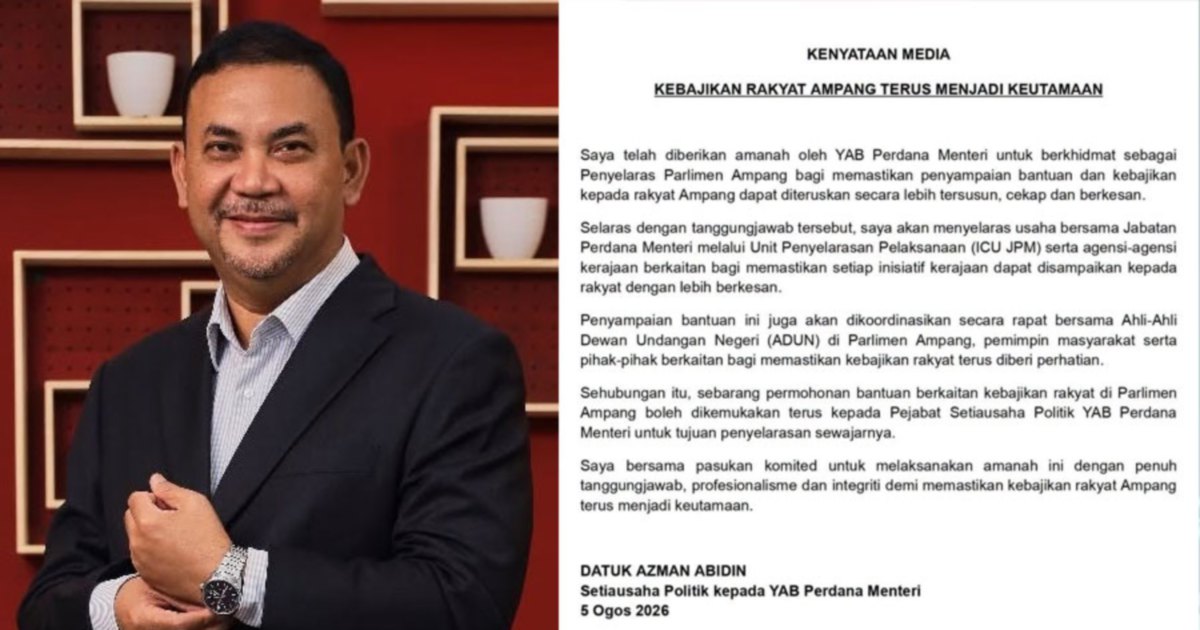
The Prime Minister's office has initiated a significant restructuring of its parliamentary support structure in Ampang, appointing one of Datuk Seri Anwar Ibrahim's political secretaries to coordinate administrative and developmental functions in the constituency. This appointment comes in direct response to the suspension of access granted to PKR lawmaker Rodziah Ismail regarding the MyKhas constituency allocation system, a digital platform designed to manage and distribute development funds for parliamentary areas nationwide.
The appointment represents an extraordinary intervention at the federal level into the mechanics of constituency administration, typically the preserve of elected representatives. The coordination role carries responsibilities that overlap significantly with functions ordinarily executed by members of parliament, raising questions about the governance framework and the distribution of responsibilities between the federal political establishment and elected representatives at the state level.
Rodziah Ismail, who represents Ampang in the Dewan Rakyat, has been prevented from accessing the MyKhas system, which serves as the primary digital infrastructure through which parliamentarians allocate and track development projects and funds within their constituencies. This suspension effectively reduces her capacity to initiate new projects, approve funding applications, and manage existing development initiatives on behalf of constituents. The MyKhas system has become central to parliamentary administrative work since its introduction, consolidating multiple functions from project proposal to disbursement into a unified digital environment.
The deployment of a political secretary from the Prime Minister's office to oversee Ampang's parliamentary coordination signals a substantial shift in how the federal government is managing accountability and resource allocation within the constituency. Political secretaries occupy a unique position within Malaysia's political architecture, serving as extensions of the Prime Minister's authority while remaining embedded within the executive establishment rather than the legislative branch. This arrangement ensures direct federal oversight of constituency-level decisions and spending.
The MyKhas allocation system represents a modernisation of how parliamentary development funds are managed across Malaysia's 222 constituencies. Previously, the allocation and tracking of funds relied on more fragmented administrative processes involving multiple government agencies. The centralised digital approach was intended to enhance transparency, prevent misallocations, and provide real-time visibility to both federal authorities and the public regarding how development resources are deployed at the grassroots level. However, the system's architecture also provides the federal government with granular control over fund disbursement, enabling authorities to restrict access to specific parliamentarians when deemed necessary.
The suspension of Rodziah Ismail's access raises important questions about the grounds on which such restrictions are imposed and the procedural safeguards available to affected legislators. While the specific justifications underlying this particular suspension have not been publicly elaborated, such measures have historically been deployed in response to political insubordination, procedural violations, or investigations into fund management improprieties. For Ampang constituents, the immediate consequence is a disruption in their elected representative's capacity to advocate for and facilitate development projects that address local needs in infrastructure, education, health services, and community facilities.
From a broader political perspective, the intervention reflects the continuing tension within Malaysia's governance system between centralised federal authority and the autonomy of elected representatives. The Prime Minister's office, through its political machinery, maintains extensive influence over resource allocation at the local level, effectively creating multiple layers of authority that supersede the direct relationship between individual MPs and their constituencies. This arrangement can enhance coordination across multiple constituencies and ensure alignment with national development priorities, but it also creates risks of politicising local development and undermining the direct accountability that voters expect from elected representatives.
The appointment of a federal political secretary also carries implications for how the Ampang constituency will be represented administratively during this period. While the coordinator will handle MyKhas-related functions, Rodziah Ismail retains her legislative responsibilities and her ability to represent constituents in parliamentary proceedings. However, the split in administrative functions may create confusion regarding lines of authority and responsibility, potentially complicating constituent service delivery and project implementation.
For PKR, the party to which both Anwar Ibrahim and Rodziah Ismail belong, this development illustrates the internal hierarchies and power dynamics within the ruling coalition. The suspension represents a clear demonstration of federal disciplinary authority over individual party members and their parliamentary operations. Such actions, while sometimes justified as necessary administrative oversight, can create internal party friction and raise concerns about factional conflicts being resolved through resource allocation mechanisms rather than through formal party structures.
The broader implications for Malaysia's parliamentary system warrant attention from observers of institutional governance. The centralisation of development fund allocation and the capacity to suspend parliamentary access to these systems represents a significant concentration of power at the executive level. While such measures may be appropriate in cases of genuine misappropriation or administrative violation, the lack of transparent criteria and procedural checks raises questions about whether such powers might be utilised for purposes beyond their intended scope.
Looking forward, the Ampang situation will likely influence how both the government and the opposition interpret the boundaries of executive authority over parliamentary operations. If such suspensions become routine or are applied inconsistently, they could establish concerning precedents regarding the independence of the legislative branch. Constituents in Ampang, meanwhile, continue to monitor how this arrangement affects their access to developmental resources and the responsiveness of their parliamentary representation during this period of administrative transition.

