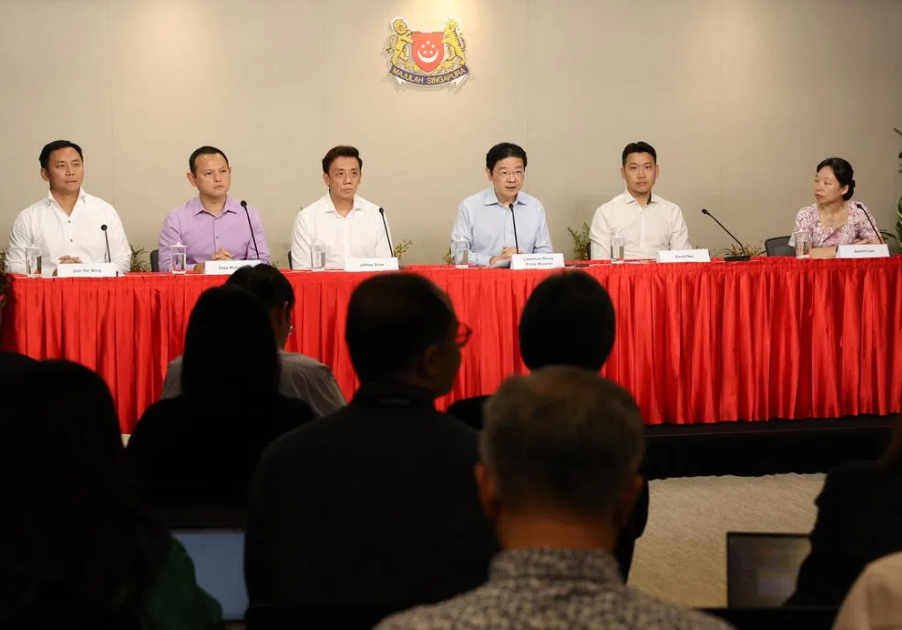
Singapore's Prime Minister Lawrence Wong has announced a substantial Cabinet reshuffle that elevates several first-term MPs to full ministerial roles, signalling an acceleration of the ruling People's Action Party's generational leadership transition. The changes, unveiled on July 22 and taking effect progressively from July 27, represent a deliberate effort to blend the experience of seasoned political veterans with the energy of newer office-holders ready to assume greater responsibilities. The announcement comes against the backdrop of two political resignations in 2026, including that of Acting Minister-in-charge of Muslim Affairs Faishal Ibrahim on July 20 over a "lapse of judgment" in handling personal interactions, and the earlier departure of senior minister of state Koh Poh Koon on June 1 citing family reasons.
The headline promotions involve two 2025 general election newcomers ascending to full ministerial rank. Jeffrey Siow and David Neo, who have been acting in transport and culture portfolios respectively since May 2025, will now assume full minister appointments while retaining their current departmental responsibilities. Their elevation reflects what PM Wong characterised as their successful integration into their roles and demonstrated readiness for expanded authority. This dual promotion underscores the Government's confidence that these legislators have earned both peer recognition and the trust of civil service leadership during their tenure in acting capacities over the past year.
Among other notable appointments, Sim Ann will transition to become Second Minister for Foreign Affairs and Home Affairs, a move that places her in a strategic position overseeing two sensitive portfolios simultaneously. Jasmin Lau, another first-term politician, will assume the role of acting minister at the Ministry of Manpower, taking over from Tan See Leng, who shifts to Minister for Trade and Industry with specific responsibility for energy and industry matters. The breadth of these reassignments demonstrates the Government's willingness to distribute portfolios across a wider circle of newer figures while maintaining continuity through strategic repositioning of experienced hands.
The reshuffle also brings back labour chief Ng Chee Meng to Cabinet as Minister in the Prime Minister's Office, a placement that signals his continued relevance to high-level governance discussions. Meanwhile, K. Shanmugam has been appointed Senior Minister, a role that acknowledges his extensive experience alongside that of Senior Minister Lee Hsien Loong. PM Wong noted that both individuals represent the most experienced members of the Cabinet and will play an increasingly mentoring role as the Government navigates its leadership renewal process. This approach reflects a deliberate strategy to retain institutional memory and seasoned judgment while creating space for emerging talent.
Two backbench MPs and former senior civil servants, Foo Cexiang and Shawn Loh, will be appointed ministers of state, continuing the pattern of elevating first-term politicians into the ministerial ecosystem. These appointments particularly illustrate how the Government is capitalising on the professional backgrounds of new legislators, drawing on their prior experience in the civil service to populate middle-ranking ministerial positions. The cross-pollination between bureaucratic expertise and electoral politics provides a practical avenue for accelerating leadership development while leveraging established administrative competence.
PM Wong's rationale for the timing emphasises the delicate balance required in Singapore's governance model. While Cabinet composition is typically reviewed annually, the unexpected political resignations necessitated recalibration to ensure continuity and functional effectiveness. The PM stressed that the Government must continually build a "strong pipeline" of future leaders, extending well beyond ministerial ranks to encompass robust parliamentary backbenches. This perspective reflects recognition that sustainable political renewal demands investment across multiple tiers of the party hierarchy, not merely reactive shuffling of existing appointments when crises arise.
A particularly notable element of the reshuffle involves what was not announced: PM Wong declined to appoint a second deputy prime minister to work alongside current Deputy Prime Minister Gan Kim Yong. The PM characterised the current structure as providing strong senior leadership while remaining flexible enough to evolve as renewal processes continue. This decision maintains the existing concentration of authority around the deputy prime ministerial position while distributing additional coordinating responsibilities through expanded ministerial appointments. The Cabinet now includes three coordinating ministers overseeing national security, domestic governance functions, and other portfolio areas.
PM Wong also addressed his continued tenure as Finance Minister since 2021, describing his search for a successor as an ongoing work-in-progress rather than an imminent transition. His comments suggest patience with the developmental pace of potential candidates, acknowledging that political figures mature at varying speeds and that premature elevation can prove counterproductive. This reflects a philosophical approach to leadership succession that prioritises readiness and demonstrated capability over mechanical rotation schedules, a principle that has characterised Singapore's PAP governance model for decades.
The Cabinet changes occur within a broader Southeast Asian context where Singapore faces intensifying regional economic competition, evolving geopolitical pressures, and domestic challenges ranging from demographic transitions to digital transformation. The elevation of first-term MPs to senior ministerial positions reflects confidence that the party possesses sufficient new talent to address these multifaceted challenges while maintaining institutional continuity. For Malaysian and regional observers, Singapore's approach to generational leadership transition offers instructive contrasts with succession patterns elsewhere in Southeast Asia, where political handovers often prove destabilising or contested.
PM Wong characterised the reshuffle as embodying "the Singapore way of leadership renewal," emphasising its continuous and deliberate nature rather than ad hoc responses to crises. This framing suggests the Government's aspiration to demonstrate managed, orderly political transition to both domestic and international audiences at a time when regional political stability remains a premium asset. The steady promotion of vetted first-term MPs into ministerial roles, coupled with the retention of senior mentoring figures, attempts to project an image of institutional vigour combined with proven stewardship.
The implications for regional analysts extend beyond personnel changes to encompass questions about the sustainability of Singapore's political model itself. As the founding generation recedes further into history and primary decision-making authority passes to figures without direct experience of the nation-building era, the Government's investment in structured mentoring and gradual responsibility-sharing suggests it takes seriously the risks of both premature transition and insufficient preparation. For comparable regional polities grappling with similar generational questions, Singapore's emphasis on pipeline development and deliberate pacing offers both strategic principles and cautionary notes about the complexity of managing institutional continuity across major political transitions.

