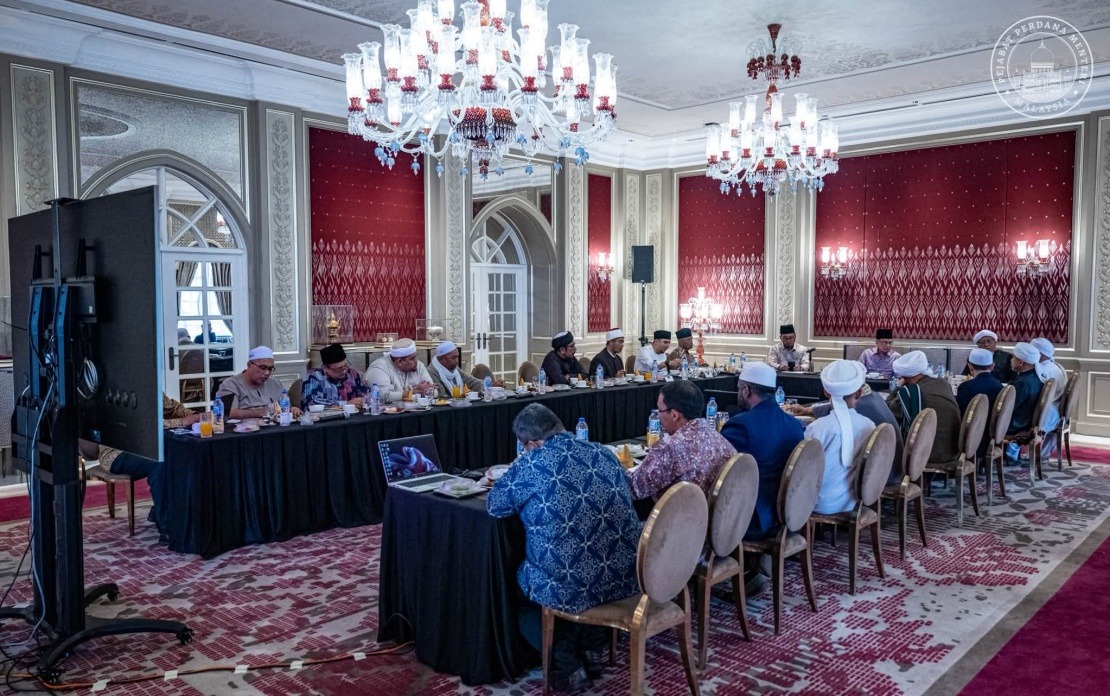
Prime Minister Datuk Seri Anwar Ibrahim has renewed his emphasis on the strategic importance of consulting with Islamic religious scholars as a foundational element in guiding government decision-making. Speaking through a Facebook post on August 27, Anwar characterised such exchanges not simply as procedural meetings but as reflective moments that afford the administration an opportunity to recalibrate its approach based on expert guidance and contemporary realities. The Prime Minister's remarks come amid a series of discussions known as muzakarah, held in conjunction with celebrations of Maulidur Rasul, the Islamic calendar's commemoration of Prophet Muhammad's birth.
During the afternoon's engagements, Anwar held substantive discussions with Sheikh Dr Muhyiddin Awwamah, who serves as a representative of Darul Hadis al-Awwamiyyah, an institution with deep roots in Islamic scholarly tradition. These consultations, Anwar indicated, form part of a deliberate framework through which the government seeks to absorb accumulated wisdom on matters concerning Islam's development and trajectory within the Malaysian context. The emphasis on seeking counsel reflects an administrative philosophy that positions religious expertise not as peripheral input but as central to the formulation of policies affecting the nation's Muslim majority.
The recognition of Sheikh Dr Muhyiddin's lineage carries particular symbolic weight. He represents the intellectual legacy of his father, Al-'Allamah Sheikh Muhammad bin Awwamah, a figure of considerable standing within Islamic scholarly circles and an acknowledged authority on hadith studies. Anwar took the occasion to publicly acknowledge the scholarly contributions of the elder Awwamah, noting that his written works represent far more than literary compilations. Instead, the Prime Minister characterised these texts as embodying an intellectual inheritance that spans generations and perpetuates the unbroken chain of Islamic scholarly transmission—a concept known in Islamic tradition as the isnad.
The timing and nature of these dialogues reflect broader patterns in how Malaysia's government seeks to position itself in relation to religious institutions and expertise. With a Muslim population constituting roughly three-quarters of the nation's demographic composition, managing the intersection between secular governance structures and Islamic principles remains a perennial challenge for policymakers. By publicly emphasising consultation with established Islamic scholars, Anwar signals an administration attentive to religious sensibilities while attempting to ground policy in substantive theological and jurisprudential foundations rather than populist sentiment.
The concept of muzakarah itself carries historical significance within Islamic practice, denoting scholarly discussion and deliberation aimed at arriving at consensus or deepened understanding on complex matters. By adopting this traditional framework for contemporary policy consultations, the government channels contemporary administrative needs through an idiom familiar and legitimising within Islamic discourse. This approach potentially bridges the tension between modern state apparatus and Islamic institutional frameworks that has periodically generated friction in Malaysian politics.
Anwar's articulation of how government effort should be "guided by knowledge, put right through advice and refined according to the needs of the Muslim community and the demands of the times" suggests an iterative model of governance. Rather than viewing policy as fixed and handed down from executive authority, this formulation acknowledges that effective administration requires continuous calibration in response to community needs and changing circumstances. The emphasis on knowledge-guided action carries implicit critique of governance approaches perceived as lacking grounding in expertise or cultural understanding.
For Malaysian readers, these developments carry practical implications for how policies affecting religious affairs, education, welfare, and social cohesion may be formulated in coming months. The Prime Minister's stated commitment to integrating scholarly counsel into the decision-making process could influence everything from curriculum design in Islamic education institutions to frameworks governing the halal industry and religious law application. Given Malaysia's complex federal system in which states retain significant autonomy over Islamic affairs, the federal government's approach to leveraging religious expertise may also have ripple effects across state-level administrations.
The broader Southeast Asian context adds another dimension to these consultations. As several countries in the region grapple with questions of religious identity, state legitimacy, and democratic governance, Malaysia's particular model of engaging religious institutions while maintaining a secular constitutional framework continues to attract scrutiny from both domestic observers and regional peers. How effectively the government incorporates scholarly wisdom into substantive policy outcomes will likely influence perceptions of whether consultation with religious authorities constitutes genuine engagement or primarily symbolic gesture.
Anwar's characterisation of religious scholarship as a "guiding light" for the Muslim community articulates a vision in which intellectual authority within religious traditions receives recognition and influence within state structures. However, this approach also raises questions about whose voices constitute legitimate religious authority, how competing interpretations among scholars are reconciled, and whether consultation mechanisms genuinely shape outcomes or function mainly for legitimisation purposes. The depth to which government acknowledges and acts upon scholarly counsel when it conflicts with political priorities remains an open question.
These ongoing consultations also reflect the Prime Minister's apparent effort to cultivate relationships with prominent Islamic figures and institutions at a time when Malaysia's political landscape continues to experience flux. Building alignment between the federal executive and respected religious scholars potentially strengthens the government's standing among constituencies for whom Islamic authenticity and proper governance hold particular significance. The investment in these relationships suggests a long-term strategic calculation about the foundations upon which sustainable political support may be constructed.

