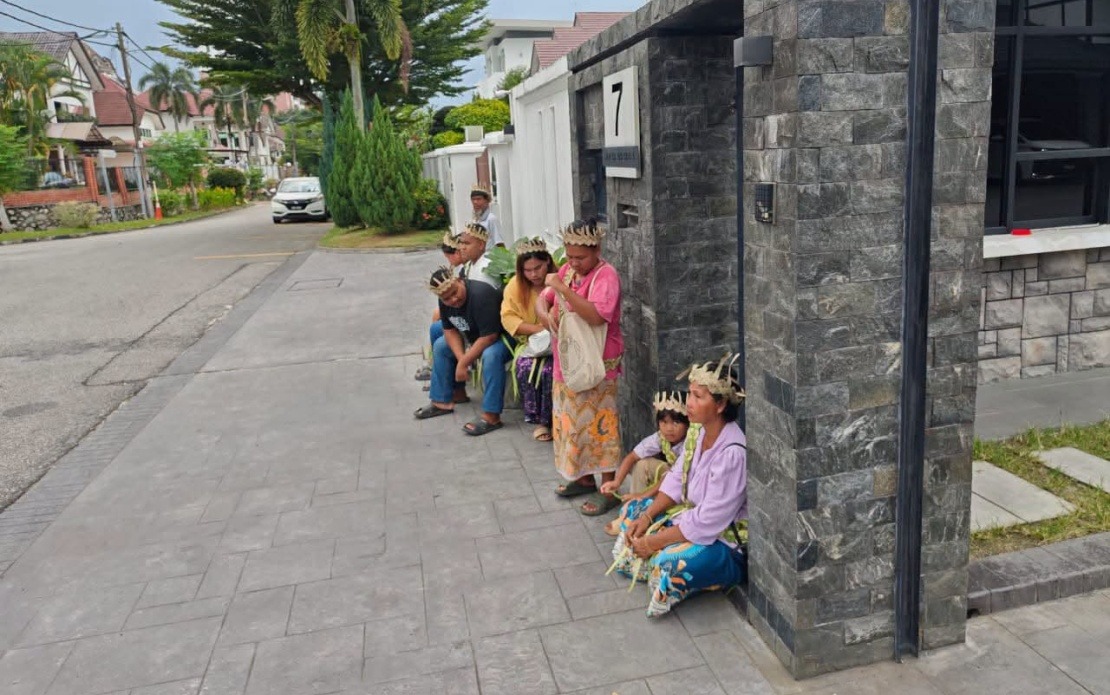
Prime Minister Datuk Seri Anwar Ibrahim has pledged to engage the Pahang state government regarding a land dispute that has become a source of mounting tension for the Orang Asli community in Kampung Sungai Cot, Maran. The commitment came after representatives from the indigenous settlement visited his residence this afternoon and shared their grievances in a telephone conversation facilitated later that evening. The Premier emphasised his willingness to act as a bridge between the community and state authorities to address what appears to be a longstanding territorial issue affecting the village.
During his interaction with the Orang Asli delegation, Anwar gained first-hand insight into the dual challenges confronting the community: the protracted land dispute itself and the recent detention of three residents. The individuals had been taken into police custody, an action that intensified concerns within the village about the handling of their case. However, Anwar reported with evident relief that the three detainees have since been released by police, suggesting some de-escalation in what had become a fraught situation.
The intervention represents a notable escalation of federal attention on indigenous land rights, a persistent challenge in Malaysia that intersects questions of customary ownership, state administration, and constitutional protections. Orang Asli communities across Peninsular Malaysia have faced successive waves of displacement and land contestation, with disputes frequently pitting traditional territorial claims against state development priorities or private interests. The Pahang case reflects patterns evident in multiple states where indigenous groups assert ancestral claims that clash with competing legal frameworks or administrative boundaries.
Anwar's public acknowledgment of the matter through his Facebook statement carries particular weight given the platform's reach among urban Malaysian voters and the symbolic importance of prime ministerial engagement on indigenous issues. By framing the matter as one requiring fairness, prudence, and legal compliance, he positioned the federal government as a neutral arbiter committed to procedural correctness rather than predetermined outcomes. This rhetorical approach may help defuse tensions while establishing parameters for whatever negotiated settlement might eventually emerge.
The Premier's explicit caution against manipulation of the issue signals awareness that land disputes involving Orang Asli communities can become weaponised by various actors pursuing agendas unrelated to the actual welfare of the affected villagers. Political parties, civil society organisations, and even competing state or federal agencies sometimes exploit such controversies to advance institutional interests or score political points. By drawing this line, Anwar sought to reclaim the narrative and insist that solutions be grounded in substantive engagement rather than rhetorical posturing.
For the Orang Asli community in Kampung Sungai Cot, the Prime Minister's assurance offers both immediate diplomatic recognition and uncertain prospects for concrete remediation. Historically, federal involvement in indigenous land matters has produced mixed results, with some cases reaching satisfactory conclusions through negotiated settlements while others languish in legal limbo for decades. The specific configuration of actors and interests in the Maran situation will largely determine whether federal pressure translates into substantive progress or merely temporary relief from immediate pressures.
The detention of the three community members prior to their release raises questions about the original grounds for their apprehension and whether legitimate law enforcement concerns or heavy-handed responses motivated police action. The fact that they were subsequently freed suggests either that initial charges were weak or that political pressure—potentially anticipating the Prime Minister's intervention—influenced the decision. Clarity on these points could inform broader assessment of how authorities have handled the underlying dispute.
Pahang's state government now faces implicit pressure to engage constructively with federal initiatives on the matter, though the precise mechanisms for coordination remain unstated. In Malaysia's federal structure, land administration rests primarily with state governments, creating potential friction when federal authorities seek to influence outcomes in disputes technically falling within state purview. The Pahang administration's openness to Anwar's involvement and the substantive terms it is willing to accept could determine whether this matter moves toward resolution or becomes mired in jurisdictional disputes.
For Malaysia's broader indigenous population and civil society advocates focused on Orang Asli rights, the episode offers a test case of how federal leadership engages with chronic grievances affecting Malaysia's most marginalised communities. The outcome will likely be scrutinised as an indicator of whether the Anwar administration prioritises indigenous welfare as a genuine policy focus or treats such matters as episodic issues requiring symbolic management. The detailed commitments made in follow-up engagement with Pahang will reveal the depth of federal commitment beyond initial statements of goodwill.
The situation also underscores the degree to which Orang Asli communities must resort to high-level political intervention to secure attention to their basic rights, reflecting deeper structural inequalities in how Malaysian governance processes serve indigenous interests. More effective long-term solutions would likely require institutional reforms ensuring that Orang Asli concerns receive systematic consideration within routine state administration rather than demanding prime ministerial intervention in individual cases. Whether Anwar's initiative catalyses such structural reflection or remains a one-off intervention will carry implications for indigenous governance in Malaysia extending well beyond the Kampung Sungai Cot dispute itself.

