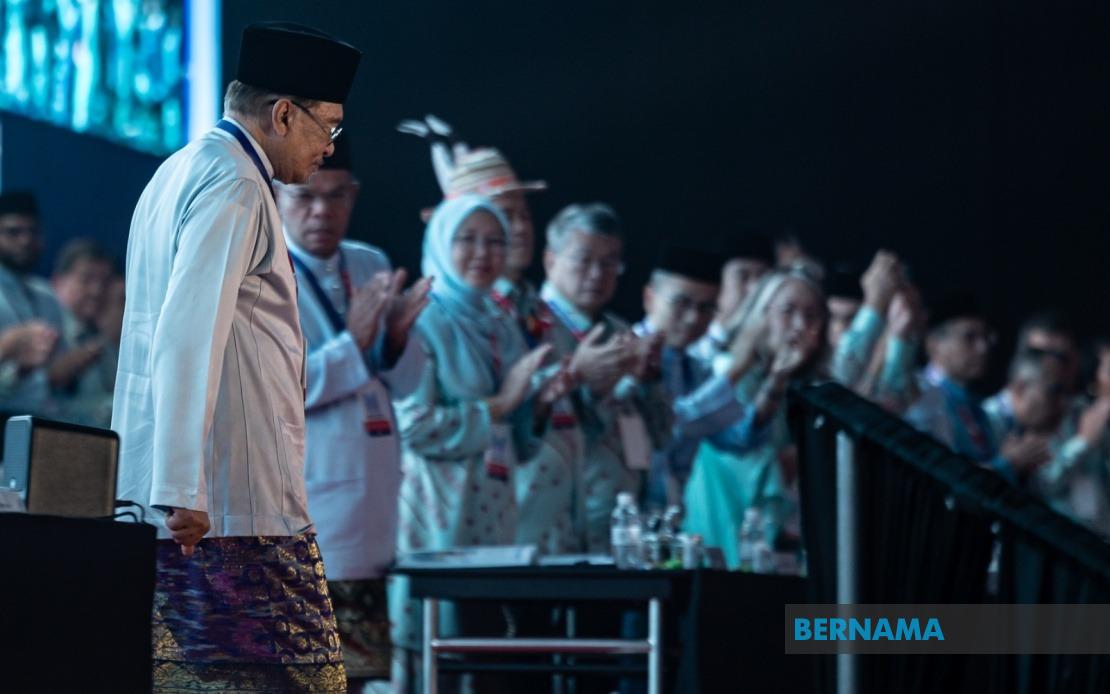
Prime Minister Datuk Seri Anwar Ibrahim has rejected claims circulating in some quarters that the MADANI Government is sidelining particular states, instead underscoring that federal expenditure has expanded meaningfully across all regions under his administration. Speaking at the 2026 PKR National Congress held at the Melaka International Trade Centre in Ayer Keroh on August 15, Anwar provided detailed breakdown of budget growth to counter perceptions of unequal regional treatment, framing allocations as responsive to distinct development priorities rather than political favouritism.
The Prime Minister highlighted Sabah's substantial gains, noting that federal spending in the state has surged by 35 per cent during the three years since his government assumed office. This trajectory represents a marked departure from earlier administrations, which Anwar suggested had not prioritised the state's budget needs as aggressively. By shifting the comparison to pre-2023 periods, Anwar implicitly challenged critics to acknowledge the difference between his government's approach and that of his predecessors, establishing a temporal baseline for evaluating his administration's performance on regional equity.
Across the East Malaysian corridors, Sarawak has experienced even more pronounced growth, with federal allocations climbing from RM10.2 billion in 2022 to RM15.1 billion projected for 2026, representing a 48 per cent increase. This elevation reflects deliberate efforts to strengthen infrastructure and service delivery in Malaysia's largest state by area, suggesting that the federal government views Sarawak's development as strategically important. The scale of this boost indicates serious investment in narrowing perceived regional disparities and addressing long-standing infrastructure deficits in East Malaysia.
Federal support for Sabah has similarly intensified, with the annual allocation climbing from RM13 billion in 2022 to RM17.6 billion expected for 2026. These figures suggest that the federal government is directing substantial additional resources toward both East Malaysian states, potentially addressing historical concerns about resource distribution that have occasionally surfaced in regional political discourse. For observers tracking federal-state relations, such commitments signal a commitment to maintaining cohesion within Malaysia's geographically dispersed federation.
Peninsula-based states have also benefited from the budgetary expansion, though the quantum of increases varies according to Anwar's framing of different development priorities. Terengganu's allocation has risen from RM6 billion in 2022 to RM8.1 billion for the current year, while Johor has seen more dramatic growth, increasing from RM10.2 billion in 2022 to RM14.6 billion projected for 2026. These figures underscore how allocations are being calibrated to reflect each state's size, population density, and development stage, rather than distributed uniformly.
Kedah, Kelantan, and Perlis have likewise experienced overall allocation increases, though the Prime Minister did not specify exact figures for these states. By lumping these smaller states together with the larger recipients of increased funding, Anwar sought to present a unified picture of inclusive fiscal distribution. This approach addresses criticism that might emanate from opposition-controlled or opposition-leaning state governments by demonstrating that federal support is not contingent on partisan alignment.
Anwar's emphasis that different allocations reflect different priorities rather than deliberate sidelining introduces an important distinction in the regional development debate. His argument suggests that the federal government assesses each state's needs and strategic importance independently, allocating resources based on infrastructure gaps, population growth trajectories, and economic development potential. This methodology would theoretically insulate the government from accusations of using the federal purse as a political weapon, instead casting budget decisions as technocratic assessments.
The timing of these remarks at a PKR party congress carries significance for internal party management. By addressing regional equity concerns directly before the party faithful, Anwar is reinforcing his administration's commitment to balanced development while fortifying the party's position among state delegations. For PKR members representing different regions, hearing concrete budget figures provides reassurance that their constituencies are receiving appropriate federal attention.
For Malaysian federalism more broadly, this public accounting reflects the persistent salience of regional distribution concerns in national politics. The fact that allegations of sidelining were credible enough to require direct prime ministerial rebuttal indicates that questions about federal equity remain sensitive flashpoints. Anwar's detailed response suggests his government takes such perceptions seriously, recognizing that regional grievances, if left unaddressed, could accumulate into legitimacy challenges.
The substantial growth figures cited by the Prime Minister—particularly the 35 to 48 per cent increases in East Malaysian states—represent significant real-world commitments of public resources. If these projections materialize, they could materially improve service delivery and infrastructure in recipient states, potentially translating fiscal pledges into visible improvements that shape voter perception. Conversely, if allocations fail to translate into tangible development projects or if implementation lags, the government risks undermining the credibility of its commitment to regional equity.
From a Southeast Asian perspective, Malaysia's approach to managing regional distribution through explicit federal allocations offers lessons for other federally-structured nations grappling with centre-periphery tensions. The detailed public accounting of budget transfers demonstrates one mechanism through which central governments can respond to equity concerns, though effectiveness ultimately depends on implementation capacity and genuine commitment to closing development gaps.

