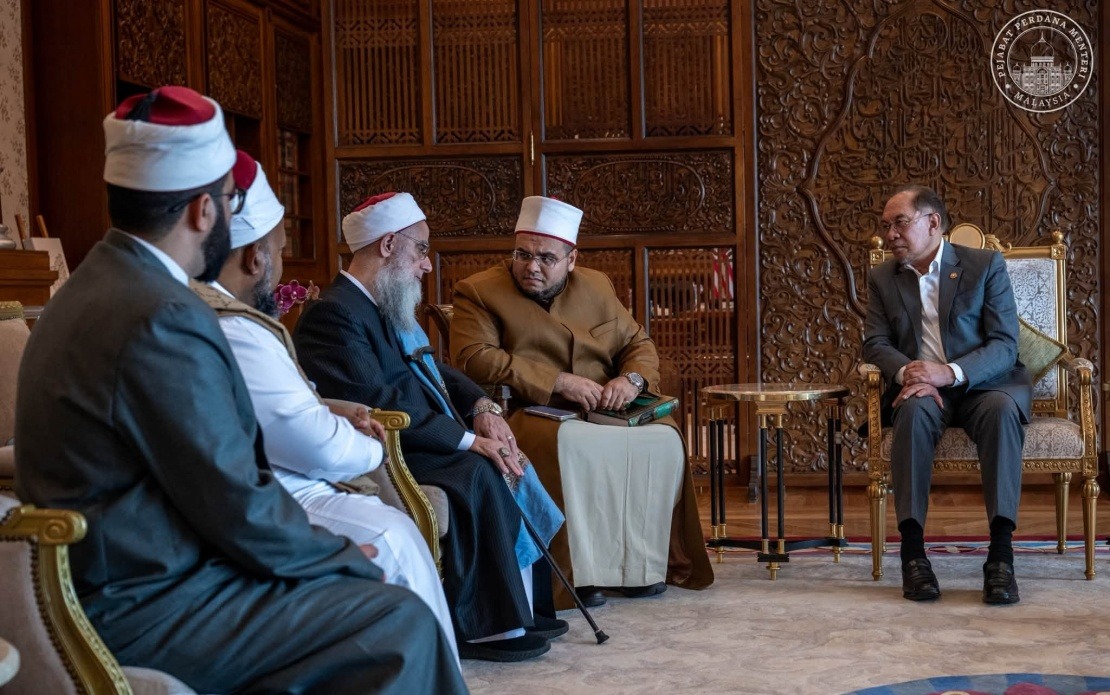
Prime Minister Datuk Seri Anwar Ibrahim received a notable visitor at his Putrajaya office on July 20, when he met with Sheikh Dr Mustafa An-Nadwi Al-Hasani Mansurah, a prominent Islamic scholar from Egypt. The meeting highlighted the prime minister's continued engagement with influential figures within the global Islamic intellectual community, reflecting Malaysia's positioning as a hub for interfaith dialogue and Islamic scholarship in Southeast Asia.
Anwar spoke highly of Sheikh Dr Mustafa's scholarly credentials and intellectual approach, describing him as an authoritative voice in matters concerning ethical conduct and traditional Islamic knowledge. The prime minister particularly noted the scholar's specialisation in hadith studies—the collection and authentication of Prophet Muhammad's teachings—and his commitment to grounding contemporary Islamic discourse in foundational theological principles. This focus on classical Islamic learning represents a deliberate counterpoint to more sensationalised interpretations that sometimes dominate public discourse.
The visitor carries impressive scholarly lineage, having studied under Sheikh Abul Hasan Ali al-Nadwi, whose influence shaped modern Islamic thought across the Middle East and Asia. Al-Nadwi himself was a towering figure in twentieth-century Islamic education, known for advocating a balanced approach to Islamic revival that emphasised both intellectual rigour and practical spirituality. Through this connection, Sheikh Dr Mustafa represents a tradition of Islamic scholarship that prioritises depth, contextual understanding, and measured wisdom over reactive or populist interpretations.
Anwar's public comments about the meeting revealed his perspective on the role of knowledge in contemporary society. Using the metaphor of morning dew—quiet yet life-giving—the prime minister contrasted genuine learning with the sensationalism that often dominates modern information ecosystems. In Malaysia's context, where social media has amplified competing narratives on religious and political matters, this emphasis on thoughtful scholarship carries particular relevance. The prime minister's framing suggests an intellectual framework in which traditional Islamic learning provides ballast against rapid ideological swings.
The timing of Sheikh Dr Mustafa's Malaysia visit reflects broader regional engagement patterns. Southeast Asia's Muslim-majority nations have increasingly become destinations for prominent Islamic scholars and educators, drawn by substantial audiences, active intellectual communities, and interest in how traditional Islamic thought addresses contemporary governance challenges. Malaysia specifically has hosted numerous scholars and organisers of knowledge circles, positioning itself as a serious centre for Islamic intellectual life beyond the Middle East.
During their meeting, Anwar and Sheikh Dr Mustafa discussed current affairs affecting the region and the global Muslim community, though specific policy areas were not detailed in the prime minister's account. These conversations typically encompass issues ranging from geopolitical developments to internal communal concerns about preserving Islamic values within rapidly modernising societies. For Malaysia, such exchanges provide opportunities to learn from scholars' perspectives on balancing tradition with progress—a perennial challenge facing the country's Islamic institutions and governance structures.
Sheikh Dr Mustafa's week-long visit to Malaysia included knowledge sessions with local audiences, suggesting that his engagement extended beyond high-level political meetings to direct educational outreach. These sessions likely attracted Islamic students, community leaders, and others interested in his scholarly perspective on hadith methodology and Islamic jurisprudence. Such grassroots intellectual exchange strengthens the connective tissue between Malaysian Muslim communities and broader Islamic scholarly traditions, helping prevent parochialism while maintaining doctrinal consistency.
Anwar's gratitude for Sheikh Dr Mustafa's prayers for Malaysia's unity and prosperity touched on a theme central to the prime minister's political messaging since taking office. The emphasis on national cohesion and communal blessings reflects concerns about divisive tendencies that have periodically strained Malaysia's multicultural social fabric. By hosting and honouring visiting Islamic scholars who exemplify wisdom and moderation, the government seeks to reinforce these values within local Islamic discourse and practice.
The prime minister's prayers for Sheikh Dr Mustafa's wellbeing and continued scholarly work reciprocated the courtesy and reflected diplomatic protocol. More substantively, Anwar's invocation of wisdom, moderation, and compassion as values to guide the scholar's ongoing work echoed his own stated political principles. These three qualities represent Anwar's repeated characterisation of desirable Islamic leadership—a framework distinct from interpretations emphasising puritanism, literalism, or confrontational religious positioning that have periodically influenced Malaysian Islamic discourse.
The meeting exemplifies how Malaysian political leadership engages with international Islamic intellectual networks. Rather than treating such encounters as ceremonial, Anwar publicly validated the substantive exchanges that occurred, signalling that engagement with global Islamic scholarship constitutes an important dimension of national governance. This approach distinguishes his administration from purely transactional diplomacy, suggesting instead a genuine interest in how classical Islamic thought can inform contemporary policy thinking.
For regional observers, the visit underscores how Malaysia's strategic importance extends into the realm of Islamic intellectual affairs. As Southeast Asia's largest economy and an established destination for Islamic studies and education, Malaysia attracts scholars and students seeking to understand how Islamic traditions interface with modern governance, technology, and social change. Hosting figures like Sheikh Dr Mustafa reinforces Malaysia's soft power credentials within Muslim-majority regions while demonstrating the country's commitment to serious engagement with Islamic scholarship beyond ceremonial religiosity.

