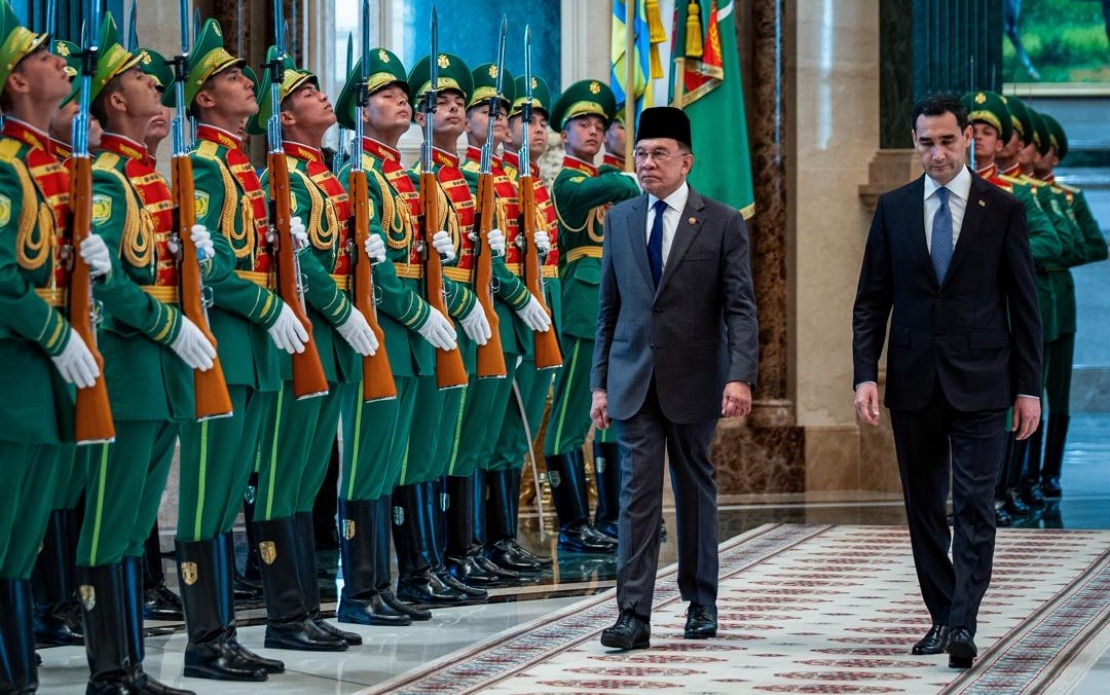
Prime Minister Datuk Seri Anwar Ibrahim was given full diplomatic honours upon arriving at the Turkmenistan Presidential Palace in Ashgabat on June 19, in a formal ceremony that underscores Malaysia's growing engagement with Central Asia. The reception marks the first time the Malaysian leader has visited the resource-rich nation since assuming office as the country's 10th Prime Minister in November 2022, having been invited by Turkmenistan President Serdar Berdimuhamedov.
The ceremonial welcome reflected the significance both nations place on strengthening their bilateral relationship. As Anwar stepped onto the palace grounds, he was met by President Berdimuhamedov in an exchange that included the traditional display of a guard of honour. The simultaneous playing of Malaysia's and Turkmenistan's national anthems created a symbolic moment, acknowledging the sovereignty and standing of both countries as they look to deepen cooperation across multiple sectors.
Following the formal reception protocols, the Malaysian delegation was introduced to key members of Turkmenistan's Cabinet and other senior government officials—a crucial step in diplomatic engagement that ensures the visiting delegation has visibility and direct access to decision-makers across various portfolios. This introduction phase also allowed Anwar to present his own team of ministers and officials who would be involved in subsequent bilateral discussions.
The visit represents Malaysia's strategic effort to expand its diplomatic and economic footprint beyond its traditional Southeast Asian sphere. Turkmenistan, located in Central Asia along the Caspian Sea, possesses vast natural gas reserves and sits at a critical crossroads between Europe and Asia. For Malaysia, establishing stronger ties with Central Asian nations can open new markets for Malaysian goods and services, while also facilitating cooperation in energy, technology, and educational exchanges.
Once the initial formalities concluded, Anwar and President Berdimuhamedov engaged in a four-eyed meeting—a private conversation between the two leaders—before transitioning to a fuller bilateral session. These structured discussions typically address matters of mutual concern and opportunity, with particular attention to enhancing cooperation frameworks that could benefit both nations' long-term interests.
The bilateral meeting agenda likely encompassed trade and investment prospects, as Malaysia seeks to diversify its international partnerships in an increasingly multipolar global environment. Energy security remains a pressing regional concern, and Turkmenistan's position as a major gas producer makes such discussions particularly relevant as nations across Asia and beyond navigate energy transitions and supply chain resilience.
Anwar's two-day visit, which began on June 18, signals Malaysia's commitment to building relationships beyond the Association of Southeast Asian Nations (ASEAN) framework. Central Asian nations have historically been somewhat distant from Southeast Asian political and economic circles, yet recent years have seen growing recognition of the mutual benefits such partnerships can yield. For Malaysia specifically, engaging with Turkmenistan and other Central Asian states diversifies diplomatic options and creates hedging opportunities in an era of great power competition.
The timing and nature of this first official visit carry weight in Malaysia's broader foreign policy trajectory. By demonstrating early engagement with Central Asia under Anwar's tenure, Malaysia positions itself as a nation genuinely interested in cross-continental cooperation rather than remaining confined to regional concerns. This approach reflects the prime minister's previously stated vision of Malaysia as a bridge nation and a constructive player in international affairs.
Turkmenistan, for its part, has been selective about its international partnerships, maintaining a policy of permanent neutrality for decades. President Berdimuhamedov's decision to extend an invitation to Anwar and to accord the Malaysian delegation full ceremonial treatment suggests Ashgabat views Malaysia as a reliable and worthwhile partner. The reception also reflects Turkmenistan's own gradual opening toward increased engagement with Asian nations, particularly those from Southeast Asia with whom it has limited historical friction.
The visit also carries implications for Southeast Asia's connectivity agenda. As ASEAN nations increasingly look to bridge the geographic and economic gap between Southeast Asia and Central Asia through initiatives such as enhanced transportation networks and trade corridors, Malaysia's active engagement at the leadership level reinforces these broader regional aspirations. By strengthening bilateral ties with Turkmenistan, Malaysia potentially creates pathways for broader ASEAN-Central Asian cooperation.
Looking ahead, the discussions held during this visit will likely inform Malaysia's approach to Central Asian engagement over the coming years. Any agreements or frameworks established during Anwar's visit could serve as templates for other Malaysian initiatives in the region, influencing how Malaysian businesses, educational institutions, and government agencies interact with their Central Asian counterparts.
The official welcome ceremony, while ceremonial in nature, carries substantive diplomatic meaning. It signals respect, commitment, and serious intent to develop the relationship beyond mere diplomatic niceties. For Malaysian observers and international stakeholders, the reception demonstrates that Anwar's government is actively pursuing a more expansive foreign policy vision that extends Malaysia's sphere of engagement and influence into regions previously underexplored by Malaysian leadership.

