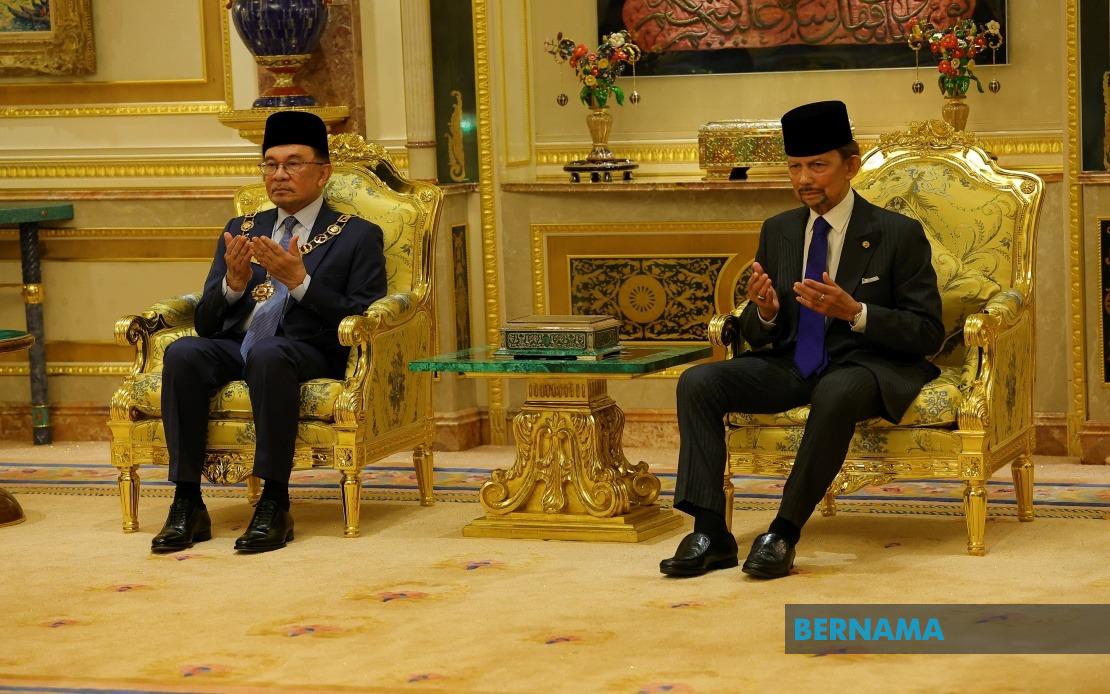
Prime Minister Datuk Seri Anwar Ibrahim received one of Brunei Darussalam's highest royal honours during an investiture ceremony at Istana Nurul Iman in Bandar Seri Begawan on August 22. Sultan Hassanal Bolkiah conferred upon the Malaysian leader the Darjah Kerabat Laila Utama Yang Amat Dihormati (D.K.), a recognition that reflects the depth of bilateral relations between the two Southeast Asian neighbours. The ceremony took place at Cheradi Laila Kenchana within the royal palace, underscoring the formal significance accorded to the occasion and Anwar's stature in regional diplomatic circles.
The Crown Prince of Brunei, Pengiran Muda Mahkota Al-Muhtadee Billah, witnessed the proceedings alongside several high-ranking Malaysian officials. Foreign Minister Datuk Seri Mohamad Hasan and Investment, Trade and Industry Minister Datuk Seri Johari Abdul Ghani accompanied Anwar, while the leaders of Malaysia's two largest states, Sarawak Premier Tan Sri Abang Johari Tun Openg and Sabah Chief Minister Datuk Seri Hajiji Noor, were also in attendance. The composition of the Malaysian delegation signals the importance placed on this visit beyond federal interests, with state governments having a direct stake in the outcomes of bilateral discussions.
Anwar's delegation arrived at the palace at approximately 11 am, having travelled to Brunei the previous day. This two-day working visit marks the Malaysian leader's participation in the 27th Annual Leaders' Consultation (ALC-27), a regular high-level meeting mechanism between Malaysia and Brunei established to address matters of mutual interest and concern. These consultations have long served as a platform for frank exchanges on regional security, economic cooperation, and matters affecting both nations and their respective populations in the Borneo region.
The state visit carries particular significance given Malaysia and Brunei's historical and geographic ties. Both nations are members of ASEAN and share maritime boundaries, making cooperation on security, maritime management, and economic matters strategically vital. The conferment of a royal honour upon Anwar suggests recognition of his leadership role in navigating bilateral relations and his efforts to strengthen ties between Kuala Lumpur and Bandar Seri Begawan. Such decorations, while ceremonial in nature, carry diplomatic weight and signal endorsement of the recipient's standing and contributions to interstate relations.
Beyond the ceremonial aspects, the visit is expected to yield substantive outcomes in bilateral cooperation. Sultan Hassanal Bolkiah and Anwar are scheduled to witness the signing of a Memorandum of Understanding concerning disaster management cooperation. This development reflects a pragmatic recognition that both nations face shared challenges from natural disasters, including flooding and tropical storms that periodically affect the Borneo region. A formalised framework for coordinating disaster response efforts, sharing expertise, and providing mutual assistance during emergencies would enhance resilience in both countries and potentially extend benefits to the wider region.
The selection of disaster management as a focal point for new cooperation demonstrates how bilateral relations increasingly encompass non-traditional security matters. While traditional concerns such as border management and maritime delimitation remain relevant, contemporary challenges from climate impacts and environmental changes have prompted governments to establish cooperative mechanisms. Malaysia's experience in managing large-scale floods and Brunei's capacity in emergency response protocols could be complementary, and institutionalising this cooperation through an MoU represents a forward-looking approach to regional stability.
Anwar's visit to Brunei also comes at a time when Malaysia is seeking to strengthen its engagement across ASEAN and with major trading partners. As Prime Minister, Anwar has prioritised regional diplomacy and economic cooperation, and the state visit to Brunei fits within this broader strategic framework. The attendance of key economic ministers signals Malaysia's intent to explore or expand commercial opportunities, investment flows, and trade partnerships with Brunei, despite the sultanate's smaller economy relative to Malaysia's.
The presence of Sarawak and Sabah leaders in the Malaysian delegation reflects the federalised nature of Malaysian politics and governance. Both states have significant maritime interests, international borders, and distinct economic profiles that warrant their representation in high-level diplomatic engagements. Their participation underscores that Malaysia speaks to Brunei not merely through federal channels but as a federation of states with varied interests and capabilities. This approach has become more prominent in recent years as regional leaders recognise the importance of sub-national governments in cross-border cooperation, particularly in areas such as tourism, trade, and environmental management.
Historically, Malaysia and Brunei have maintained cordial relations, though these have occasionally been overshadowed by maritime boundary disputes and competing economic interests. Regular high-level consultations such as the ALC serve to manage differences and identify common ground. The 27th iteration of this meeting continues a tradition of dialogue that has helped maintain stability in Southeast Asia and prevented minor disagreements from escalating into significant tensions. For Malaysian policymakers, these consultations offer opportunities to align positions on regional issues and coordinate stands within ASEAN forums.
The broader context of this visit includes ASEAN's efforts to maintain unity and pursue a common agenda amid geopolitical shifts in the region. Malaysia and Brunei, as founding ASEAN members, play roles in shaping the organisation's direction and priorities. Strengthening bilateral ties strengthens ASEAN's cohesion, a matter of importance given external pressures and competing interests within the region from major powers. The royal honour awarded to Anwar may thus be interpreted partly as recognition of his contribution to regional stability and Malaysia's commitment to ASEAN solidarity.
Economically, while Brunei's oil and gas revenues dwarf many economies in the region, both nations benefit from deepened trade and investment linkages. Malaysian companies operate across various sectors in Brunei, and further cooperation in areas such as tourism, halal products, and financial services could yield mutual benefits. The presence of the Investment, Trade and Industry Minister during this visit suggests that commercial dimensions were on the agenda, with the possibility of new initiatives or the elevation of existing partnerships being explored.
For Malaysia specifically, maintaining strong relations with Brunei has domestic implications, particularly for Sarawak and Sabah. Border communities in both states depend partly on cross-border trade and people-to-people exchanges with Brunei. Diplomatic engagement at the highest levels facilitates the resolution of local issues, eases regulatory hurdles, and creates an enabling environment for economic activity in border regions. The inclusion of state leaders in the delegation ensures that these local concerns are communicated to the highest levels of the Malaysian government and, through official channels, to the Brunei leadership.
Looking ahead, the outcomes of this visit, particularly the MoU on disaster management, may serve as a template for enhanced cooperation in other non-traditional security areas. Climate adaptation, public health resilience, and cybersecurity are emerging areas where bilateral and multilateral cooperation could yield significant benefits. As Southeast Asia faces mounting challenges from environmental degradation and climate change, frameworks for regional cooperation on these fronts become increasingly critical. Malaysia and Brunei's willingness to formalise cooperation on disaster management signals a readiness to address contemporary challenges through structured engagement.

