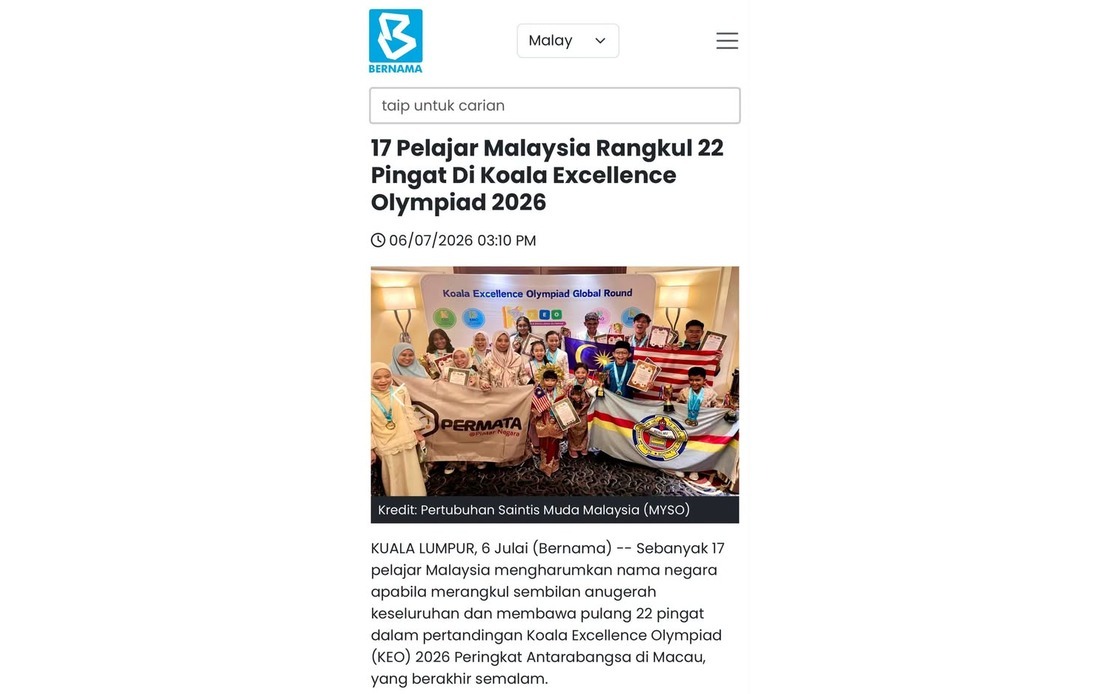
Prime Minister Datuk Seri Anwar Ibrahim has praised 17 Malaysian students for their outstanding academic performance at the 2016 Koala Excellence Olympiad (KEO) Global Finals, which took place in Macau and concluded recently. The delegation achieved considerable success on the international stage, bringing home nine overall awards alongside a haul of 22 medals across multiple disciplines. The Prime Minister's commendation reflects Malaysia's ongoing commitment to nurturing young talent and positioning the nation as a competitive player in international academic competitions.
In a public statement posted on social media, Anwar acknowledged the students' dedication and encouraged them to maintain their pursuit of excellence. His message carried a forward-looking tone, expressing confidence that the cohort would continue to scale greater heights in their academic endeavours. The recognition from the nation's highest political office underscores the value placed on such international achievements and signals government backing for student participation in global forums.
According to Aidah Misran, the Malaysia Young Scientists Organisation (MYSO) coordinator who led the Malaysian contingent to Macau, the team's medal distribution reflected strong performances across the board. The delegation captured five gold medals, six silver medals, and eleven bronze medals, demonstrating breadth of excellence rather than concentration in a single discipline. This spread of achievement suggests that the selected students possessed well-rounded capabilities across the competition's various components.
The Koala Excellence Olympiad represents a relatively newer entrant to the international student competition landscape, having been developed by a consortium of Australian educational experts and graduates. The platform emphasises four core academic disciplines: English, Mathematics, Science, and Arts. By bringing together competitors from multiple countries under a single framework, KEO provides Malaysian students with valuable exposure to international peers and learning methodologies, fostering cross-cultural understanding alongside intellectual development.
MAYSO played a pivotal role in organising Malaysia's participation in the event, working in coordination with the international organisers, KEO, and Miss Man International Group. The involvement of such locally-rooted scientific and educational organisations ensures that student selection, preparation, and representation align with national educational standards and priorities. This institutional framework has enabled Malaysia to maintain consistent representation at international academic competitions despite the logistical and financial challenges involved.
For Malaysian students competing in international forums, such exposures carry implications beyond medal counts. Participation in competitions like KEO develops critical thinking, communication skills across linguistic boundaries, and the ability to perform under pressure in unfamiliar environments. These soft skills prove invaluable as Malaysia seeks to develop a workforce capable of navigating an increasingly globalised economy and competing in knowledge-intensive sectors.
The timing of this achievement is noteworthy given Malaysia's ongoing efforts to position itself as a regional hub for education and technology. As the nation invests in upgrading its education system and encouraging student mobility, success stories from international competitions serve as motivational touchstones for younger cohorts. They demonstrate that Malaysian students can compete effectively with their international counterparts when given adequate preparation and support.
The breadth of disciplines covered by KEO—spanning humanities through to hard sciences—reflects a holistic approach to academic excellence that mirrors Malaysia's educational philosophy. Rather than narrowly focusing on mathematics and science alone, the inclusion of English and Arts ensures that student development encompasses communication, cultural literacy, and creative problem-solving. This comprehensive approach resonates with contemporary thinking about twenty-first century competencies.
From a Southeast Asian perspective, Malaysia's success at KEO contributes to the region's growing visibility in international academic circles. While competitions like the International Mathematical Olympiad and Asian Science Olympiad have long been established platforms, newer competitions such as KEO represent expanding opportunities for regional students. Strong showings by Malaysian teams encourage participation from neighbouring countries and help establish the region as a serious contender in global academic competitions.
The celebration of this achievement also highlights the personal sacrifices made by competing students, who typically dedicate months to intensive preparation and training. Beyond the students themselves, success reflects the commitment of coaches, teachers, and supporting institutions who identify talented youngsters early and nurture their development. Recognising these collective efforts encourages a broader culture of academic aspiration within Malaysia's education system.
Looking forward, the Prime Minister's public endorsement signals that the government views investment in student development and international competition as a policy priority. This could translate into enhanced funding for preparatory programmes, expanded support for scientific olympiads, and greater institutional backing for organisations like MYSO. Such policy backing proves essential for sustaining Malaysia's competitive position in recurring international competitions.
The 22 medals won at the KEO 2026 Global Finals represent tangible evidence of Malaysia's capacity to develop academically gifted students capable of standing on international stages. As the nation continues to refine its education system and foster a culture of excellence, such achievements provide valuable benchmarks for measuring progress. The recognition extended by political leadership amplifies the significance of these accomplishments beyond their face value, positioning them as markers of national capability and promise.

