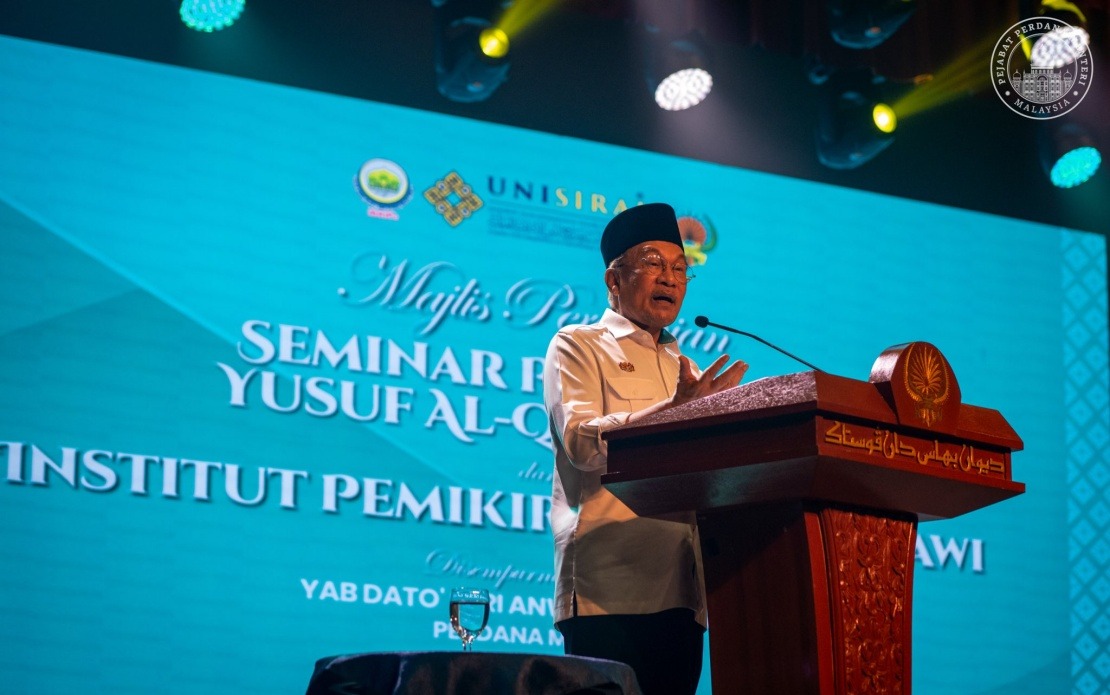
Prime Minister Datuk Seri Anwar Ibrahim has pledged RM2 million in MADANI Government support to the Al-Qaradawi Thought Institute, cementing the administration's commitment to advancing research into the intellectual legacy of the late Islamic scholar Sheikh Dr Yusuf Al-Qaradawi. The announcement was made at the inaugural ceremony for both the Yusuf Al-Qaradawi Thought Seminar and the institute itself, held at Wisma Dewan Bahasa dan Pustaka in Kuala Lumpur on July 21.
The funding underscores Anwar's personal reverence for Al-Qaradawi, whose ideological imprint shaped an entire generation of Islamic activists and thinkers across Southeast Asia. Through a post on social media platform X, the Prime Minister articulated his deep gratitude, acknowledging the scholar's multifaceted contributions spanning intellectual guidance, moral encouragement, and sustained friendship rooted in shared principles. Anwar expressed optimism that such institutional investments would generate meaningful outcomes for the broader Muslim community, termed the ummah in Islamic terminology.
The Prime Minister's formative relationship with Al-Qaradawi traces back to his involvement with the Malaysian Islamic Youth Movement, or ABIM, during the turbulent early decades following Malaysia's independence. This institutional connection allowed Anwar to witness firsthand how the prominent Egyptian-Qatari theologian engaged with emerging Muslim movements attempting to navigate rapid modernisation whilst maintaining religious authenticity. Al-Qaradawi's correspondence with ABIM leadership became historically significant, establishing intellectual bridges between Malaysian activists and the broader Islamic world during a period of fervent religious revival.
Central to Al-Qaradawi's philosophical contribution, and the Prime Minister's recollection of it, was his consistent advocacy for wasatiyyah—the Islamic principle of moderation and balance. During the early 1980s, when Islamic movements worldwide were increasingly polarised between fundamentalist and accommodationist camps, Al-Qaradawi dispatched written guidance to ABIM's leadership urging the organisation to resist sectarian extremism. He encouraged the movement to embrace intellectual pluralism, remaining receptive to diverse viewpoints rather than retreating into ideological rigidity. This counsel proved pivotal during a volatile period when Malaysian Islamic activism risked fragmenting along doctrinal lines.
Anwar characterised Al-Qaradawi as a quintessential agent of change—a defining intellectual force whose influence transcended national boundaries. The Prime Minister employed the German term zeitgeist to describe the scholar's role as a spirit embodying the philosophical currents of his era, one who consistently advocated for progressive reinterpretation of Islamic jurisprudence in response to contemporary exigencies. Rather than treating traditional Islamic law as static doctrine, Al-Qaradawi demonstrated how classical jurisprudential principles could generate contextually relevant solutions for modern dilemmas whilst preserving doctrinal integrity.
The establishment of this dedicated research institute reflects growing regional recognition that Southeast Asian Islamic thought requires institutional scaffolding to preserve, analyse, and extend the intellectual contributions of foundational figures. Malaysia's investment signals that policymakers increasingly understand scholarship as infrastructure—not merely academic indulgence but essential knowledge production supporting informed governance. In an era of accelerating social change and contestation over Islam's political role, systematic study of moderate Islamic intellectual traditions provides empirical grounding for policy positions otherwise vulnerable to populist challenge.
For Malaysian audiences, the initiative carries particular relevance given ongoing domestic debates surrounding Islamic education, interfaith relations, and the boundaries between religious authority and secular governance. Al-Qaradawi's historical advocacy for institutional pluralism and intellectual openness offers constructive philosophical resources for navigating these contentious terrain. His emphasis on distinguishing between immutable religious principles and culturally contingent applications provides methodological framework applicable to contemporary Malaysian questions about Islamic banking, family law reform, and minority rights protection.
The institute's prospective research agenda appears positioned to examine how Muslim-majority societies can simultaneously uphold religious commitment and embrace democratic governance, scientific advancement, and multicultural coexistence. This intellectual project carries implications beyond Malaysia, resonating across Southeast Asia where Muslim populations confront comparable modernisation pressures. Thailand, Indonesia, and the Philippines all host significant Muslim communities wrestling with identical tensions between tradition and change, providing potential regional audiences for the institute's scholarly output.
Anwar's association with this initiative also signals his continuing commitment to a particular vision of Malaysian Islamic politics—one emphasising consensus-building, institutional inclusivity, and doctrinal flexibility over confrontational identity politics. By linking government resources to intellectual institutions promoting moderation and scholarly rigour, the Prime Minister positions his administration within a lineage of Islamic leadership valuing complexity over simplification. This approach distinguishes his government from constituencies advocating more restrictive interpretations of religious authority, creating institutional scaffolding supporting his preferred governance model.
The institute's establishment arrives amid broader regional contestation over Islamic intellectual authority. Competing centres of Islamic learning across the Middle East, South Asia, and Southeast Asia each claim interpretive legitimacy, generating fragmentation within global Muslim discourse. Malaysia's investment in Al-Qaradawi scholarship represents strategic positioning within these transnational debates, asserting that Southeast Asian Muslim perspectives merit serious scholarly attention and institutional support. The RM2 million commitment, whilst modest in absolute terms, symbolises political will to sustain research infrastructure producing rigorous analysis of Islamic thought engaged with contemporary challenges.

