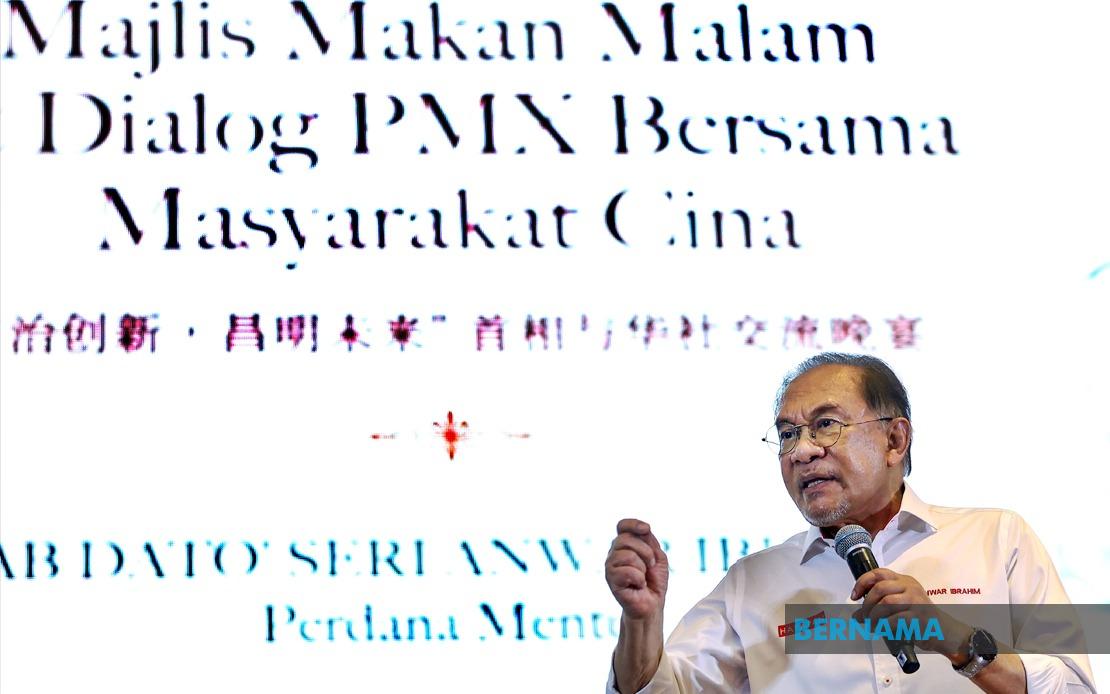
Prime Minister Datuk Seri Anwar Ibrahim has reiterated his determination to guide Malaysia towards becoming a thriving and prosperous nation, emphasising an inclusive approach that transcends communal divisions. Addressing attendees at a community gathering in Johor Bahru on July 4, the Premier underscored his conviction that good governance and national development must benefit every citizen equally, regardless of their ethnic or religious background.
Anwar's remarks reflected a broader strategic messaging around national unity and social cohesion at a time when Malaysia continues navigating complex economic and political terrain. The Prime Minister's emphasis on serving all segments of Malaysian society signals an attempt to reinforce confidence in his administration's commitment to equitable policymaking, a theme that has become increasingly central to his political narrative since assuming office. By highlighting his engagement with diverse communities, including the Chinese Malaysian constituency, Anwar appears to be consolidating support across demographic lines.
The concept of legacy loomed large in the Premier's address, with Anwar articulating a personal vision for how he wishes to be remembered after his tenure concludes. He expressed a desire to be regarded as a leader who genuinely connected with the Malaysian population across all backgrounds, transcending the narrow factional politics that has characterised much of the nation's recent history. This framing suggests an awareness that his place in Malaysia's historical record will be evaluated not merely on economic metrics or policy achievements, but on his success in bridging social divides.
At his current stage of life and political career, Anwar emphasised that his principal ambition centres on establishing foundations for fair and untainted leadership that would serve the entire nation's population. The Prime Minister articulated this as a deliberate choice to prioritise principled governance over partisan advantage. Such a positioning reflects an implicit acknowledgement that public trust in Malaysian institutions has been strained by scandals and perceived favouritism in recent years, necessitating a conscious effort to rebuild confidence through demonstrated commitment to ethical conduct.
Anwar stressed the fundamental importance of recognising every Malaysian citizen as having equal value and deserving equal consideration from their elected representatives. He articulated the constitutional obligation of a Prime Minister to serve the broader population rather than narrow constituencies or interest groups. This assertion, while foundational to democratic principle, carries particular weight in Malaysia's context, where allegations of ethnic and religious preferentialism have periodically disrupted social harmony and stoked communal tensions.
The Premier's reflective tone when discussing his advancing years and eventual retirement suggested a contemplation of mortality and historical judgment that may resonate with voters concerned about the direction of national leadership. By framing his legacy in terms of popular affection and reciprocal love between leader and citizenry, Anwar articulated an emotional dimension to governance that extends beyond technocratic competence. He implied that the measure of successful leadership lies in whether citizens feel genuinely valued and cared for by their government.
Anwar's call for collective stewardship of the nation invoked a shared responsibility model wherein Malaysians from all backgrounds would work collaboratively towards national interest. The emphasis on unity and mutual investment in Malaysia's future represented an attempt to transcend zero-sum competition between communities that sometimes characterises political discourse. This framing suggests that the Prime Minister views national success as fundamentally dependent upon social cohesion and the willingness of diverse groups to prioritise collective welfare.
The presence of Parti Keadilan Rakyat vice president and Selangor Menteri Besar Datuk Seri Amirudin Shari at the event underscored the government's deliberate engagement with different strata of Malaysian society and reflected broader coalition dynamics within Malaysia's political landscape. Such attendance signals coordination between federal and state levels of governance around shared messaging on national unity and inclusive leadership principles.
For Malaysian observers, Anwar's statements carry implications regarding the government's policy direction across diverse portfolios. A commitment to serving all communities equitably would logically extend to education policy, economic opportunity distribution, religious freedom protections, and language rights—areas where intercommunal sensitivities frequently surface. How these broad principles translate into concrete policy decisions will likely determine whether public perception aligns with the Premier's articulated vision of fair and clean governance.
The timing of such pronouncements also merits consideration, as Malaysia continues managing complex economic challenges, infrastructure development initiatives, and efforts to restore international investor confidence following years of political turbulence. Demonstrating commitment to principled, impartial governance serves both immediate governance objectives and longer-term nation-building aspirations. For Southeast Asia more broadly, Malaysia's trajectory towards either deepened social fragmentation or genuine inclusive governance carries regional implications given the country's economic significance and geopolitical position.

