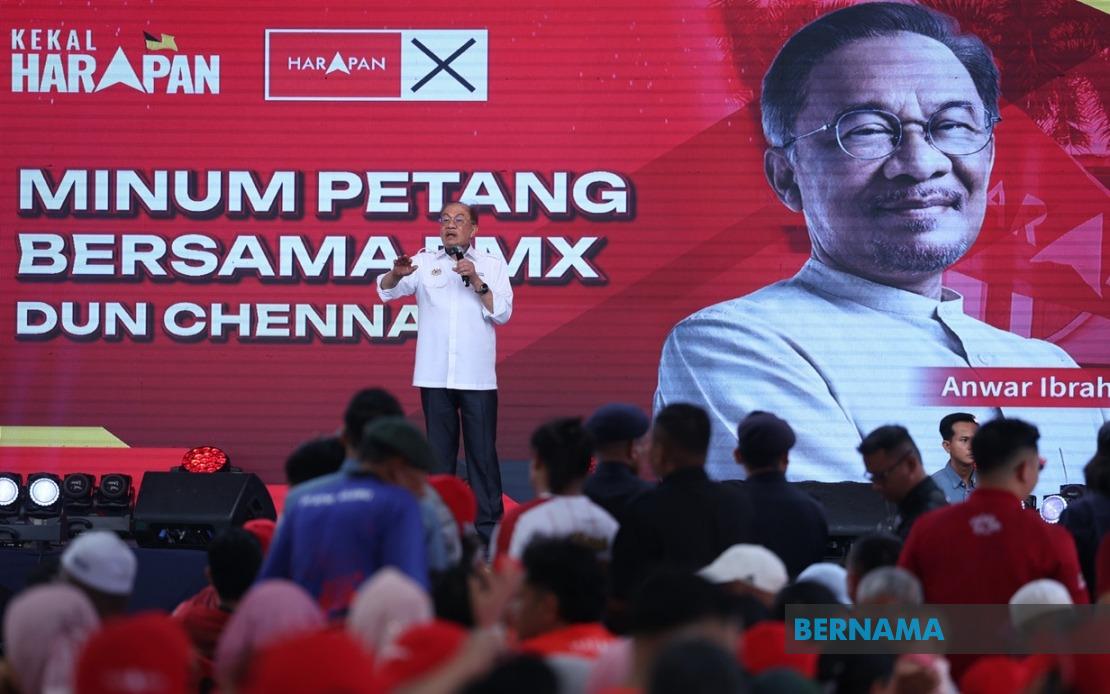
Prime Minister Datuk Seri Anwar Ibrahim has moved to reassure the Orang Asli community that their government funding streams remain secure and will not be contingent on political outcomes, directly addressing circulating narratives that suggest otherwise ahead of the Negeri Sembilan state election. Speaking during an afternoon engagement in the Chennah constituency at Simpang Durian in Jelebu on July 29, Anwar sought to dispel what he characterised as misleading claims suggesting that indigenous communities would face funding cuts should certain candidates fail to secure electoral victory.
The Prime Minister, who concurrently holds the portfolio of Finance Minister, articulated a fundamental principle underpinning governmental resource distribution. He emphasised that budgetary allocations for the Orang Asli are determined exclusively through statutory processes and constitutional provisions, rather than being manipulated as electoral incentives or punitive measures linked to campaign outcomes. This distinction carries particular significance in Malaysian politics, where indigenous communities represent a demographically significant constituency whose support carries real electoral weight.
Anwar's intervention directly confronts what Pakatan Harapan characterises as disinformation tactics deployed during the campaign period. Opposition parties and other political actors have reportedly circulated claims within Orang Asli settlements suggesting that incumbent coalition members would withdraw essential services and financial support if they failed to retain their seats. Such messaging appears calibrated to exploit community vulnerabilities and existing anxieties about resource security among populations that have historically experienced marginalisation within Malaysia's development framework.
The Finance Minister's personal guarantee carries institutional weight given his singular authority over budgetary approvals. By positioning himself as the guarantor of continued allocations, Anwar sought to elevate the credibility of his assurance beyond routine political rhetoric. He reiterated that provided administrative processes remain properly executed and constitutional requirements satisfied, funding continuation represents an administrative certainty rather than a discretionary political favour contingent upon electoral performance.
Transport Minister Anthony Loke, who is contesting the Chennah state seat as the Pakatan Harapan candidate, underscored the broader implications of such campaign tactics for electoral integrity. He expressed concern that fearmongering narratives undermined the democratic principle that voters should exercise choices based on factual information rather than manufactured anxieties. Loke's comments reflect a strategy by the ruling coalition to frame the election as a contest between truth-based political engagement and what they characterise as manipulative opposition tactics targeting vulnerable communities.
The Orang Asli demographic presents a complex political terrain within Malaysian electoral dynamics. Indigenous communities, dispersed across various constituencies and states, have historically received targeted development programmes and fiscal allocations designed to address socioeconomic disparities. These funding mechanisms represent not merely charitable disbursements but structural elements of Malaysia's developmental architecture. When political actors invoke threats of funding withdrawal, they exploit the precarity experienced by communities whose basic service access frequently depends on government programmes rather than market mechanisms.
The Negeri Sembilan context adds particular resonance to this exchange. The state has experienced competitive electoral dynamics in recent cycles, with Pakatan Harapan seeking to consolidate its position against opposition parties that have mounted credible challenges. Orang Asli constituencies within Negeri Sembilan have demonstrated shifting voting patterns, making them strategically significant for both coalitions. The appearance of systematic disinformation targeting these communities during the campaign suggests that both sides recognise their electoral importance.
Anwar's public intervention represents an attempt to preempt further erosion of indigenous community confidence in the ruling coalition. By personally guaranteeing funding continuation and anchoring his assurance to constitutional and legal frameworks, he seeks to establish that fiscal commitments transcend electoral calculations. This positioning matters because it challenges the implicit proposition, advanced by opposition messaging, that government allocations function as rewards for political loyalty rather than entitlements within Malaysia's constitutional framework.
The broader implications for Southeast Asian governance merit consideration. In plural democracies across the region, vulnerable populations frequently face disinformation campaigns that weaponise anxieties about resource access. Malaysia's experience with such tactics reflects broader regional patterns wherein electoral competition becomes increasingly characterised by appeals to communal interests and threats regarding government resource distribution. The Negeri Sembilan election provides a case study in how democracies respond to these challenges, with Pakatan Harapan attempting to reassert institutional normalcy against what it frames as destabilising manipulation.
Look's emphasis on campaign conduct norms suggests that Pakatan Harapan perceives a credibility advantage when elections are contested on policy substance rather than fear-based messaging. The coalition's public documentation of alleged opposition tactics appears designed to establish reputational narratives favourable to its own campaign approach. Whether such positioning proves electorally effective depends partly on whether Orang Asli voters perceive the ruling coalition's institutional guarantees as credible and whether opposition narratives regarding funding insecurity maintain traction despite Prime Ministerial reassurances.
The episode underscores deeper questions about indigenous political representation within Malaysia's democratic architecture. Orang Asli communities' susceptibility to resource-based disinformation partly reflects their limited institutional voice within major political structures and their historical experience with governmental paternalism. Addressing such vulnerabilities requires not merely electoral-cycle reassurances but sustained institutional engagement demonstrating genuine community inclusion within policy formulation rather than passive recipient status.
Moving forward, the Negeri Sembilan election result will provide data regarding whether Anwar's personal intervention successfully reestablished indigenous community confidence in Pakatan Harapan's commitment or whether opposition disinformation succeeded in shifting voting calculus. The outcome carries implications extending beyond state-level dynamics, signalling which political coalition more effectively navigates the contemporary challenge of contesting elections amid widespread disinformation targeting vulnerable constituencies.

