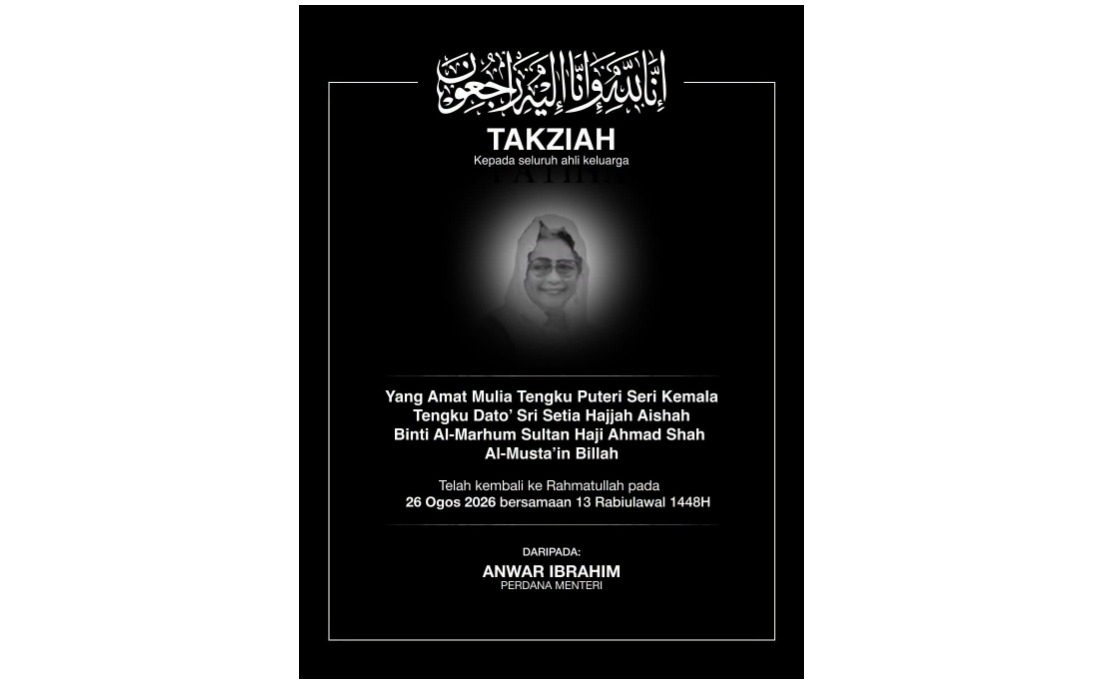
Prime Minister Datuk Seri Anwar Ibrahim has expressed his condolences to Sultan Abdullah Ri'ayatuddin Al-Mustafa Billah Shah and the entire Pahang Royal Family following the passing of Tengku Puteri Seri Kemala Tengku Datuk Seri Aishah Almarhum Sultan Ahmad Shah. The Sultan's elder sister died at a Kuala Lumpur hospital at 9.15 pm on Tuesday, marking a significant loss for the Pahang royal household.
Taking to Facebook to share his sympathies, Anwar offered prayers for the deceased, requesting divine mercy and forgiveness upon Tengku Datuk Seri Aishah's soul. The Prime Minister's public expression of condolences reflects the customary protocol observed by Malaysia's political leadership during periods of royal mourning, underscoring the importance placed upon maintaining respectful relations with the nation's traditional rulers.
Beyond his prayers for the departed, Anwar extended his compassionate wishes to Al-Sultan Abdullah and Tengku Ampuan of Pahang Tunku Azizah Aminah Maimunah Iskandariah, as well as the broader membership of the Pahang Royal Family. The Prime Minister entreated the Almighty to grant them strength and resilience as they navigate the emotional weight of their bereavement and adjust to life without a cherished family member.
Tengku Datuk Seri Aishah's funeral arrangements proceeded according to royal protocol, with her remains being interred at the Pahang Royal Mausoleum in Pekan on Wednesday. This ceremonial placement reflects her status within the royal hierarchy and ensures she rests alongside other members of the Pahang royal line, a final honour befitting her position as sister to the reigning monarch of the state.
The passing of senior members of Malaysia's royal families serves as a poignant reminder of the deep cultural and constitutional significance these institutions hold within the Malaysian political and social fabric. As constitutional monarchies, the individual states maintain their own ruling families who serve ceremonial and symbolic roles while exercising certain constitutional prerogatives, and the death of prominent royal family members resonates throughout their respective communities and the broader nation.
Anwar's response demonstrates the expectations placed upon Malaysia's national leadership to acknowledge and respect moments of royal grief with appropriate formality and sincere compassion. Such gestures, though primarily symbolic, reinforce the bonds between the federal government and state authorities, maintaining the delicate balance that characterizes Malaysia's federal system where power is distributed between the national and state levels.
The Pahang Royal Family, one of Malaysia's oldest and most established royal houses, has historically played influential roles in shaping the state's development and maintaining its cultural heritage. The loss of senior family members thus carries implications beyond the immediate family circle, affecting the institutional memory and continuity of traditions that have defined Pahang's identity for generations.
For Malaysian citizens and observers of the nation's constitutional arrangements, such moments underscore how the monarchy functions as a unifying institution that transcends partisan political divisions. Regardless of political affiliation, leaders across the spectrum customarily set aside partisan considerations to honour royal occasions and mourning periods, demonstrating respect for the institution and those who serve in it.
The immediate family's period of mourning will likely involve various private ceremonies and observances according to Islamic tradition and royal custom, though details of such intimate proceedings typically remain within the family's purview. The public aspect of the mourning period, however, provides an opportunity for the broader Malaysian society to join in expressing collective sympathy and acknowledging the contributions Tengku Datuk Seri Aishah made throughout her life as a member of Pahang's royal house.

