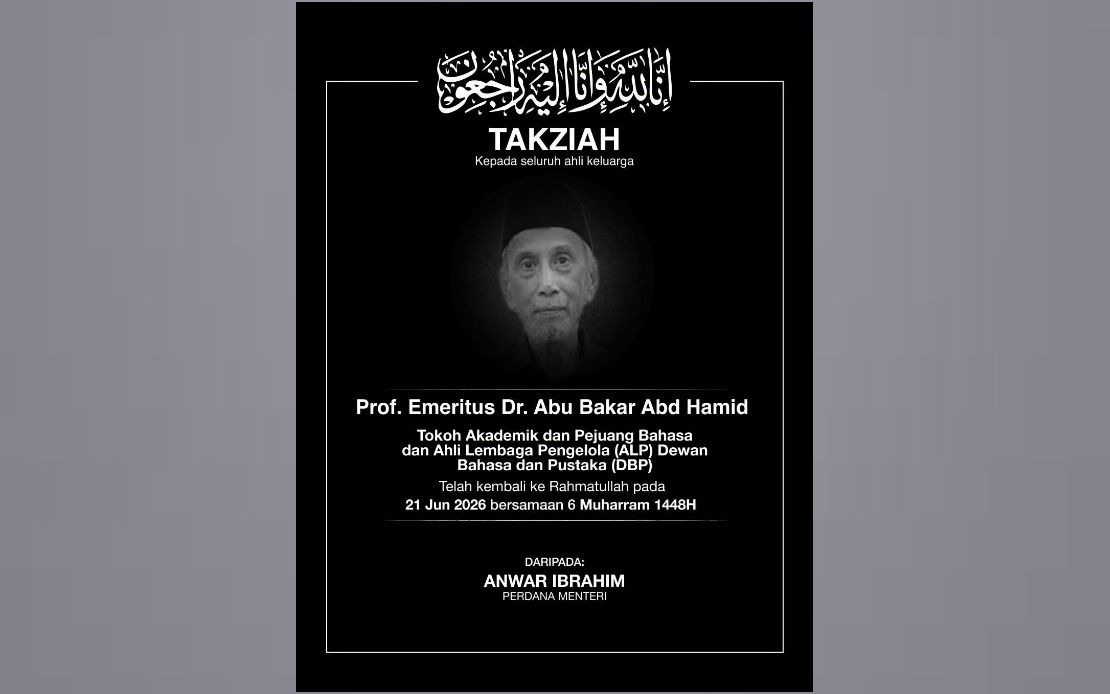
Prime Minister Datuk Seri Anwar Ibrahim has paid tribute to one of Malaysia's most influential academic figures following the death of Professor Emeritus Datuk Abu Bakar Abd Hamid, who passed away on June 21 at his residence in Petaling Jaya, Selangor. The renowned scholar, who suffered sudden respiratory complications around 10.30pm that evening, left behind a legacy that fundamentally shaped Malaysia's literary and higher education landscapes. In a Facebook post released on June 24, Anwar articulated his deep sorrow at the loss, reflecting on both the nation's intellectual inheritance and his own personal connection to the departed educator.
The late Abu Bakar, originally from Johor, occupied a singular position within Malaysia's literary establishment as both a pioneering academic and cultural custodian. His contributions extended far beyond conventional scholarship; he was recognised as a formative presence in the development of Malay literature as a serious field of intellectual inquiry within Malaysian universities. This recognition reflected decades of commitment to elevating literary studies and ensuring that the richness of Malay cultural expression received the scholarly attention it deserved. His work laid crucial groundwork upon which subsequent generations of Malaysian literature scholars have built their own research and teaching.
Anwar's tribute carried particular weight given his own academic trajectory. As a former student of Abu Bakar, the Prime Minister positioned his remembrance not merely as a formal state acknowledgment but as a personal expression of gratitude toward a mentor who had shaped his intellectual development. This student-teacher relationship underscores the personal impact Abu Bakar wielded within Malaysian academic circles, where his influence extended through direct mentorship of individuals who would themselves rise to national prominence. Anwar's words reflected the affection and admiration that characterised Abu Bakar's relationships with his pupils, many of whom credited him with inspiring their scholarly pursuits.
Beyond his literary contributions, Abu Bakar played a decisive institutional role in Malaysia's post-independence educational expansion. His involvement as joint secretary of the committee responsible for establishing Universiti Kebangsaan Malaysia in 1968 placed him at a critical juncture in the nation's development. UKM emerged as a flagship institution dedicated to advancing Malay language and culture within the university system, a mission that reflected the educational priorities of the newly independent nation. Abu Bakar's fingerprints remained on this institution's foundational framework, particularly in shaping how it approached literary scholarship and cultural studies within a Malaysian context.
The scholar's administrative credentials extended to the highest levels of Malaysia's information infrastructure. He served as chairman of the Board of Governors of the Malaysian National News Agency (Bernama) from 1996 to 2000, a position that reflected the esteem in which he was held across government and academic sectors. This appointment demonstrated the versatility of his expertise and the trust placed in his judgment across diverse institutional settings. His stewardship of Bernama during those years coincided with significant developments in Malaysian media and communications, a period when the agency navigated technological and editorial challenges while maintaining its role as a primary source of official information.
At Universiti Malaya, Abu Bakar rose to the position of deputy vice-chancellor in 1987, further cementing his status as an institutional leader capable of influencing academic direction and policy at Malaysia's premier university. This appointment represented recognition of his scholarly standing and administrative acumen, responsibilities that extended far beyond literature into the broader governance of academic affairs. His tenure during this period witnessed important transitions within Malaysian higher education as universities grappled with expanding enrolments, curriculum modernisation, and the growing importance of research output within the global academic context.
Throughout his career, Abu Bakar accumulated numerous accolades and recognitions that acknowledged his outstanding contributions to the field of literature. These honours reflected the esteem of both academic peers and official bodies, testament to the regard in which his scholarship and intellectual contributions were held. Such recognition typically comes only to scholars whose work genuinely advances their field and whose influence extends across institutional and generational boundaries. In Abu Bakar's case, these awards validated a lifetime devoted to elevating Malaysian literary consciousness and establishing rigorous scholarly standards within the discipline.
Anwar's public mourning emphasised Abu Bakar's role as an intellectual beacon who transcended the conventional boundaries of academic work. The Prime Minister characterised him not merely as a teacher dispensing information but as a passionate advocate for knowledge and an inspirational figure who motivated those around him to pursue intellectual excellence. This portrayal captures something essential about Abu Bakar's impact: his ability to communicate the intrinsic value of literary study and cultural scholarship at a time when such pursuits required articulate advocates within the nation's educational establishment.
The scholar's passing represents a significant loss for Malaysia's literary and academic communities at a moment when questions about the preservation and transmission of cultural knowledge remain pressing. Abu Bakar belonged to a generation of post-independence intellectuals who consciously worked to establish Malaysian literary scholarship as a serious academic discipline capable of international recognition while remaining grounded in local cultural realities. The departure of such figures inevitably creates a gap in institutional memory and mentorship networks that had accumulated decades of experience.
Abbakar was laid to rest at the Bukit Kiara Muslim Cemetery on June 23, concluding the earthly chapter of a life dedicated to knowledge advancement and institutional building. His funeral drew acknowledgment from political and academic leadership, reflecting the broad appreciation for his contributions across multiple sectors. While his physical presence has departed, the structures he helped establish—from UKM's foundational frameworks to the scholarly standards he championed—continue to shape Malaysian intellectual life and will perpetuate his influence across future generations.

