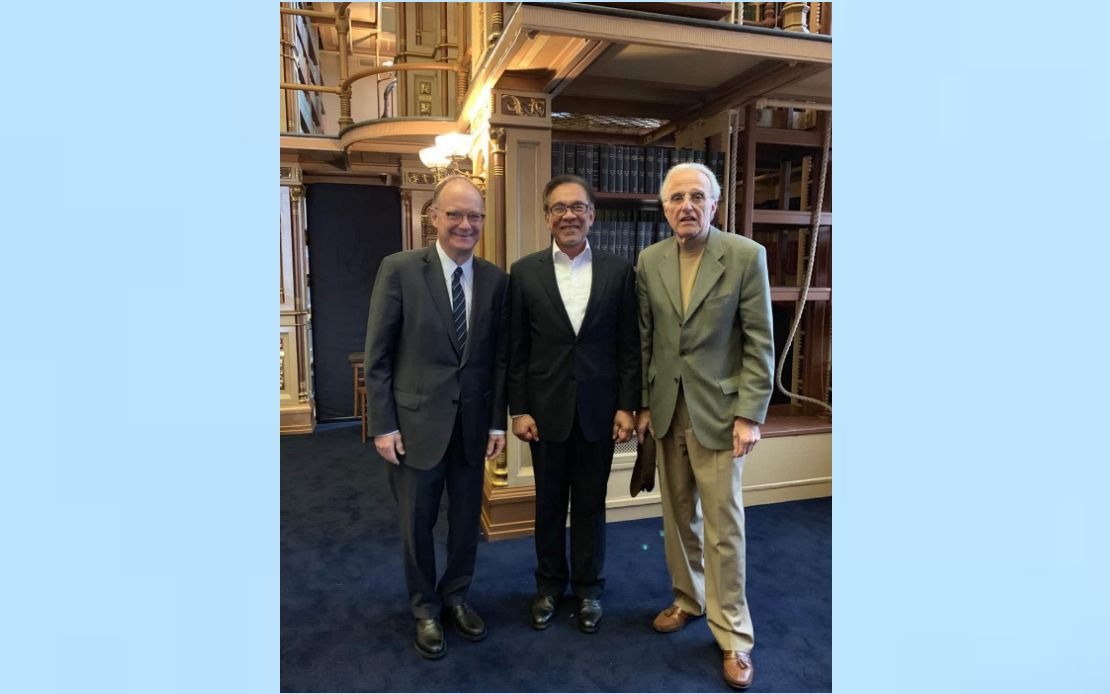
Prime Minister Datuk Seri Anwar Ibrahim has extended his condolences following the death of Professor John L. Esposito, one of the globe's most authoritative voices on Islamic studies and interfaith relations. Through a Facebook statement released in Kuala Lumpur on July 16, Anwar reflected on the profound influence Esposito exerted in shaping how the Western world comprehended Islam, whilst simultaneously acknowledging the personal significance of their long-standing relationship.
The connection between Malaysia's leader and the American scholar stretched across more than half a century, with their first encounter occurring during the early 1970s. This enduring bond positioned Anwar as someone uniquely positioned to assess both Esposito's professional contributions and his character as a human being. The Prime Minister's tribute went beyond ceremonial acknowledgment, instead painting a detailed portrait of a man whose intellectual legacy remains central to contemporary discussions about Islam's role in global affairs.
Esposito's most visible institutional achievement was establishing Georgetown University's Centre for Muslim-Christian Understanding, a facility that became instrumental in fostering serious academic inquiry into religious coexistence. This initiative proved particularly timely, emerging during an era when polarisation between different faith communities threatened constructive dialogue. Anwar specifically credited Esposito with creating intellectual space where misunderstandings could be systematically addressed through scholarly investigation rather than inflammatory rhetoric. The centre became a training ground for a generation of academics committed to moving beyond simplistic characterisations of Islam and Muslims.
Beyond institutional frameworks, Esposito made his greatest impact through accessible scholarship that transcended academic circles. His most widely recognised works—including "What Everyone Needs to Know About Islam" and "Who Speaks for Islam?"—represented a deliberate strategy to democratise knowledge about Islamic traditions and contemporary Muslim societies. These publications arrived at a critical juncture in global history. Following the September 11 terrorist attacks, widespread ignorance about Islam's theological foundations, historical diversity, and contemporary expressions created a dangerous vacuum that ideologues of various persuasions eagerly filled. Esposito's rigorous yet comprehensible approach offered an alternative to both inflammatory demonisation and uncritical celebration.
As co-author of "Makers of Contemporary Islam," Esposito contributed to charting the intellectual currents shaping modern Islamic thought. This collaborative work examined influential thinkers and movements within Islam, providing context for understanding how Muslim societies negotiated the challenges of modernity, globalisation, and cultural change. For Malaysian readers particularly, such scholarship proves invaluable in grasping how Islamic intellectual traditions continue evolving in response to contemporary pressures, rather than representing a static or monolithic entity resistant to change.
Anwar's characterisation of Esposito as someone who "built bridges where others were content to build civilisational barriers" captures the essence of the scholar's life work. This metaphor proves especially resonant in Southeast Asian contexts, where plural societies with Muslim-majority populations depend upon functional coexistence among different religious communities. Esposito's scholarship provided intellectual ammunition for those arguing that Islam's theological resources support pluralism and interfaith cooperation, rather than inevitable conflict.
The personal dimension of Anwar's tribute illuminates aspects of Esposito's character beyond his published work. The Prime Minister recalled valuing Esposito's wisdom across decades of friendship, suggesting that their relationship extended into confidential counsel during challenging periods. Anwar's assertion that Esposito was "as generous in private conversation as he was rigorous on the page" suggests a scholar whose intellectual integrity matched his human warmth—a combination increasingly rare among public intellectuals who sometimes sacrifice authentic connection for rhetorical posturing.
Esposito's commitment to standing with Anwar "through thick and thin" gains particular resonance given Malaysian political history. Anwar's own trajectory has encompassed periods of significant adversity and challenge, making such loyal friendship from an internationally respected figure especially meaningful. This personal loyalty, rooted in genuine conviction rather than political calculation, demonstrates how Esposito's influence extended beyond formal academic contributions into the realm of principled moral support.
For Malaysia and broader Southeast Asia, Esposito's passing represents a loss to the intellectual infrastructure supporting interfaith understanding and nuanced Islamic scholarship. His work directly influenced how Muslim intellectuals within the region articulate the compatibility between Islamic faith and democratic governance, religious pluralism, and modern statecraft. Universities throughout Asia utilised his textbooks and research to educate successive generations of scholars and policymakers now navigating complex questions about Islam's public role in diverse societies.
Anwar's decision to issue an official tribute on behalf of Malaysia underscores how significantly Esposito's scholarship impacted the nation's own efforts to project moderate Islamic perspectives internationally. Malaysia has positioned itself as a model of Muslim-majority democracy respecting religious freedom and pluralism, and Esposito's work provided crucial intellectual validation for this positioning. His scholarship demonstrated that such coexistence rested not on reluctant pragmatism but on theologically grounded Islamic principles.
The Prime Minister's closing statement—that Esposito remained "to the end, a true friend to the Muslim world"—encapsulates how the scholar navigated a delicate position. Rather than adopting a detached posture of academic neutrality, Esposito aligned himself with Muslim communities seeking to articulate progressive Islamic visions whilst maintaining deep theological commitment. This partisanship in service of understanding and dialogue, rather than polemic or vilification, distinguished his approach from more polemical Western commentaries on Islam.
Esposito's intellectual legacy will likely deepen in coming years, as new generations of scholars build upon his foundational work in examining Islam's complex relationship with modernity, democracy, and pluralism. The scholarly ecosystem he helped cultivate through Georgetown University's centre and through his prolific writing will continue generating research illuminating how Muslim societies navigate challenges that transcend any single nation or region. For Malaysia specifically, this legacy offers continued resources for substantiating claims about Islamic moderation and interfaith cooperation with evidence-based scholarship rather than mere political rhetoric.
As Malaysia continues articulating its position as a moderate Muslim-majority nation engaged constructively with the wider world, the intellectual foundations that scholars like Esposito provided grow increasingly valuable. His passing marks the end of a remarkable career spanning decades of advancing human understanding across religious boundaries, work that Anwar's tribute rightfully celebrates as a gift to humanity.

