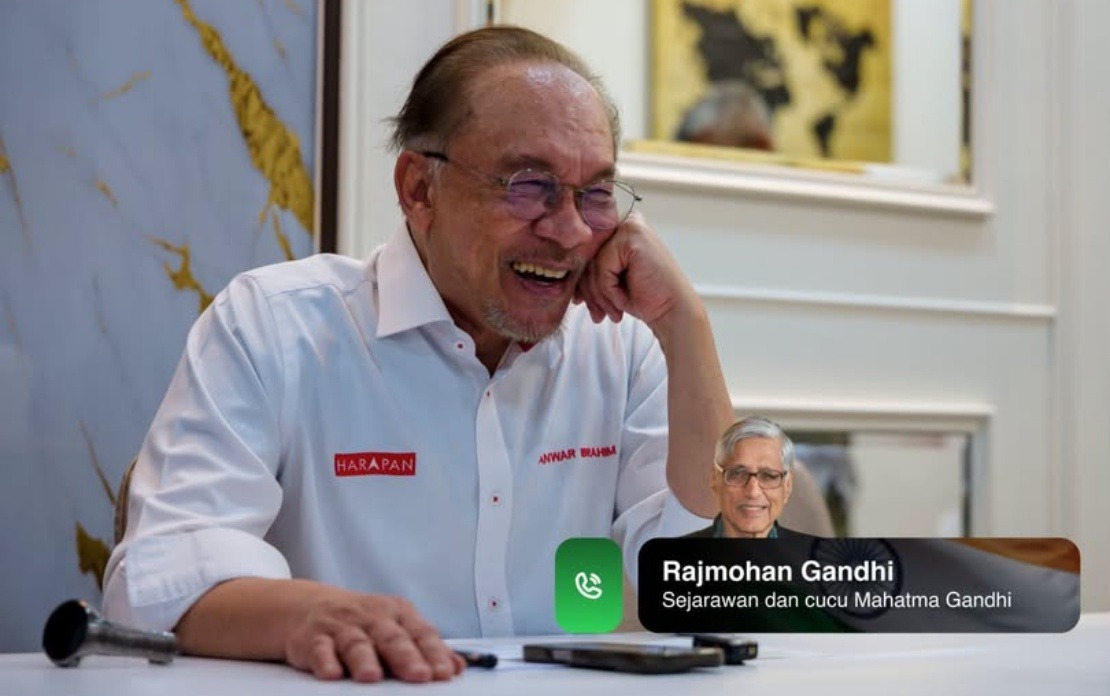
Prime Minister Datuk Seri Anwar Ibrahim has extended a formal invitation to Indian historian Rajmohan Gandhi, the grandson of independence icon Mahatma Gandhi, to visit Malaysia during the opening months of next year. The invitation carries particular significance as it aims to facilitate intellectual exchange on critical themes including democracy, peace, harmony and values-based leadership with Malaysian academic and community stakeholders.
Anwar announced the invitation through a Facebook statement following a telephone conversation with Rajmohan Gandhi, during which the two leaders discussed avenues for deepening bilateral engagement. The timing of this diplomatic gesture underscores Malaysia's commitment to strengthening people-to-people connections with India through cultural and intellectual pathways that extend beyond conventional government-to-government relations.
The Prime Minister recalled their previous encounter at a democracy conference held in Mumbai in 2012, which Rajmohan himself had organised. That meeting evidently left a lasting impression, establishing the foundation for renewed contact and collaboration. Such continuity in high-level intellectual dialogue reflects the enduring nature of Malaysia-India ties rooted in shared values and historical connections.
During their recent conversation, both leaders engaged in substantive discussions about enhancing the civilisational and historical bonds between their nations. Rather than focusing solely on trade or strategic partnerships, they concentrated on academic cooperation and inter-civilisational dialogue—dimensions increasingly recognised as vital for regional stability and understanding. This approach aligns with Malaysia's broader foreign policy emphasis on soft power and cultural diplomacy in Southeast Asia.
Rajmohan Gandhi brings considerable credentials to such an engagement. As a respected historian and commentator, he has written extensively on his grandfather's legacy and its contemporary relevance. His intellectual contributions span analyses of non-violence, leadership ethics and social harmony—subjects with pronounced resonance in Malaysia's multicultural context. The planned lectures would thus offer Malaysian audiences direct access to perspectives grounded in one of history's most influential movements for peaceful social transformation.
The invitation specifically targets multiple audience segments including academic scholars, university students and community leaders. This multi-layered approach ensures that the visiting historian can engage with Malaysia's intellectual ecosystem across different levels, from established academics to emerging student voices. Universities and educational institutions stand to benefit significantly from exposure to his research and interpretative frameworks regarding democratic governance and ethical leadership.
For Malaysia's higher education sector, hosting such distinguished international intellectuals contributes to enriching campus discourse and broadening students' exposure to global thought leaders. Malaysian universities increasingly seek to position themselves as regional intellectual hubs, and hosting prominent visiting scholars forms part of that strategic positioning. Rajmohan Gandhi's presence would facilitate comparative discussions on how democratic principles manifest differently across Asian societies.
The emphasis on democracy, peace and harmony in Anwar's invitation carries particular weight given Malaysia's own journey as a plural society navigating complex religious, ethnic and cultural dynamics. Drawing on perspectives rooted in the Gandhian tradition of non-violent social progress offers Malaysian stakeholders alternative frameworks for understanding how diverse communities can coexist and prosper together. Such lessons prove increasingly pertinent as Malaysia continues refining its social compact.
The proposed engagement also reflects broader trends in Malaysia-India relations characterised by growing people-to-people connectivity alongside traditional bilateral mechanisms. Both nations recognise that sustained friendship requires continuous renewal through cultural exchange, educational partnerships and intellectual collaboration. The visit represents one manifestation of this principle in action.
Anwar's personal investment in extending this invitation underscores his administration's priority on values-based governance and ethical leadership—themes central to his political philosophy. By facilitating dialogue with internationally recognised figures who have engaged deeply with these questions, the government signals its commitment to anchoring policy discussions in rigorous intellectual foundations rather than purely pragmatic considerations.
The visit, scheduled for the first quarter of 2024, remains subject to finalisation of specific dates and logistical arrangements. Nevertheless, the invitation itself constitutes a significant diplomatic gesture affirming Malaysia's respect for Indian intellectual traditions and its openness to learning from diverse perspectives on governance and social harmony. As regional tensions periodically resurface, such confidence-building measures through cultural and educational channels prove invaluable for maintaining stable, mutually enriching relationships between neighbouring nations.

