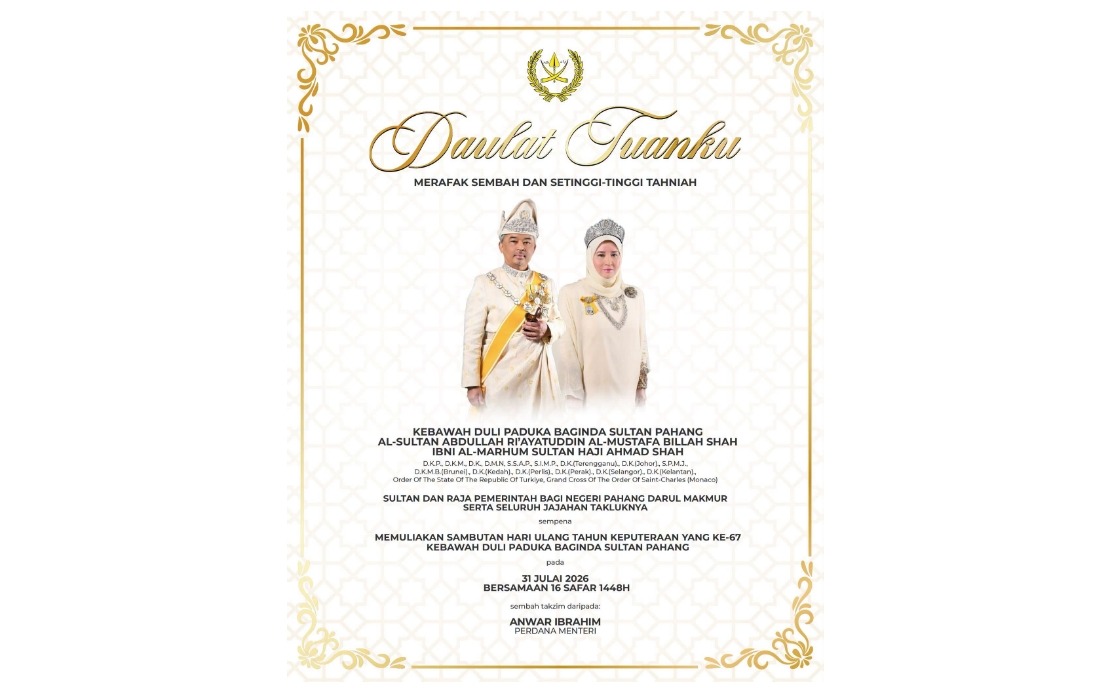
Prime Minister Datuk Seri Anwar Ibrahim has publicly extended his congratulations to the Sultan of Pahang, Al-Sultan Abdullah Ri'ayatuddin Al-Mustafa Billah Shah, marking His Royal Highness's 67th birthday with a heartfelt message shared across social media platforms. The gesture underscores the significance of maintaining cordial relations between the federal government and Malaysia's state rulers, a constitutional cornerstone of the nation's governance framework.
Anwar's birthday tribute, conveyed through a Facebook post, reflected the customary respect and reverence afforded to the institution of the Sultanate within Malaysia's political and social hierarchy. The Prime Minister's public acknowledgement of the Sultan's milestone birthday serves both ceremonial and diplomatic functions, reinforcing the bonds between executive leadership and the constitutional monarchy that underpins the country's system of government.
In his message, Anwar invoked spiritual blessings for the Sultan and the entire Pahang Royal Family, requesting divine mercy and guidance to accompany the Sultan throughout his years of service and stewardship. Such invocations are traditional elements of formal well-wishes in Malaysia, where Islamic values are woven into state protocols and official expressions of goodwill, particularly when addressing the country's rulers.
The greeting specifically conveyed hopes for the Sultan's continued good health and enduring sovereignty, concerns that hold particular resonance given the demanding nature of royal and state leadership responsibilities. Pahang, as one of Malaysia's largest states both geographically and in terms of population, plays a significant role in the nation's political landscape, making the health and stability of its Sultan a matter of broader national interest.
Al-Sultan Abdullah Ri'ayatuddin Al-Mustafa Billah Shah has served as Sultan of Pahang since 1998, making him one of Malaysia's longest-serving state rulers. His tenure has encompassed periods of significant economic, social, and political change across the state, and he has maintained an active role in state governance and ceremonial functions representing Malaysia's constitutional monarchy.
The practice of federal leaders publicly acknowledging state rulers' significant dates reflects the delicate balance that Malaysia's constitutional monarchy requires. Unlike Westminster parliamentary systems where the head of government and head of state are often the same person, Malaysia's federal structure necessitates strong working relationships between the Prime Minister and the various state sultans, who collectively form the Council of Rulers and hold constitutional powers including the election of the Yang di-Pertuan Agong.
Anwar's gesture gains additional context within the broader landscape of federal-state relations in Malaysia, where maintaining harmony between Kuala Lumpur and state capitals is essential for effective governance. The Sultan of Pahang, as a member of the Council of Rulers, plays a role in matters of national significance, including constitutional amendments and the selection of the country's federal monarch, making the relationship between the Prime Minister's office and the Pahang court an important dimension of Malaysian political dynamics.
Birthday acknowledgements from senior government officials to state rulers are standard diplomatic protocol in Malaysia, yet each such gesture carries symbolic weight in reinforcing institutional respect and constitutional propriety. In an era where political tensions occasionally surface between different levels of government and between federal and state authorities, such public demonstrations of deference and goodwill serve as important reminders of the shared commitment to Malaysia's constitutional framework.
The Sultan of Pahang's role extends beyond ceremonial functions to encompass significant influence over matters affecting the state's development, resource management, and welfare of its citizens. The state, home to vast tracts of rainforest, significant agricultural regions, and substantial mineral resources, remains economically important to the nation, making the stability and continued effective leadership of its Sultan a matter of broader economic and environmental significance.
Anwar's public birthday greetings also reflect contemporary norms around state communication, with social media platforms now serving as primary vehicles for official announcements and gestures that might previously have been confined to formal diplomatic channels. This democratisation of official communication allows for wider public awareness of ceremonial interactions between the federal government and state institutions, creating transparency in what had traditionally been more exclusive governmental interactions.

