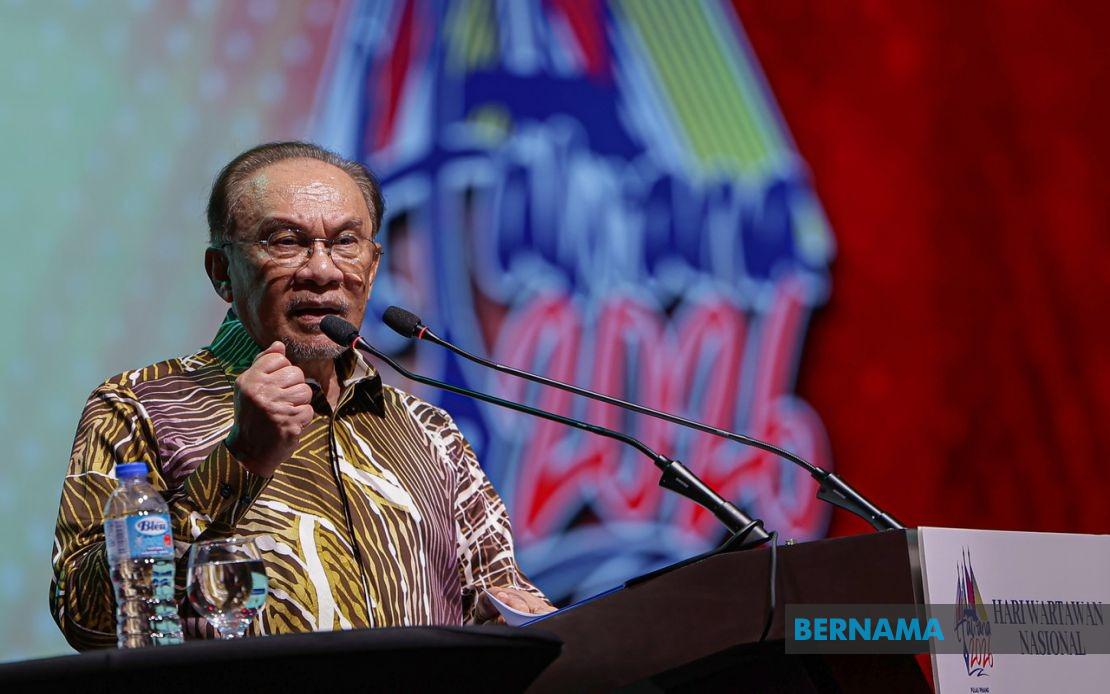
Prime Minister Datuk Seri Anwar Ibrahim has thrown his weight behind the appointment of former Federal Court judge Tan Sri Nallini Pathmanathan as chairman of the Malaysian Media Council, emphasizing that her distinguished legal background will bolster the organization's credibility and public standing. Speaking at the National Journalists' Day (HAWANA) 2026 event in Butterworth on June 20, Anwar underscored the significance of Nallini's selection, describing it as the outcome of thorough deliberation that factored in her stellar judicial career, professional accomplishments, and unwavering ethical standards.
The Prime Minister's public endorsement carries particular weight given the MMC's recent establishment and its mandate to serve as the media industry's principal self-regulatory mechanism. Anwar emphasized that Nallini's impeccable credentials would furnish the council with enhanced legitimacy and restore confidence among stakeholders—a notably important consideration for an institution tasked with policing journalistic conduct and managing media-related grievances at a time when public trust in institutions remains fragile.
The Malaysian Media Council was formally constituted under the Malaysian Media Council Act 2025, marking a significant development in the country's media governance landscape. As a self-regulating body, the MMC carries responsibility for elevating journalistic standards, adjudicating public complaints regarding media outlets and content, promoting ethical conduct within the industry, and safeguarding press freedom as a foundational democratic principle. For Malaysian readers and media practitioners, this institutional framework represents an attempt to balance industry autonomy with public accountability—a perennial tension in democracies across Southeast Asia.
Nallini's candidacy received unanimous backing from the MMC board during a formal meeting held on May 26, signaling strong consensus around her suitability for the role. Her appointment also carried the attendance and approval of senior government figures, including Penang Chief Minister Chow Kon Yeow and Communications Minister Datuk Fahmi Fadzil, demonstrating cross-party political support for the selection. This broad-based endorsement suggests that stakeholders view the appointment as transcending partisan divisions and rooted instead in meritocratic considerations.
The significance of selecting a former judge to lead a media self-regulatory body reflects a deliberate strategy to insulate the council from perceptions of political interference or industry favoritism. Judicial officers typically command public respect for impartiality and adherence to established rules of procedure, attributes essential to an organization responsible for investigating complaints and rendering judgments on journalistic conduct. In the Malaysian context, where concerns about media independence have periodically surfaced, importing judicial credibility into media governance carries symbolic and practical value.
Nallini's judicial credentials position her to navigate complex disputes between competing interests: protecting legitimate press freedom while addressing valid public grievances about inaccurate reporting, sensationalism, or ethical lapses. Her experience presiding over cases likely exposed her to the intricacies of balancing free expression against other societal interests—a skillset directly applicable to her new portfolio. Furthermore, her background suggests she will approach MMC decisions with procedural rigor and reasoned judgment rather than ideological predisposition.
The establishment and proper functioning of the MMC matters significantly for Malaysia's media environment and democratic health. A credible self-regulatory body can forestall heavy-handed government intervention in press affairs while simultaneously addressing legitimate concerns about journalistic standards. For regional observers, Malaysia's experiment with media self-regulation offers insights into how democracies can maintain editorial independence while instituting accountability mechanisms. The appointment of respected judicial figures to leadership roles within such bodies becomes a critical confidence-building measure.
Anwar's formal congratulations to Nallini, delivered during a national commemoration of journalists, reinforced the government's commitment to media professionalism and institutional credibility. The venue and occasion—a celebration of journalism itself—underscored the administration's messaging that it views robust, ethical media practice as complementary rather than adversarial to sound governance. This framing is particularly relevant in a region where tensions between governments and media outlets frequently dominate headlines.
For the Malaysian media industry specifically, Nallini's leadership of the MMC will likely shape how complaints are processed, which ethical standards are prioritized, and how conflicts between press freedom and other public interests are adjudicated. Her judicial temperament and legal expertise should translate into decisions grounded in precedent and principle rather than ad hoc determinations. Media organizations and individual journalists will watch closely to assess whether the council operates with genuine independence or becomes subject to external pressure—a test that will reveal much about Malaysia's commitment to authentic press self-regulation.

