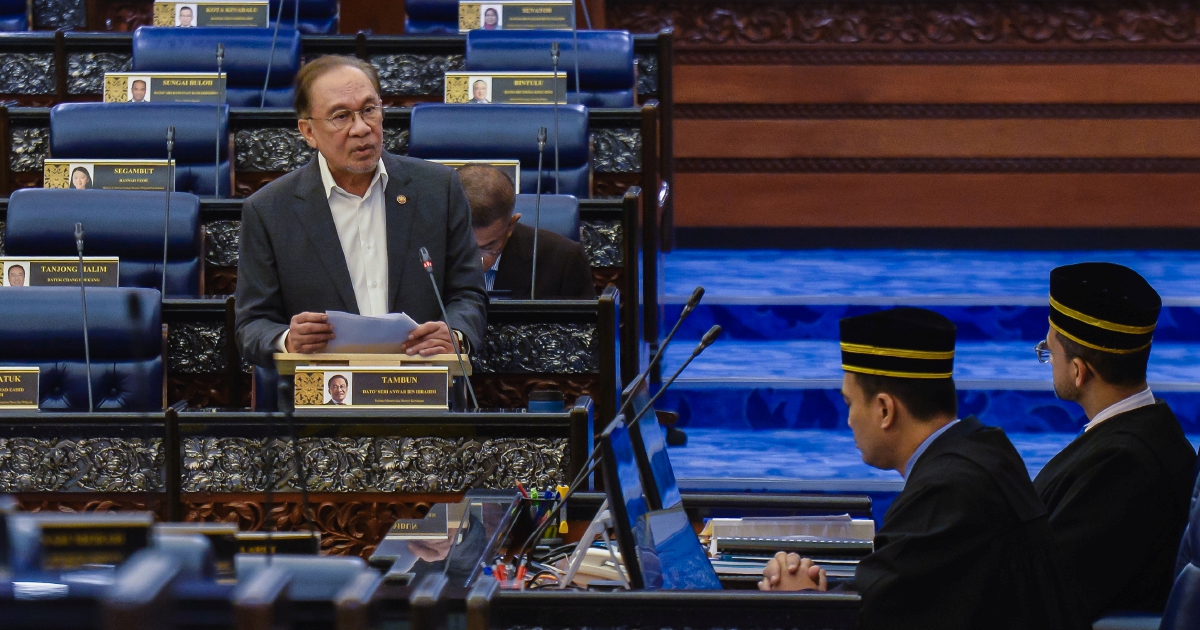
Prime Minister Datuk Seri Anwar Ibrahim has once again moved to distance himself from allegations that he personally instructed the cancellation of a Johor Felda Settlers' Day celebration planned for Kluang, addressing the controversy during parliamentary proceedings in the Dewan Rakyat. The clarification comes amid mounting scrutiny over the event's postponement and suggestions that political considerations may have influenced the decision.
In his statement to parliament, Anwar stressed that he issued no explicit directive targeting the Kluang gathering. Instead, he characterised the situation as falling within the scope of broader administrative guidance that applies universally during electoral cycles. The prime minister's repeated denials suggest the issue has become sensitive enough to warrant direct parliamentary intervention, indicating that confusion or miscommunication at different levels of government may have contributed to the event's cancellation.
The core restriction in effect, according to Anwar, pertains to the prohibition of government machinery being deployed for campaign-related activities during election periods. This standard operating procedure is designed to maintain neutrality in the civil service and prevent state resources from being weaponised for political advantage—a principle that most Commonwealth democracies observe. In Malaysia's context, such restrictions become particularly important given the substantial overlap between government institutions and ruling-party infrastructure in several states, including Johor.
The Felda Settlers' Day celebration carries significant symbolic weight in Johor's political and social landscape. The Federal Land Development Authority, commonly known as Felda, has historically served as both an economic institution and a pillar of rural support for the government. Settlers within the Felda scheme represent a key constituency that often determines electoral outcomes in rural districts, making such community gatherings politically resonant even when ostensibly non-partisan. The fact that this particular celebration became caught up in broader questions about propriety during an election cycle underscores how contentious the intersection of governance and electioneering remains in Malaysian politics.
Anwar's clarification regarding the scope of restrictions speaks to a broader tension within Malaysia's regulatory framework. While election commissions and administrative bodies routinely issue guidance on the appropriate use of government resources during campaign periods, the line between what constitutes a legitimate public event and what might be construed as political campaigning remains ambiguous in practice. A Felda Settlers' Day celebration, organised at district level and attended primarily by scheme members and their families, could plausibly be categorised either way depending on interpretation. This interpretative flexibility has likely enabled different officials to reach different conclusions about whether the gathering should proceed.
The parliamentary exchange also illuminates questions about chain-of-command and implementation in Malaysia's federal system. If no central directive from the Prime Minister's office existed, then some other authority—whether at state level in Johor, within the Felda hierarchy itself, or among local administration—must have made the decision to postpone. This diffusion of responsibility suggests that lower-level officials may have over-interpreted or misapplied general guidance in seeking to avoid any appearance of impropriety. Such cautious interpretation of directives, while administratively safe, can create the impression of political interference even where none was explicitly mandated.
For Malaysian and regional observers, the incident exemplifies recurring challenges in maintaining institutional autonomy and public confidence during electoral campaigns. Election periods inevitably introduce heightened scrutiny of government activities, yet the impulse towards excessive caution can itself become counterproductive if it disrupts routine community functions or creates perception of political meddling. The controversy surrounding the Kluang event demonstrates how ambiguity in administrative procedures, combined with the politicised environment of campaigns, can generate disputes that require prime ministerial intervention to resolve.
Anwar's insistence on clarifying his personal non-involvement also reflects awareness that direct attribution of such decisions to the Prime Minister can damage his standing as a leader committed to institutional integrity and democratic norms. By emphasising that no personal directive was issued and that only standard election-period protocols applied, he seeks to position the matter as routine administrative procedure rather than political interference. However, the need to address the issue multiple times in parliament suggests that initial denials failed to fully satisfy questioning parliamentarians or settle public scepticism.
Looking forward, the incident underscores the need for clearer, more transparent guidelines regarding which government-organised or government-associated events can proceed during election periods and under what conditions. The ambiguity surrounding Felda Settlers' Day illustrates how existing frameworks may be insufficient to prevent misunderstandings or uneven implementation across different jurisdictions and institutions. For Felda settlers in Johor and similar communities throughout Malaysia that depend on state-coordinated gatherings for social cohesion and representation, such clarity would provide welcome assurance that their celebrations and commemorations will not become collateral casualties of electoral administration.

