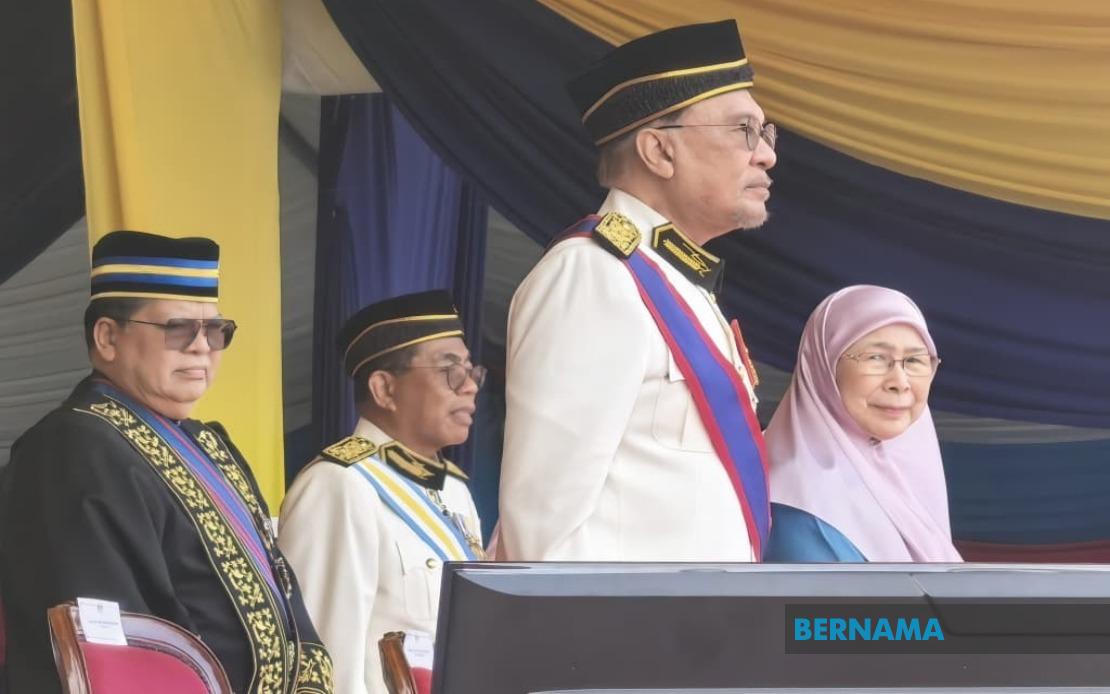
Prime Minister Datuk Seri Anwar Ibrahim has appealed to young Malaysians to value the country's freedom and stability by acknowledging the profound contributions of the nation's security forces. Speaking at the 2026 National Warriors' Day Parade held at Dataran Pahlawan Negara in Putrajaya on Wednesday, Anwar stressed that contemporary generations often take for granted the privileges they inherit, without fully understanding the price paid by those in uniform to secure them.
Central to the ceremony was a powerful theatrical performance titled "Darah Pahlawan Ulu Legong" (The Blood of the Ulu Legong Warriors), presented by the Malaysian Armed Forces. The pantomime recounted a tragic chapter in Malaysia's modern military history, depicting the events of October 29, 1981, when seven soldiers were killed in an ambush orchestrated by communist terrorists during an operation in Ulu Legong, Baling in Kedah. The performance moved attendees deeply by transforming historical tragedy into a lived emotional experience rather than mere factual recounting, a distinction Anwar himself highlighted as crucial to understanding the true cost of national defence.
Anwar's remarks underscore a strategic effort by the government to maintain collective memory of Malaysia's security challenges and the human cost of resolving them. The focus on the Emergency era and Confrontation period is particularly significant for Southeast Asia, as these conflicts shaped the region's modern borders and power dynamics. For Malaysian readers, this historical context is essential: the armed forces' success in maintaining territorial integrity and preventing communist expansion directly enabled the economic development and regional stability that Malaysians have experienced over the past four decades.
The gathering brought together senior government figures, including Home Minister Datuk Seri Saifuddin Nasution Ismail, Defence Minister Datuk Seri Mohamed Khaled Nordin, Chief of Defence Force General Tan Sri Malek Razak Sulaiman, and Inspector-General of Police Tan Sri Mohd Khalid Ismail, signalling the administration's commitment to honouring military heritage. The presence of Anwar's wife, Datuk Seri Dr Wan Azizah Wan Ismail, reinforced the inclusive, family-oriented framing of national remembrance.
A poignant element of the ceremony involved Anwar's personal recognition of surviving witnesses to history. Private Md Said Adam, one of only two soldiers who survived the Ulu Legong ambush, was among those whom the Prime Minister met and thanked individually. Similarly, Lieutenant Colonel Hamzah Othman, who commanded the 22nd Battalion, Royal Malay Regiment during the incident, and the families of those who perished, were acknowledged for their service and loss. These personal interactions transformed the formal state occasion into a moment of genuine human connection between political leadership and the military community.
The theme of this year's parade—"Mengenang Jasa, Mengukuh Pertahanan" (Honouring Service, Strengthening Defence)—reflects a dual purpose: remembrance and contemporary relevance. By honouring past sacrifices, the government simultaneously reinforces the legitimacy and necessity of current defence spending and military institutional strength. For Malaysia, which faces ongoing regional security considerations including maritime threats and transnational challenges, this message carries practical implications beyond ceremonial significance.
Anwar's insistence that independence "comes at the price of sacrifice" represents a philosophical position with immediate policy consequences. In an era when many nations debate defence budgets and military priorities, his framing positions security spending not as an abstract economic calculation but as a moral imperative grounded in historical obligation. This rhetorical approach may influence public discourse around future defence investments and military modernisation initiatives that the Malaysian government may pursue.
The emphasis on youth engagement is particularly telling. By specifically urging the current generation—those born after the Emergency and Confrontation periods—to understand these historical events, the government is attempting to bridge a generational gap in national consciousness. In Malaysia's multicultural context, where different communities may hold varying historical perspectives, such formal state ceremonies serve an integrative function, establishing a shared national narrative that transcends ethnic or religious boundaries.
For regional observers, Malaysia's continued commemoration of its security challenges reflects broader Southeast Asian patterns. The region's armed forces and governments regularly invoke historical struggles against communism and regional instability to justify contemporary security policies and investments. Malaysia's approach is notably less nationalist in tone than some neighbouring countries, emphasising sacrifice rather than martial glory, which may reflect the country's experience with internal security challenges requiring broad-based public cooperation.
The gathering also underscores the Malaysian Armed Forces' role in national identity formation. By producing sophisticated theatrical presentations rather than relying solely on traditional military parades, the armed forces demonstrate awareness that contemporary audiences require emotional and intellectual engagement to connect with historical narratives. This represents an evolution in how institutions communicate with citizens in an increasingly media-saturated environment.
Anwar's intervention in this military-centred occasion carries particular significance given his own controversial history with the security forces and judiciary. His emphasis on honouring sacrifices may be read partly as a broader effort to rebuild institutional relationships and signal respect for the armed forces after periods of tension. For Malaysian political observers, the seamless coordination between civilian and military leadership evident at the ceremony suggests a consolidated institutional consensus around national defence priorities.
Looking forward, the ceremony establishes a template for how the Malaysian government plans to engage younger citizens with national security narratives. As demographic shifts bring those with no living memory of the Emergency or Confrontation into adulthood, such formal remembrance events become increasingly important anchors for collective historical consciousness. The success of such initiatives in sustaining national cohesion remains an open question, particularly given Malaysia's complex religious and ethnic composition.

