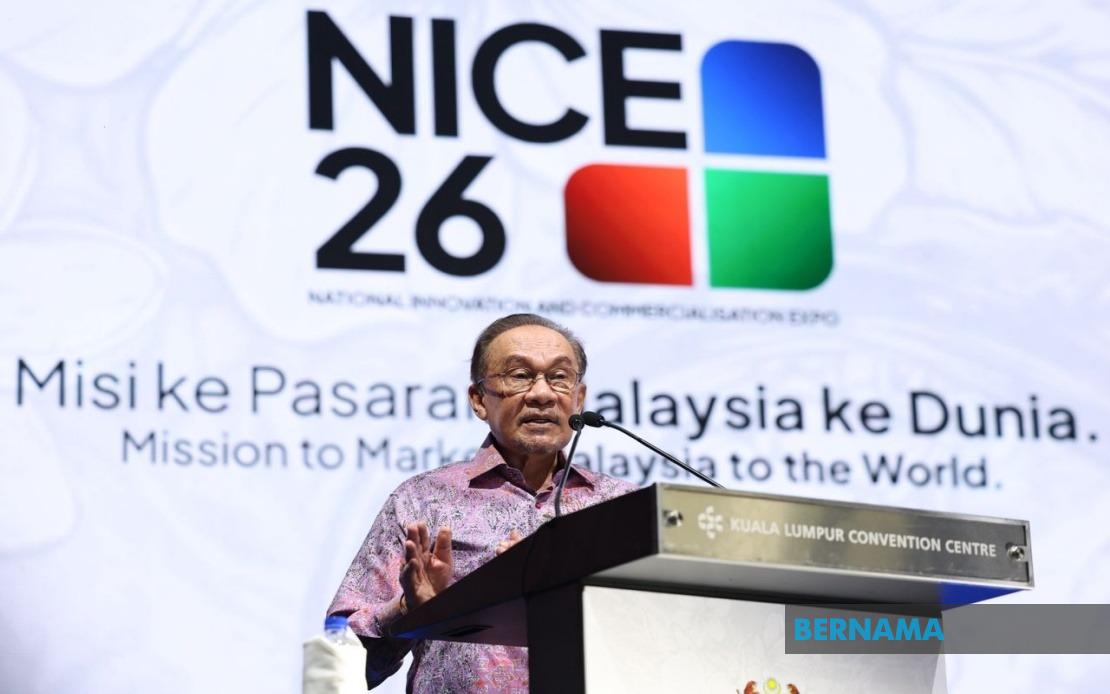
Prime Minister Datuk Seri Anwar Ibrahim has issued a stark warning that Malaysia risks falling behind in the global innovation race unless the government dismantles cumbersome bureaucratic procedures that delay commercialisation and impede the rapid establishment of cutting-edge academic facilities. Speaking at the National Innovation and Commercialisation Expo (NICE) 2026 at the Kuala Lumpur Convention Centre here, Anwar emphasised that the pace of modern technological advancement demands a fundamental shift away from traditional governance frameworks that prioritise procedural compliance over speed and market responsiveness.
The Prime Minister's intervention reflects growing frustration within government circles about the mismatch between Malaysia's innovation ambitions and the administrative machinery tasked with delivering them. Conventional approval mechanisms—which typically require multiple senate meetings, council deliberations, and layered departmental sign-offs—have become incompatible with the velocity at which technology evolves and competitive advantages emerge in the global marketplace. Anwar's statement signals his determination to recalibrate how the government operates, particularly across agencies responsible for science, technology, and innovation policy.
To illustrate the practical implications of this disconnect, Anwar highlighted a concrete achievement: the establishment of Artificial Intelligence faculties at several Malaysian universities was accomplished in just three months—a process that ordinarily consumes twelve months under existing protocols. This dramatic compression of timelines demonstrates both what is possible when bureaucratic constraints are relaxed and what Malaysian institutions have been forfeiting through adherence to rigid administrative structures. The success story serves as a proof-of-concept that governmental decision-making can be restructured without sacrificing standards or accountability.
The innovation landscape has fundamentally altered over the past decade. Countries such as Singapore, South Korea, and increasingly Vietnam have demonstrated that agility in approving new academic programmes, research initiatives, and technology commercialisation ventures confers genuine competitive advantage. Delays of even a few months can mean the difference between capturing emerging talent, securing research funding, and establishing market leadership in nascent fields. Malaysia's historical reliance on consensus-building and hierarchical approval chains, while perhaps appropriate for infrastructure projects with long gestation periods, proves counterproductive when applied to knowledge-based sectors characterised by rapid iteration and adaptation.
Anwar's remarks carry particular weight given his position and his administration's explicit commitment to positioning Malaysia as a regional innovation hub. The government has invested substantially in research infrastructure, international collaborations, and talent attraction initiatives. Yet these investments risk yielding diminished returns if the institutional framework for decision-making remains sluggish. The Prime Minister's public call-out to the Ministry of Science, Technology and Innovation (MOSTI) and related ministries amounts to a directive to fundamentally rethink their operational philosophy and accept that the post-pandemic, post-normal world operates according to different temporal and competitive dynamics.
The implications extend beyond academic institutions. Malaysia's private sector, particularly within technology and biotechnology domains, has repeatedly expressed frustration about regulatory timelines. Venture capital investors evaluating whether to establish regional headquarters in Kuala Lumpur or elsewhere frequently cite bureaucratic efficiency as a determinant factor. By signalling governmental commitment to streamlined processes, Anwar attempts to address a persistent concern that constrains Malaysia's attractiveness as a hub for innovation-driven enterprises. The symbolic and practical dimensions of this message work in tandem to influence both domestic institutional behaviour and foreign investor perceptions.
Implementing this transformation will require more than rhetorical commitment. Government agencies must develop alternative approval pathways that maintain fiduciary responsibility and quality assurance while dramatically reducing processing time. This might involve establishing expedited review committees, pre-approved templates for common applications, delegated authority frameworks that empower lower-level officials, and performance metrics tied to turnaround time rather than procedural adherence. Southeast Asian precedents, including Singapore's regulatory sandbox approach and Indonesia's recent administrative reforms, offer instructive models that Malaysian agencies could adapt to local contexts.
The broader strategic context matters here as well. China, India, and other regional competitors have substantially increased their investment in artificial intelligence, biotechnology, and semiconductor research. Malaysia's window for establishing itself as a leading research destination in these fields is narrowing. While the nation possesses genuine advantages—including English-language proficiency, multicultural demographics, and geographic positioning—these assets become liabilities if institutional friction prevents their effective mobilisation. Anwar's intervention recognises this urgency and attempts to catalyse institutional change from the top of the political hierarchy.
Yet resistance to change should not be underestimated. Bureaucratic systems persist partly because they embody entrenched interests and risk-averse cultures that prioritise harm avoidance over opportunity creation. Mid-level officials accustomed to following established procedures may resist pressure to adopt faster, more flexible approaches, particularly if they lack explicit protection against accountability when expedited processes yield unexpected outcomes. Anwar's challenge, therefore, extends beyond issuing directives to fundamentally reshaping institutional incentives and cultures across the civil service.
The NICE 2026 platform itself represents an attempt to showcase Malaysia's innovation ecosystem to domestic and international audiences. However, the event's success ultimately depends not on exhibition halls but on whether Malaysia's institutional framework can translate innovation concepts into commercial reality at competitive speeds. Anwar's speech reframes the expo as part of a broader policy repositioning, using a public platform to communicate to the bureaucracy, private sector, and international observers that Malaysia is serious about eliminating administrative friction from its innovation pipeline.
Moving forward, government agencies will face pressure to demonstrate concrete progress. Whether specific timelines for approvals can be reduced, whether new pathways for establishing programmes become operational, and whether measurable outcomes improve will determine whether this intervention translates into systemic change or remains a rhetorical flourish. Success requires coordination across multiple ministries, clear accountability mechanisms, and political backing sustained beyond the immediate term. For Malaysia's innovation ambitions to be credible, the government must demonstrate that it can practice what its Prime Minister preaches about agility and efficiency.

