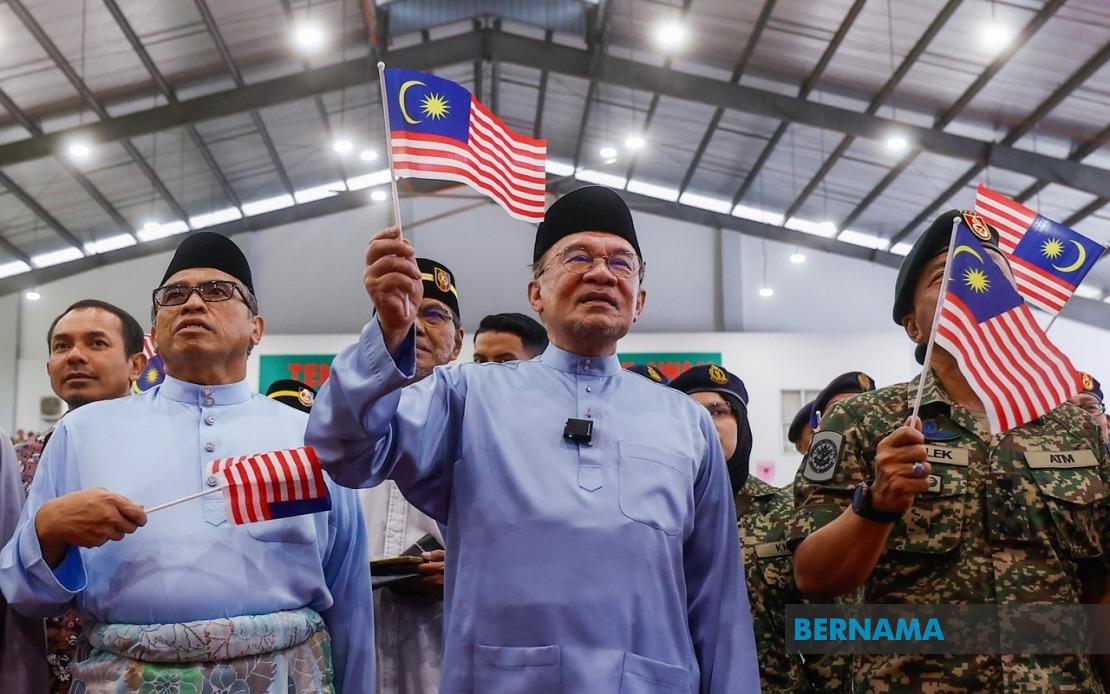
Prime Minister Datuk Seri Anwar Ibrahim has issued a stern appeal to all contesting parties in the upcoming Negeri Sembilan state election to abandon slanderous tactics and false narratives as instruments of political competition. Speaking in Port Dickson on July 24, Anwar emphasised that winning elections through character assassination and fabricated claims represents a dangerous degradation of democratic standards in the country. His remarks came as campaigning intensifies for the 16th Negeri Sembilan state election, scheduled for August 1, with early voting commencing on July 28.
The Prime Minister drew on his own extensive history of facing malicious accusations to underscore the corrosive impact of political slander on public discourse. He revealed that morning briefings had brought to his attention a particularly egregious example: a fabricated claim circulating that he had organised a gathering specifically to distribute propaganda among military personnel and war veterans. The allegation, Anwar stressed, was entirely fabricated and represented a troubling pattern of cutting and pasting statements to misrepresent his positions and activities. His frustration with such tactics was palpable, as he reflected on how Malaysian politics had descended to a point where such transparent distortions could gain traction.
Anwar acknowledged his own imperfections and readiness to account for genuine shortcomings in his conduct and statements. He made clear that he harbours no illusions about his record and remains prepared to apologise for any actions or words that might have caused harm or offence. However, he drew a firm line between legitimate criticism and defamatory fabrications designed solely to damage his standing. This distinction, he argued, should form the moral foundation of any legitimate electoral competition. The Prime Minister's appeal reflected a broader concern about the degradation of campaign discourse across Southeast Asia, where misinformation and social media manipulation have increasingly undermined the quality of democratic participation.
Anwar's remarks gained additional weight from the high-level audience assembled to hear them. Chief Secretary to the Government Tan Sri Shamsul Azri Abu Bakar, Deputy Defence Minister Adly Zahari, Chief of Defence Forces General Tan Sri Malek Razak Sulaiman, and Army Chief General Tan Sri Azhan Md Othman all attended the event. The presence of these senior defence and civil service officials highlighted the government's concern that military and security personnel were being targeted with propaganda materials during the election period. The gathering underscored the seriousness with which the administration treats efforts to compromise the political neutrality and integrity of the armed forces.
The Prime Minister connected his cautionary message to his decades-long experience as a political figure subjected to numerous false accusations throughout his career. He encouraged other participants in the electoral process to learn from his experiences and recognise that short-term political advantage gained through slander carries substantial long-term costs to the nation's democratic fabric. Anwar's perspective, shaped by decades in Malaysian politics including periods of imprisonment and rehabilitation, lends particular credibility to his warnings about the dangers of allowing electoral competition to descend into unbridled character attacks. His call reflected a statesman-like concern for institutional integrity that transcends immediate partisan advantage.
Beyond his campaign ethics message, Anwar also directed remarks to Malaysia's civil service, urging continued commitment to supporting the government's broader agenda of maintaining national peace and stability. He emphasised that the country's extensive reform programme and policy innovations require sustained bureaucratic competence and institutional loyalty. This dual message—to political actors about ethical boundaries and to government machinery about implementation excellence—reflected the administration's ambition to operate both a cleaner politics and a more effective state apparatus. The timing of these remarks, with the Negeri Sembilan election imminent, suggested that the government views ethical standards during campaigning as integral to its legitimacy and reform credentials.
The Negeri Sembilan contest itself carries significant implications for the Pakatan Harapan coalition's governance trajectory. The ruling alliance has fielded candidates for all 36 state seats, distributing them among its constituent parties according to established formulas. The PKR, Anwar's own party, is contesting 16 seats, while the DAP fields 11 candidates and Amanah contributes nine. This distribution reflects the internal balance of forces within the coalition and the respective strengths of each party in different state constituencies. The election will serve as a valuable gauge of coalition cohesion and voter sentiment regarding the federal government's performance.
The electoral schedule itself—with early voting on July 28 and polling day on August 1—provides a compressed timeframe for campaigns to unfold. This compressed schedule intensifies pressure on parties to communicate their messages quickly and efficiently, potentially creating incentives for shortcuts and exaggeration. Against this backdrop, Anwar's warnings about slanderous tactics acquire particular urgency. The Prime Minister's message suggests that the government intends to monitor campaign conduct closely and expects all parties, including those within its own coalition, to maintain ethical standards. Such vigilance could set valuable precedents for future electoral contests in Malaysia and potentially influence campaign standards across the Southeast Asian region.
Anwar's emphasis on learning from his personal experiences with false accusations carries resonance beyond the immediate Negeri Sembilan context. Malaysian voters across the country have become increasingly saturated with political messaging through social media and digital platforms, making them more susceptible to rapid spread of unverified claims. The Prime Minister's appeal to political responsibility essentially asks contending parties to resist the temptation to exploit these vulnerabilities. His assertion that Malaysian politics should aspire to higher standards reflects both institutional confidence in the country's democratic processes and concern about the corrosive effects of unchecked misinformation on public trust.
The convergence of Anwar's personal history, his current institutional role, and the specific circumstances of the Negeri Sembilan election created a moment of unusual political clarity. A Prime Minister who has personally experienced imprisonment on politically motivated charges now occupied a position to set standards for campaign conduct affecting millions of citizens. Whether his appeal will substantially influence the behaviour of contesting parties remains uncertain, particularly given the intensity of electoral competition and the prevalence of digital misinformation strategies. Nonetheless, his intervention established a clear marker for what the federal government considers acceptable campaign practice and signalled that maintaining democratic standards remains a priority even amid competitive electoral pressures.

