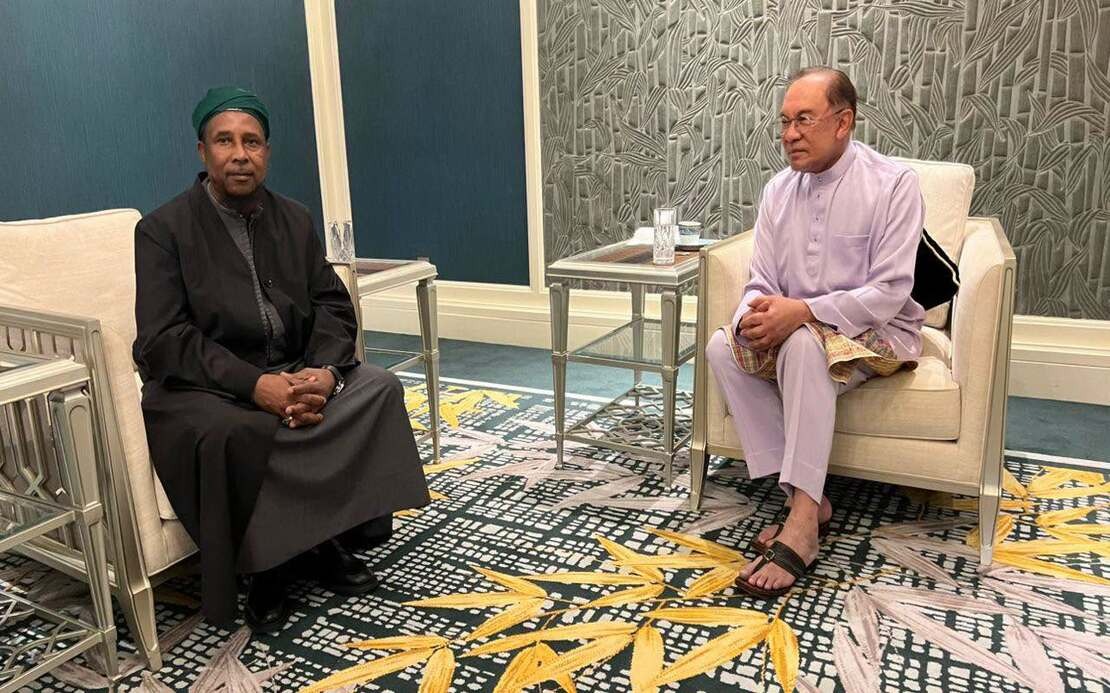
Prime Minister Datuk Seri Anwar Ibrahim received a farewell visit on June 26 from Gambian Islamic scholar Sheikh Muhammad Haydara Al-Jilani, marking the conclusion of an extended religious engagement programme that has taken the scholar across multiple locations throughout Malaysia over the past month. The meeting, held at the Prime Minister's office in Kuala Lumpur, coincided with the Day of Ashura, a significant date in the Islamic calendar that falls on a Friday, lending additional spiritual significance to the occasion.
The visit represents the culmination of a broader dakwah initiative in which Sheikh Muhammad Haydara Al-Jilani has been actively engaged throughout his Malaysian sojourn. Rather than limiting his activities to a single venue or audience, the scholar has conducted a series of knowledge-sharing sessions and dhikr gatherings at various locations across the country, reflecting a systematic approach to religious education and community engagement.
During the encounter, Anwar took the opportunity to request the scholar's prayers for the nation during this auspicious period. The Prime Minister expressed his desire for special supplications directed towards the prosperity, stability, and overall well-being of the Malaysian people, underscoring the spiritual dimensions of leadership that he has previously emphasised in public statements.
In a statement shared on his official Facebook page, Anwar highlighted the convergence of the meeting with the Day of Ashura, a day of profound religious significance in Islamic tradition. He specifically requested that the Sheikh offer prayers seeking Allah's continued mercy, blessings, and protection for Malaysia as a nation, positioning the encounter as a moment of spiritual renewal and intercession.
The scholar's month-long residency in Malaysia reflects the nation's continued openness to hosting international Islamic figures and facilitating cross-cultural religious exchange programmes. Such visits serve multiple purposes within Malaysia's diverse Muslim community, offering opportunities for spiritual enrichment, theological dialogue, and the transmission of Islamic knowledge from established scholars to local audiences.
Sheikh Muhammad Haydara Al-Jilani's tenure in Malaysia demonstrates the broader trend of Southeast Asian nations, particularly Malaysia, serving as hub for Islamic learning and dissemination. The programme structure, involving multiple knowledge-sharing sessions and dhikr gatherings at selected venues nationwide, suggests a careful coordination between the scholar and his local hosts to maximise reach and engagement across different regions and communities.
The timing of this farewell visit carries particular weight given Malaysia's complex religious and political landscape. Anwar's explicit request for prayers for national prosperity and peace underscores how Malaysia's leadership engages with international Islamic figures as partners in promoting spiritual cohesion and national unity. The emphasis on seeking divine protection and blessings for the country reflects a statecraft approach that integrates religious symbolism and spiritual intercession with governance.
The Day of Ashura, the tenth day of Muharram in the Islamic calendar, holds profound significance across the Muslim world and is observed with varying degrees of religious intensity depending on theological traditions and cultural contexts. By hosting this farewell meeting on this date, Prime Minister Anwar has deliberately chosen a moment that carries deep religious meaning, suggesting strategic consideration of how religious observance and state leadership intersect.
For Malaysian observers, this episode illustrates the continuing relevance of international Islamic scholarship in shaping local religious discourse and practice. The nationwide scope of Sheikh Muhammad Haydara Al-Jilani's programme indicates that demand exists among Malaysian Muslim communities for engagement with internationally respected Islamic figures, and government facilitation of such programmes remains a consistent feature of Malaysia's approach to Islamic affairs.
The scholar's visit also occurs within a broader context of Malaysia's positioning as a moderate Islamic nation and a bridge between diverse religious traditions. Official engagement with international Islamic scholars provides an opportunity for Malaysia to demonstrate its commitment to authentic Islamic learning while simultaneously showcasing the country's religious tolerance and pluralistic values to international audiences.
As the scholar concludes his Malaysian engagement and prepares for departure, the Prime Minister's personal farewell visit underscores the official recognition and respect accorded to visiting Islamic figures of standing. This gesture reflects established diplomatic protocol within Malaysia's approach to international religious engagement, where symbolic and substantive recognition of scholarly visitors is viewed as reinforcing Malaysia's role within the global Islamic community.

