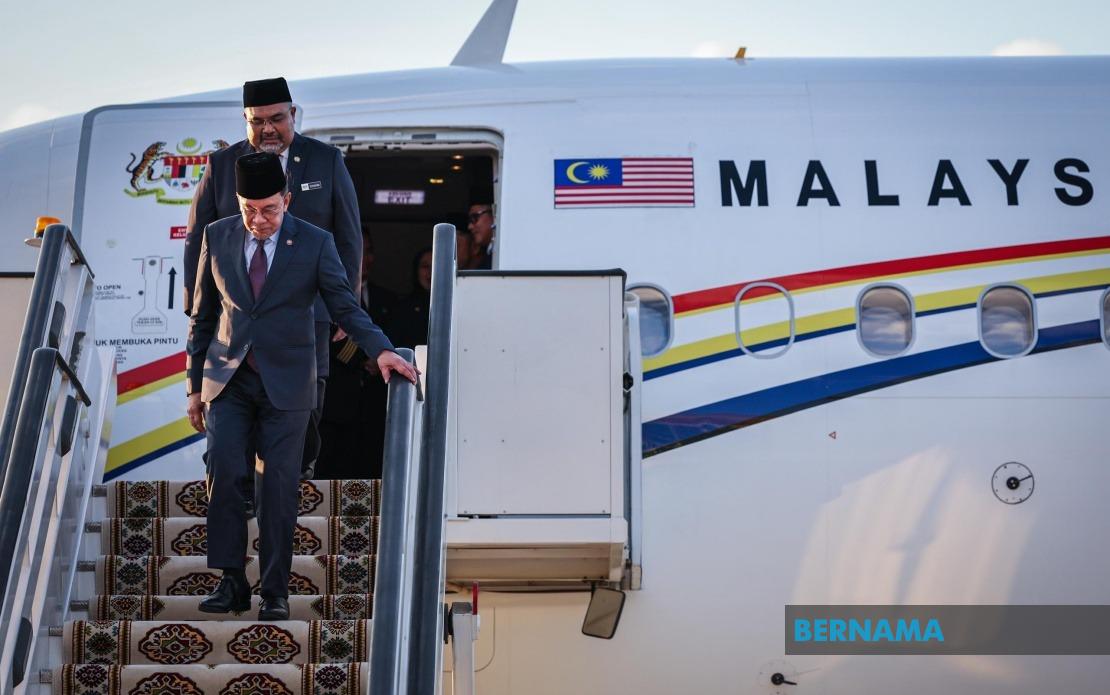
Prime Minister Datuk Seri Anwar Ibrahim touched down in Ashgabat on June 18 to begin a two-day official visit to Turkmenistan, marking Malaysia's continued engagement with Central Asian nations at the highest political level. The arrival capped off Anwar's preceding working visit to Kazan in the Republic of Tatarstan, allowing him to advance Malaysia's strategic interests across Russia's vast regions. His arrival at Ashgabat International Airport at 8 pm local time underscores the deliberate pacing of high-level diplomatic missions across the former Soviet space, a region increasingly important for trade diversification and energy security in the post-pandemic landscape.
The delegation accompanying the Prime Minister reflected the economic focus of the journey. Alongside Anwar travelled Minister of Investment, Trade and Industry Datuk Seri Johari Abdul Ghani and Minister of Economy Akmal Nasrullah Mohd Nasir, signalling that this visit prioritises commercial advancement and bilateral economic frameworks over ceremonial protocol alone. Supporting officials from both the Prime Minister's Office and the Foreign Ministry completed the party, ensuring seamless coordination of discussions touching on governance, trade mechanisms, and strategic partnership architecture. Malaysia's Ambassador to Turkmenistan Mohd Suhaimi Ahmad Tajuddin welcomed Anwar upon arrival, while the Turkmenistan side fielded Deputy Chairman of the Cabinet of Ministers for Oil and Gas Guvanch Agajanov as his counterpart, indicating the energy sector's centrality to bilateral relations.
This inaugural official visit by Anwar represents the fifth such mission by a Malaysian prime minister to Turkmenistan, reflecting a pattern of sustained diplomatic engagement despite geographic distance. The timing carries particular significance: Anwar's journey reciprocates the official visit to Malaysia made by Turkmenistan President Serdar Berdimuhamedov in December 2024, a symmetry that reinforces mutual respect and balances the diplomatic ledger. Such reciprocal high-level visits, though sometimes overlooked by observers focused on nearer neighbours, cement institutional relationships and provide forums for tackling complex bilateral matters beyond what ambassadorial channels can accomplish. The visit arrives at an opportune moment, as Malaysia seeks to expand its footprint in Central Asia amid broader geopolitical shifts in the region and global energy markets.
Anwar's schedule for June 19 underscores the ceremonial yet substantive nature of the engagement. A welcoming ceremony hosted by President Berdimuhamedov at the Presidential Palace will launch the formal proceedings, followed by bilateral meetings structured to permit candid discussion of shared priorities and concerns. The planned signing of a joint statement and the exchange of pre-negotiated agreements and memoranda of understanding indicate that preliminary technical work has been completed by both administrations, transforming abstract diplomatic goodwill into concrete institutional frameworks. The inclusion of bilateral talks reflects recognition that Malaysia and Turkmenistan, though separated by thousands of kilometres, share overlapping interests in regional stability, energy cooperation, and economic pragmatism.
Beyond official protocols, Anwar's itinerary includes an official luncheon and a visit to the Turkmenbashi Ruhy Mosque, also known as the Gypjak Mosque, for Friday prayers. These moments carry symbolic weight, demonstrating respect for Turkmenistan's Islamic heritage and allowing the Prime Minister to connect with the local Muslim community. The Malaysia-Turkmenistan Forum, to be jointly officiated by Anwar and Berdimuhamedov at the Chamber of Commerce and Industry of Turkmenistan, promises to bring together business leaders, investors, and policy stakeholders eager to identify new opportunities in bilateral commerce. Such forums, when executed with genuine intention, can catalyse unexpected partnerships and create informal networks that prove invaluable as market conditions evolve.
The economic dimension of this visit cannot be overstated. In 2025, Turkmenistan ranked as Malaysia's fourth-largest trading partner among Central Asian nations, a position reflecting years of steady commercial engagement. Total bilateral trade reached RM75.80 million, with Malaysian exports constituting the bulk at RM75.50 million, marking a respectable 9 per cent year-on-year increase. While these figures may appear modest compared to Malaysia's trade with Southeast Asian neighbours or global economic powerhouses, they represent meaningful activity in a region where market penetration often demands patience and sustained commitment. The upward trajectory, even if modest in absolute terms, suggests growing confidence in the commercial relationship and expanding scope for Malaysian products and services in Turkmen markets.
Yet the true economic anchor of Malaysia-Turkmenistan relations remains Petroliam Nasional Bhd, the national oil company. Petronas has cultivated a substantial presence in Turkmenistan since 1996, accumulating investments totalling RM52.73 billion over nearly three decades. This commitment transforms Turkmenistan from a peripheral economic partner into a strategically vital asset for Malaysia's energy security and corporate revenue streams. Petronas operations in Turkmenistan represent patient capital deployment, weathering geopolitical uncertainties, commodity price fluctuations, and evolving regulatory environments. The sheer scale of this investment portfolio explains why Anwar prioritises Turkmenistan despite competing demands on his time, and why ministerial delegations accompany him to explore avenues for deepening corporate partnerships, streamlining operational frameworks, and potentially unlocking new exploration or production opportunities.
Central Asia occupies an intriguing position in Malaysia's foreign policy architecture. Geographically distant and culturally distinct from Southeast Asia, the region nonetheless offers complementary economic advantages and untapped potential. Malaysia's diplomatic presence in Central Asia, though less visible than engagement with ASEAN or traditional partners, reflects recognition that a truly global trading nation must cultivate relationships across multiple regions and time zones. Turkmenistan, with its substantial hydrocarbon reserves and geographic positioning along historic Silk Road corridors, merits sustained attention. For Malaysian policymakers and business leaders, the region represents both a source of raw materials critical to energy security and a market for Malaysian exports, services, and technical expertise.
Anwar's visit also arrives within a broader context of Malaysia reasserting itself as a serious player in Central Asian affairs. The presence of the Minister of Investment, Trade and Industry signals intent to move beyond symbolic diplomacy toward tangible commercial outcomes. Discussions likely touch on regulatory harmonisation, investment protections, dispute resolution mechanisms, and sectoral opportunities spanning energy, agriculture, petrochemicals, and financial services. The memoranda of understanding expected to be signed will codify these discussions into formal commitments, establishing frameworks through which Malaysian firms can engage with Turkmenistan with greater clarity and confidence.
For Malaysian readers and observers, this visit encapsulates several broader themes in contemporary Malaysian foreign policy. First, it demonstrates Malaysia's commitment to multi-aligned engagement, refusing to concentrate diplomatic and economic energies solely within Southeast Asia despite the region's historical importance. Second, it underscores the critical role of national enterprises like Petronas in anchoring Malaysia's strategic partnerships abroad, particularly in resource-rich regions. Third, it reflects a pragmatic approach to economic diversification, recognising that growth opportunities extend far beyond conventional trading hubs. Finally, it illustrates how high-level political visits, when properly structured and substantively focused, can catalyse deeper institutional relationships and unlock commercial potential that might otherwise remain dormant.
The two-day visit concludes with a press conference addressing Malaysian media, affording Anwar an opportunity to communicate outcomes and vision to domestic stakeholders. Such transparency, while sometimes overlooked, reinforces public understanding of why national resources are committed to diplomatic missions in regions that may seem distant or unfamiliar. As Malaysia navigates an increasingly complex global environment characterised by shifting trade patterns, energy transitions, and geopolitical realignment, partnerships with energy-rich Central Asian nations like Turkmenistan acquire heightened strategic significance. Anwar's presence in Ashgabat signals that Malaysia's leadership recognises this reality and remains committed to building enduring relationships that serve the nation's long-term prosperity and security interests.

