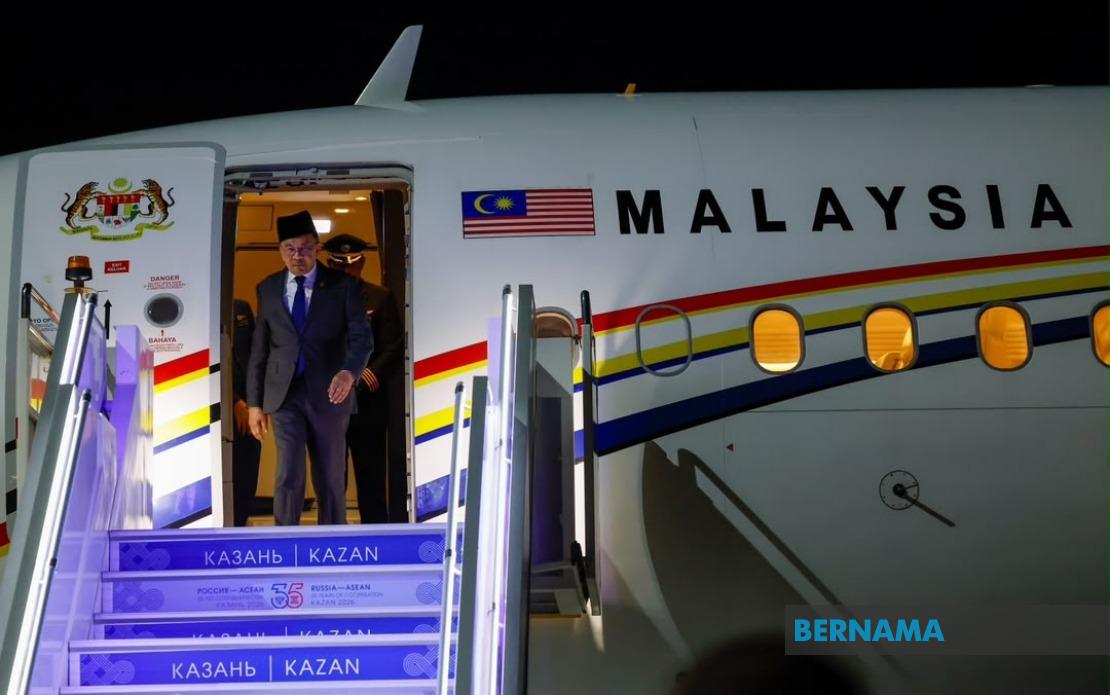
Prime Minister Datuk Seri Anwar Ibrahim touched down in Kazan on June 16 for a two-day working visit centred on attending the ASEAN-Russia Commemorative Summit scheduled for June 17-18. The aircraft carrying the Malaysian premier landed at Kazan International Airport at 10.20 pm local time, with Anwar accompanied by a high-level delegation including Minister of Investment, Trade and Industry Datuk Seri Johari Abdul Ghani and Minister of Economy Akmal Nasrullah Mohd Nasir, along with officials from the Prime Minister's Office and the Foreign Ministry. Upon arrival, Malaysia's Ambassador to Russia Datuk Cheong Loon Lai received the delegation, while the Russian side was represented by the Minister of Digital Development of Tatarstan Ilya Nachvin, Kazan Mayor Ilsur Metshin and state protocol officials.
The summit carries significant symbolic weight, serving as the formal commemoration of 35 years of ASEAN-Russia diplomatic relations dating back to their establishment in Kuala Lumpur in 1991. This milestone represents more than three decades of engagement between the ten-member Southeast Asian bloc and Moscow, a period marked by expanding ties across multiple sectors. The gathering in Russia's Tatar capital provides both sides with an opportunity to reflect on achievements made over these three and a half decades whilst establishing a strategic roadmap for future collaboration.
Malaysia's participation in this summit underscores the country's commitment to maintaining ASEAN Centrality within the region's international architecture. As the principle of ASEAN Centrality continues to face pressure from competing geopolitical interests, Malaysia's active engagement in dialogue with major powers remains crucial to preserving the bloc's cohesion and bargaining power. The summit represents a deliberate effort by Southeast Asian nations to demonstrate their independence and strategic autonomy by deepening engagement with Russia at a time of heightened global tensions and competing blocs.
The substantive agenda encompasses a broad range of cooperation areas reflecting the evolving needs of both regions. Discussions are expected to prioritise strengthening practical cooperation in trade and investment, energy security, food security, the digital economy, science and technology, culture, education, tourism and people-to-people exchanges. These focus areas reflect the contemporary challenges facing both ASEAN and Russia, particularly amid global supply chain disruptions and the transition towards digital-driven economies. The emphasis on food and energy security is particularly relevant for Southeast Asia, where resource dependency and agricultural vulnerabilities remain persistent policy concerns.
The summit will produce four significant outcome documents designed to institutionalise and guide future cooperation. These include the Kazan Declaration on the 35th Anniversary of ASEAN-Russia Relations, the Joint Statement on Energy Cooperation, the Joint Statement on Cultural Cooperation and the Comprehensive Plan of Action to Implement the ASEAN-Russia Strategic Partnership 2026-2030. These documents will provide the framework for bilateral and multilateral engagement over the coming five years, establishing concrete mechanisms for cooperation and facilitating regular high-level dialogue between the two sides.
Energy cooperation represents a particularly important element of these discussions for Malaysia and the broader Southeast Asian region. Russia's significant hydrocarbon reserves and technological capabilities in the energy sector offer opportunities for Malaysian and ASEAN companies to diversify their energy procurement and explore alternative partnerships. Given Malaysia's own role as an energy exporter and the region's substantial energy consumption needs, deepening energy diplomacy with Russia could provide additional leverage in global energy negotiations and reduce over-reliance on traditional suppliers.
During his Kazan visit, Anwar is scheduled to hold bilateral discussions with Russian President Vladimir Putin and the Rais of the Republic of Tatarstan, in addition to engaging with fellow ASEAN leaders attending the summit. These bilateral meetings will allow Malaysia to advance its particular interests whilst facilitating broader ASEAN-Russia coordination. The prime minister intends to advocate for dialogue and peace, support economic resilience, advance energy and food security and deepen people-to-people links, issues that reflect Malaysia's broader foreign policy orientation towards multilateralism and pragmatic engagement.
This Kazan visit marks Anwar's third engagement with Russia since he assumed office in November 2022, demonstrating Malaysia's consistent prioritisation of Russian relations despite global geopolitical divisions. His previous visits included attendance at the Eastern Economic Forum in Vladivostok in September 2024 and an official visit to Moscow in May 2025, where he held substantive discussions with President Putin covering trade, investment, agriculture, education, aerospace and energy cooperation. This pattern of regular high-level engagement suggests that Malaysia views Russia as an important strategic partner worthy of sustained diplomatic attention.
Anwar's May 2025 visit to Moscow proved particularly consequential, with discussions ranging across multiple sectors and indicating the depth of Malaysia-Russia relations beyond the traditional framework of bilateral diplomacy. The breadth of topics covered during that visit, including aerospace cooperation and agricultural partnership, reveals the growing sophistication of the bilateral relationship and Malaysia's efforts to diversify cooperation channels with Moscow. Such engagement contrasts with the more limited diplomatic relationships some Western-aligned nations maintain with Russia, positioning Malaysia as a bridge-builder and advocate for inclusive multilateralism.
For Malaysia, participation in the ASEAN-Russia summit underscores the country's belief that inclusive regional architecture requires maintaining substantive engagement with major powers regardless of their positions in global power competitions. This approach reflects a distinctly Southeast Asian pragmatism that rejects binary alliance structures in favour of flexible, interest-based partnerships. As regional tensions persist and global powers compete for influence in Southeast Asia, Malaysia's emphasis on dialogue and economic cooperation with Russia provides a counterweight to narratives that pit nations into opposing ideological camps.
The timing of this summit occurs amidst a complex international environment characterised by shifting geopolitical alignments and efforts by major powers to consolidate influence in the Indo-Pacific region. ASEAN's engagement with Russia through the commemorative summit demonstrates the bloc's commitment to maintaining relationships with all major powers whilst advancing shared interests. For Malaysia specifically, the visit represents an opportunity to reinforce its credentials as an important interlocutor capable of facilitating dialogue and cooperation across traditional dividing lines, a role that enhances the country's regional and international standing.
Moving forward, the outcome documents from the Kazan summit will likely shape Malaysia's approach to Russia relations through 2030, establishing clear priorities and mechanisms for engagement. The focus on strategic partnership formalises what has been an increasingly practical relationship, transforming ad hoc cooperation into institutionalised frameworks. For Malaysian businesses and policymakers, these developments create clearer pathways for investment, trade and collaboration with Russian counterparts, whilst also signalling to the international community Malaysia's balanced and independent foreign policy orientation.