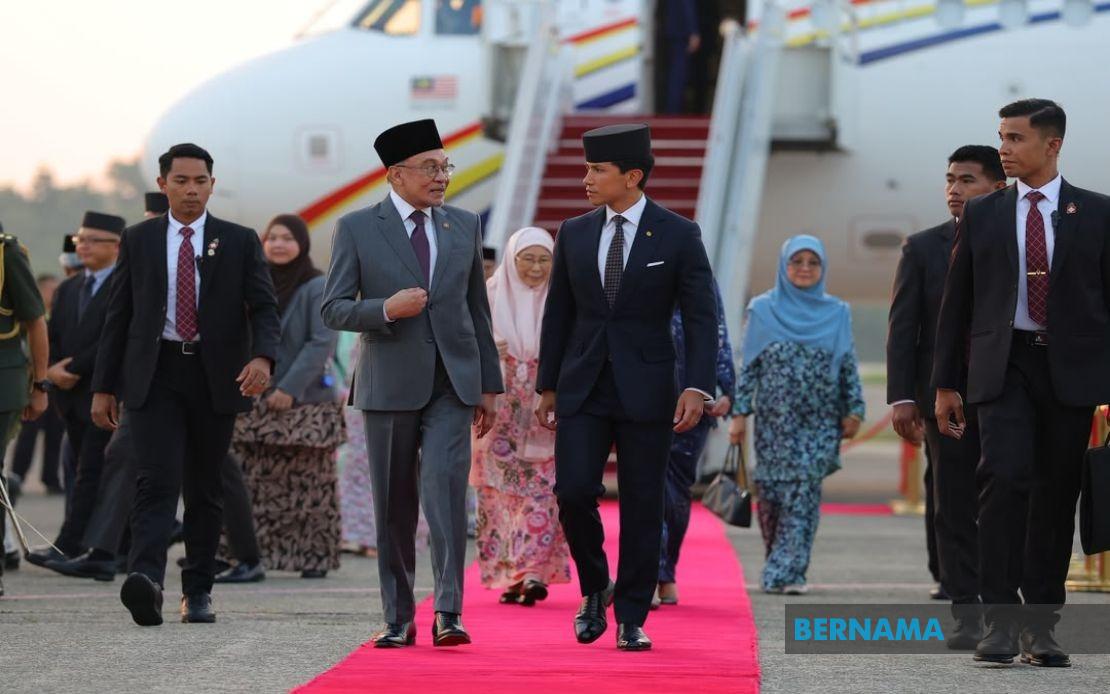
Prime Minister Datuk Seri Anwar Ibrahim touched down in Brunei on August 21 for a two-day working visit centred on the 27th Annual Leaders' Consultation, the flagship bilateral engagement mechanism between Malaysia and its smallest ASEAN neighbour. The Malaysian leader's special aircraft, carrying his wife Datuk Seri Dr Wan Azizah Wan Ismail, landed at Brunei International Airport at 6.10 pm, where they were received by Brunei Minister of Foreign Affairs Prince Abdul Mateen Bolkiah. The arrival underscores the importance both nations place on maintaining high-level diplomatic dialogue despite their geographic proximity and deep historical ties.
The Malaysian delegation's arrival was marked by the presence of several senior government officials, reflecting the significance of the bilateral engagement. Foreign Minister Datuk Seri Mohamad Hasan, Foreign Ministry secretary-general Tan Sri Amran Mohamed Zin, and Malaysian High Commissioner to Brunei Datuk Mohd Aini Atan were among those on hand to greet the Prime Minister. This ceremonial reception demonstrates Kuala Lumpur's commitment to strengthening institutional relationships with Bandar Seri Begawan, a commitment that has been consistent across multiple administrations in Malaysia.
The centrepiece of Anwar's visit is scheduled for the following day, when he will be received in audience by Sultan Hassanal Bolkiah at the iconic Nurul Iman Palace. Beyond the ceremonial aspects, the two leaders are expected to engage in bilateral discussions, commonly referred to as four-eyed meetings, where sensitive and strategic matters can be discussed away from formal settings. This direct engagement allows both sides to address concerns, clarify positions, and build personal rapport that often proves instrumental in resolving disputes or accelerating cooperation initiatives.
A significant outcome of the visit will be the joint witnessing of a Memorandum of Understanding on disaster management cooperation. This agreement reflects the shared vulnerability of both nations to natural disasters and climate-related risks in the Southeast Asian region. By formalising disaster management protocols, Malaysia and Brunei are establishing frameworks that enable rapid response coordination, information sharing, and resource mobilisation should either nation face calamities. Given the region's exposure to flooding, typhoons, and other environmental hazards, such bilateral mechanisms carry practical importance beyond diplomatic symbolism.
The 27th Annual Leaders' Consultation serves as the apex platform for Malaysia-Brunei bilateral relations. Unlike functional working groups or technical committees that operate below the ministerial level, this consultation brings together the highest political leadership to assess the breadth of bilateral cooperation and chart new directions. The forum provides an opportunity for both leaders to review implementation of previous agreements, identify bottlenecks in ongoing projects, and initiate fresh initiatives. Additionally, it creates space for exchanging perspectives on regional security challenges, ASEAN cohesion, and global developments affecting mutual interests.
Economic ties between the two nations form a substantial component of bilateral relations, though trade figures reveal patterns worth examining. In 2025, total bilateral trade reached RM5.86 billion, comprising Malaysian exports of RM4.20 billion and imports of RM1.66 billion. The significant surplus in Malaysia's favour reflects the structural reality that Brunei's economy, while wealthy on a per-capita basis due to petroleum revenues, remains relatively small and import-dependent. However, the first half of 2026 recorded RM2.38 billion in trade, suggesting a pace that would slightly exceed the 2025 annual figure if maintained, indicating potential growth in bilateral commerce despite global economic uncertainties.
The trade imbalance favouring Malaysia holds important implications for both nations. For Malaysian exporters, particularly those in manufacturing, consumer goods, and food products, Brunei represents a reliable market with high purchasing power and relatively close cultural and regulatory alignment. Brunei's reliance on Malaysian imports reflects the complementary nature of their economies, with the sultanate's petroleum-driven economy creating demand for goods and services that Malaysian firms are well-positioned to supply. Conversely, Malaysia's imports from Brunei, while considerably smaller in volume, are strategically valuable, including energy products and specialised goods.
Beyond trade statistics, the Malaysia-Brunei relationship encompasses deeper strategic considerations. Both nations share maritime boundaries and must navigate questions of resource management, security, and environmental protection in adjacent waters. Brunei's position as the smallest ASEAN member means it has particular interests in maintaining a rules-based regional order that protects smaller states from being overwhelmed by larger neighbours. Malaysia, conversely, values stable relations with Brunei as part of maintaining broader ASEAN cohesion, particularly on issues where consensus is vital for regional credibility.
The timing of the 27th Annual Leaders' Consultation also situates Malaysia within broader Southeast Asian dynamics. As a regional heavyweight with significant economic and political weight, Malaysia's engagement with smaller neighbours like Brunei sends messages about its commitment to multilateralism and equitable partnership. This is particularly relevant given ongoing territorial and maritime disputes in the South China Sea, where ASEAN unity and principle-based approaches are essential for small states seeking protection under international law. Malaysia's consistent high-level engagement with Brunei reinforces the principle that size disparities need not dictate the character of bilateral relations.
Cultural and people-to-people connections complement official-level diplomacy between the two nations. Both countries share significant portions of their populations who have family ties across borders, similar religious and cultural values, and aligned developmental aspirations within the broader Islamic and ASEAN frameworks. These human connections create natural constituencies for cooperation and foster public support for bilateral initiatives. Educational exchanges, religious dialogue, and cultural festivals all strengthen the intangible fabric binding the two societies beyond formal agreements and trade transactions.
Looking ahead, the outcomes of this consultation will likely shape Malaysia-Brunei cooperation trajectories over the coming period. Whether discussions yield new agreements on digital cooperation, healthcare collaboration, or enhanced security coordination will indicate the depth of bilateral ambition. Given the post-pandemic emphasis on resilience and preparedness, both nations may use this platform to deepen crisis management frameworks that extend beyond natural disasters to include health security and economic shocks. The willingness of both leaders to commit high-level time and resources to this engagement suggests that bilateral relations remain a priority despite inevitable pressures from other regional and global concerns demanding leadership attention.

