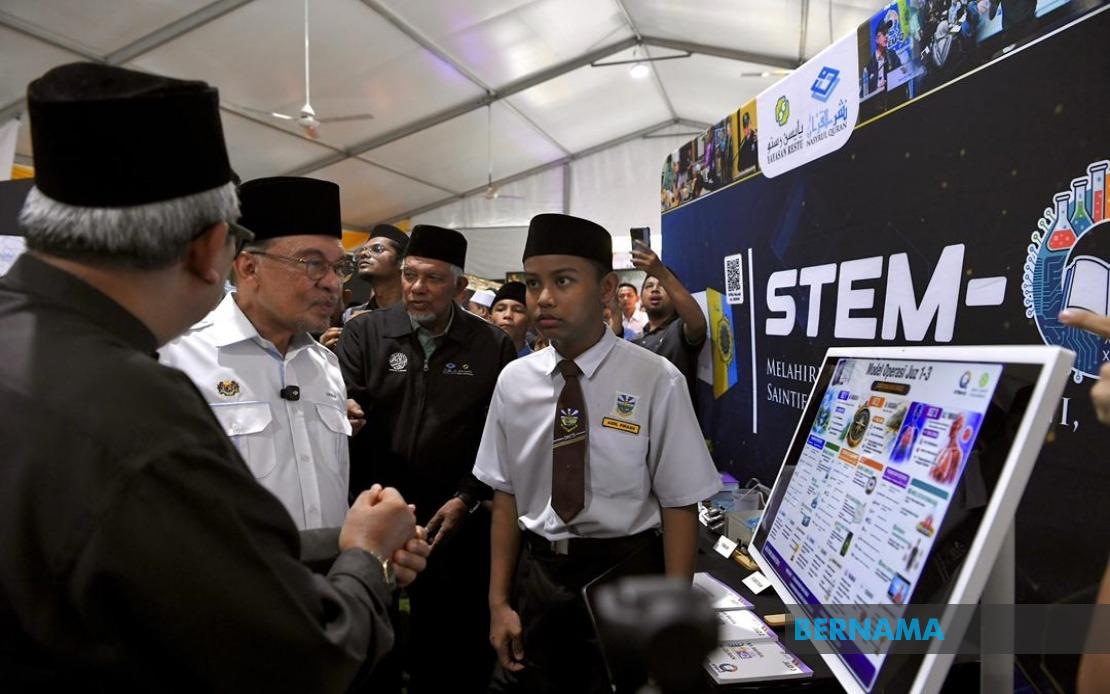
Prime Minister Datuk Seri Anwar Ibrahim has committed an additional RM4.6 million to bolster infrastructure at 27 Islamic educational institutions scattered across Penang this year, marking a significant escalation in the government's investment in religious education. The funding announcement, made during the National Tadabbur Perdana and Maidah Wanita MADANI Permatang Pauh programmes at Masjid Muhajirin in Butterworth, demonstrates the administration's continued prioritisation of strengthening religious facilities in the northern state.
The fresh allocation substantially surpasses last year's commitment, when the government channelled RM2.11 million towards upgrading works spanning just 11 Islamic educational institutions in Penang. This expansion of both funding volume and the number of beneficiary institutions reflects an accelerated tempo in the government's infrastructure development strategy for religious education across the state. Anwar, who holds the dual portfolio of Prime Minister and Finance Minister, underscored that the investment would be deployed across multiple categories of improvement initiatives to address varying institutional needs.
The scope of upgrading works encompasses a diverse range of infrastructure improvements critical to the functioning of these institutions. Projects earmarked for funding include structural repairs such as wall and fence construction, facility enhancements at madrasahs and schools, establishment of new kindergarten buildings, and development of tahfiz academies dedicated to Quranic memorisation programmes. This comprehensive approach recognises that religious institutions require not only basic maintenance but also expansion of their physical capacity to accommodate growing numbers of students and diversify their educational offerings.
Beyond the material dimensions of infrastructure development, Anwar articulated a broader vision for Islamic education that encompasses technological integration and intellectual advancement. He called for religious institutions to evolve in tandem with global technological developments, specifically highlighting the potential applications of artificial intelligence in enhancing Quranic and Islamic studies. This forward-looking perspective positions Islamic education not as an insular domain resistant to modernisation, but rather as a field capable of harnessing contemporary tools to deepen scholarly understanding and accessibility.
However, the Prime Minister introduced a crucial caveat regarding technological adoption in religious contexts. He emphasised that artificial intelligence and other technological systems must be anchored in robust moral and ethical frameworks rather than deployed purely for technical advancement. Anwar stressed that technology functioning in the Islamic educational sphere cannot be divorced from values and must remain rooted in principles of morality. This qualification reflects a nuanced understanding that while innovation can enhance educational delivery, it must always serve purposes aligned with Islamic ethical principles rather than becoming an end in itself.
For Malaysian policymakers and religious educators, this stance on technology in Islamic education carries significant implications. As Southeast Asian nations grapple with integrating digital tools into traditional educational frameworks, Anwar's articulation of a values-guided approach to technological adoption offers a template that prioritises ethical foundations. This becomes increasingly relevant given rapid AI advancement and the need for religious institutions to maintain their philosophical integrity while embracing beneficial innovations.
The government's investment strategy reflects deeper recognition that Islamic educational institutions serve as crucial pillars of religious knowledge dissemination and moral formation in Malaysian society. By directing substantial funds toward infrastructure enhancement, the administration signals its commitment to ensuring these institutions operate from positions of physical adequacy and institutional stability. For Penang specifically, the enhanced allocation acknowledges the state's significant Muslim population and the essential role that Islamic educational facilities play in community development.
Apart from infrastructure provisioning, Anwar encouraged broader public engagement in religious programming and knowledge-deepening activities. He promoted continuous organisation of Quranic classes, tadabbur sessions involving reflection on Quranic teachings, and religious talks designed to foster deeper comprehension of authentic Islamic scholarship. This emphasis on sustained educational engagement beyond formal institutional structures recognises that religious learning functions most effectively when supported by community-wide commitment and consistent participation.
The Prime Minister's remarks also touched on the crucial relationship between individual freedom and collective religious responsibility. He urged citizens to leverage the democratic freedoms enshrined in the Malaysian constitution to organise religious programmes that strengthen community understanding of Islam. This framing positions religious education not as something passively consumed through institutional provision alone, but as an active endeavour requiring public initiative and grassroots mobilisation.
For observers tracking Malaysia's approach to balancing modernisation with religious education, this funding allocation and accompanying statements signal a government attempt to demonstrate responsiveness to religious constituencies while maintaining commitment to contemporary standards. The doubling of infrastructure investment within a single year suggests either accelerated recognition of pressing needs or political prioritisation of religious education as a policy domain deserving elevated resource commitment.
The broader regional significance of Malaysia's investment in Islamic institutions extends beyond Penang. As Southeast Asian governments navigate questions of religious education quality, technological integration, and institutional development, Malaysia's approach offers relevant lessons. The emphasis on combining material infrastructure improvement with intellectual and technological advancement, whilst insisting on ethical foundations, presents a model that other Muslim-majority nations in the region may examine and adapt to their contexts.

