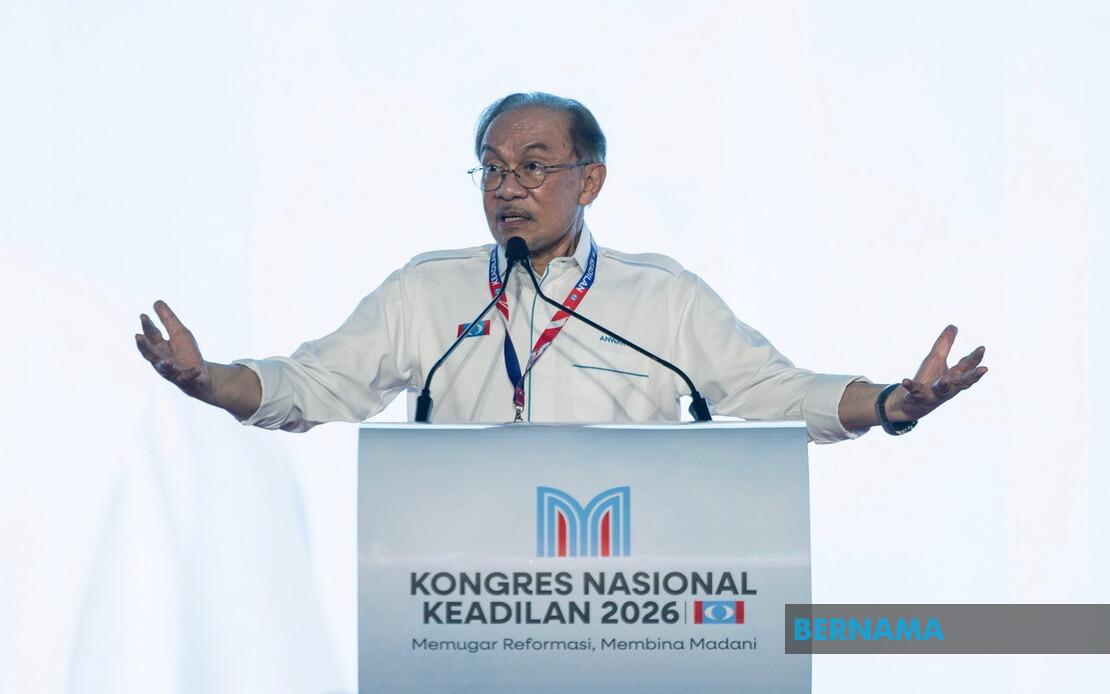
Prime Minister Datuk Seri Anwar Ibrahim has announced a fresh allocation of RM1 million for each of Malaysia's parliamentary constituencies, representing a significant expansion of direct government support flowing to local communities. The move was unveiled during his closing address at the PKR National Congress held at the Melaka International Trade Centre, signalling the MADANI Government's determination to translate national economic gains into tangible benefits felt by ordinary Malaysians across all regions.
The decision underscores an evolving approach to welfare delivery in which the federal administration seeks to bypass traditional bureaucratic channels that historically delayed the disbursement of assistance to communities. By directing funds straight to parliamentary constituencies, the government aims to empower local representatives and community leaders to identify and address pressing needs—from basic infrastructure repairs to emergency welfare support—without waiting for approvals filtered through multiple administrative levels. Anwar, who also serves as Finance Minister, framed this as essential to the MADANI agenda's core mission of citizen-centred governance.
This announcement arrives against the backdrop of multiple existing cash assistance programmes already implemented by the administration. The Sumbangan Tunai Rahmah (STR) and Sumbangan Asas Rahmah (SARA) schemes collectively represent RM16 billion in direct financial transfers, designed to cushion lower and middle-income households against persistent inflationary pressures. Rather than replacing these established initiatives, the new parliamentary constituency allocation functions as a supplementary channel, allowing targeted interventions at the hyperlocal level where small-scale but urgent community problems often fall between the cracks of larger nationwide programmes.
Poverty reduction remains a centerpiece of the administration's economic narrative. Anwar highlighted that Malaysia's hardcore poverty rate now stands at 0.09 per cent, a metric the government presents as evidence that macroeconomic stability is translating into improved living standards for the most vulnerable segments of society. However, the Prime Minister's acknowledgment that he wants government support to reach the grassroots suggests recognition that awareness of available assistance and actual take-up rates remain problematic challenges. Many eligible beneficiaries—particularly in rural areas and among elderly or less digitally connected populations—remain unaware of or struggle to access existing schemes.
The timing of this announcement carries political significance beyond its immediate fiscal implications. Delivered at the PKR party congress, the initiative signals to the party's grassroots membership and supporters that they will possess greater resources and discretion in responding to constituent concerns. For PKR members occupying parliamentary seats, the allocation enhances their capacity to deliver visible improvements in their constituencies, potentially strengthening their political standing ahead of future electoral cycles. This localized empowerment model represents a subtle shift toward rewarding parliamentary representatives with greater budgetary flexibility.
For Malaysian constituencies, particularly those in less developed regions or facing acute infrastructure deficits, the injection of direct funding offers genuine opportunity. A million ringgit per constituency, while not transformative at the national scale, can meaningfully address neighbourhood-level challenges—pothole repairs, community centre maintenance, emergency relief distribution, or support for small-scale welfare initiatives that municipal governments or local authorities might not prioritize. The cumulative effect across all parliamentary constituencies represents material investment in community infrastructure and social support networks.
However, the announcement's success hinges on implementation effectiveness and transparent allocation mechanisms. The risk exists that political considerations may influence how these funds are distributed, with constituencies governed by coalition government representatives potentially receiving swifter and more generous implementation compared to opposition-held seats. Malaysia's history of centralized decision-making raises questions about whether parliamentary constituencies will genuinely enjoy discretionary control or whether the Finance Ministry will impose conditions restricting how these allocations are deployed. Clear governance frameworks and accountability mechanisms will prove essential to ensuring the fund achieves its stated objectives rather than becoming another channel for patronage politics.
For Southeast Asian observers, Malaysia's parliamentary allocation model offers an instructive case study in decentralized welfare administration. Unlike purely centralized systems that require beneficiaries to navigate complex application processes, or pure devolution models that place entire responsibility on local governments, this hybrid approach channels federal resources through elected parliamentary representatives whilst maintaining central oversight. This reflects broader trends across the region as governments seek to reconcile the efficiency advantages of centralized planning with the responsiveness benefits of local knowledge and decision-making authority.
The Prime Minister's specific emphasis on reducing bureaucratic friction speaks to documented frustrations among Malaysian communities regarding slow-moving government assistance mechanisms. Previous programme evaluations have identified delays in fund disbursement, complex eligibility verification processes, and poor coordination between federal and state agencies as barriers preventing rapid delivery of promised support during emergencies or acute hardship periods. The new allocation, coupled with Anwar's explicit instruction that PKR party machinery explain these programmes and ensure beneficiaries receive assistance, suggests recognition that implementation culture must shift to emphasize speed and accessibility.
The announcement also reflects nuanced positioning within Malaysia's current political landscape. By framing the RM1 million allocation as complementary to existing social protection schemes rather than a replacement, the government avoids the appearance of scaling back its MADANI platform whilst demonstrating continued expansion of support mechanisms. This allows the administration to present itself as simultaneously prudent fiscal managers and committed welfare advocates—a delicate balance essential for maintaining middle-class support whilst demonstrating tangible commitment to lower-income voters.
Looking forward, the efficacy of this programme will depend substantially on whether parliamentary constituencies can mobilize these funds responsively and whether communities can overcome information barriers to access available support. Government party leaders will need to demonstrate that allocations reach intended beneficiaries equitably rather than concentrating resources in urban constituencies or those with more sophisticated administrative capacity. Regional disparities in implementation capacity—a persistent challenge throughout Malaysia—could otherwise exacerbate rather than reduce inequality across different constituencies.
For Malaysian policymakers and citizens alike, this initiative represents an experiment in welfare localism that extends beyond traditional cash transfer programmes. Success would validate an approach emphasizing parliamentary-level intermediation as a mechanism for responsive, efficient aid delivery. Failure would raise uncomfortable questions about whether decentralization creates accountability gaps and inconsistency that ultimately undermine programme objectives. As the MADANI Government implements this policy nationwide, its real measure of success will not be the announcement itself but whether communities genuinely experience faster, more seamless access to government assistance.

