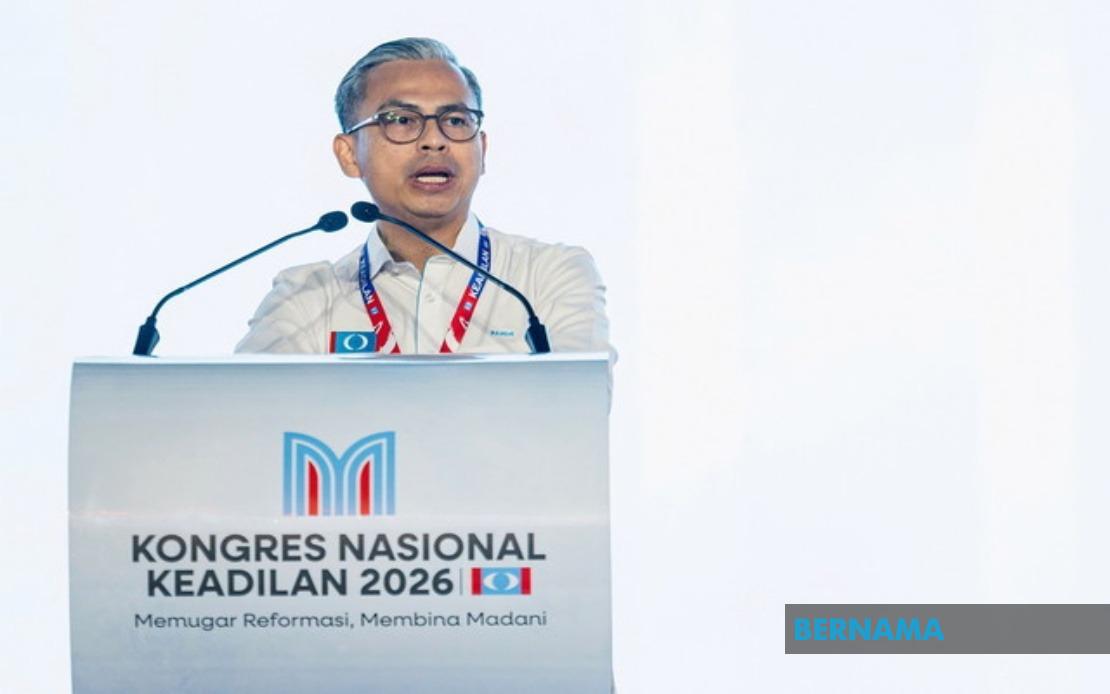
The governing coalition must do more to translate macroeconomic success into messaging that resonates with everyday Malaysians, according to PKR information chief Datuk Seri Fahmi Fadzil, who delivered this assessment during winding-up remarks at the party's 2026 National Congress in Melaka on Friday. Speaking on behalf of the PKR Central Leadership Council, Fahmi acknowledged a significant communication gap between the government's policy achievements under Prime Minister Datuk Seri Anwar Ibrahim and public perception of those gains, a problem he characterised as failing to bridge the gap between headline economic data and lived experience.
The Communications Minister framed the challenge as one requiring a deeper understanding of how Malaysians emotionally connect with government initiatives. While describing the government's macroeconomic record as a "pot economy"—suggesting prosperity at the aggregate level—Fahmi stressed that such achievements remain hollow if ordinary citizens cannot see how these translate into improved circumstances in their own lives. This diagnosis hints at broader political vulnerability for the coalition, particularly as it prepares for electoral contests and seeks to consolidate voter support ahead of potential state and general elections.
Fahmi outlined a multipronged strategy to address the communications deficit, beginning with enhanced coordination between the information machinery and grassroots party structures. Division chiefs and frontline party operatives will play a crucial role in filtering government messages to their communities, with the expectation that decentralised communication channels can better tailor national policies to local contexts. This approach recognises that top-down communications from Putrajaya often fail to penetrate the trust networks through which ordinary Malaysians actually learn and form opinions about government performance.
The party plans to significantly expand smaller-scale engagement forums where government officials and party leaders can interact directly with citizens in less formal settings. According to Fahmi, these intimate conversations allow for more nuanced explanation of complex policy matters while simultaneously providing officials with direct feedback on public concerns. Such formats circumvent traditional media filters and create space for two-way dialogue rather than broadcast-style announcements, potentially building stronger connections between policymakers and constituents.
Parallel to improving communication channels, PKR will intensify efforts to combat misinformation that exploits sensitive social fault lines. Fahmi noted that the Malaysian Communications and Multimedia Commission has identified over 8,410 fake accounts exploiting 3R issues—religion, race, and royal institutions—since the recent Johor state election. These coordinated inauthentic campaigns appear designed to manipulate public sentiment by weaponising emotionally charged topics, a tactic that undermines rational evaluation of government performance and creates unnecessary polarisation.
The fight against disinformation takes on particular significance given Malaysia's historically fractious ethnic and religious landscape. Malicious actors have previously exploited sensitivities around Islam, Malay-Muslim interests, and constitutional monarchy to generate political turbulence. By identifying and removing fake accounts engaged in such manipulation, MCMC aims to preserve informational integrity and prevent artificial amplification of divisive narratives that could destabilise the current coalition's political base or provoke intercommunal tension.
Fahmi also signalled a commitment to managing media relations through dialogue rather than confrontation, explicitly rejecting any suggestion that the government aims to control editorial content. Instead, he framed the approach as correcting demonstrably false information through respectful engagement with news organisations and journalists. This diplomatic framing responds to concerns—particularly among international observers and media freedom advocates—about potential government overreach in information management.
The Wanita PKR wing will receive renewed emphasis as a communication vector, reflecting recognition that women members often possess deep community connections and credibility within their networks. By integrating women's structures into the broader information campaign, the party hopes to amplify messages about government policies through trusted local voices while simultaneously strengthening internal party cohesion and member engagement.
These communications challenges carry significance beyond Malaysia's borders. As Southeast Asian governments confront rising public cynicism about whether growth translates into shared prosperity, and as disinformation campaigns proliferate across the region's fragmented media ecosystems, PKR's approach offers a case study in how ruling coalitions attempt to rebuild trust through strategic messaging. For Malaysian readers, the congress remarks reveal implicit concerns about coalition cohesion and public satisfaction with the current government's performance, suggesting that despite headline economic improvements, political risks remain substantial as the coalition prepares for future electoral contests.

