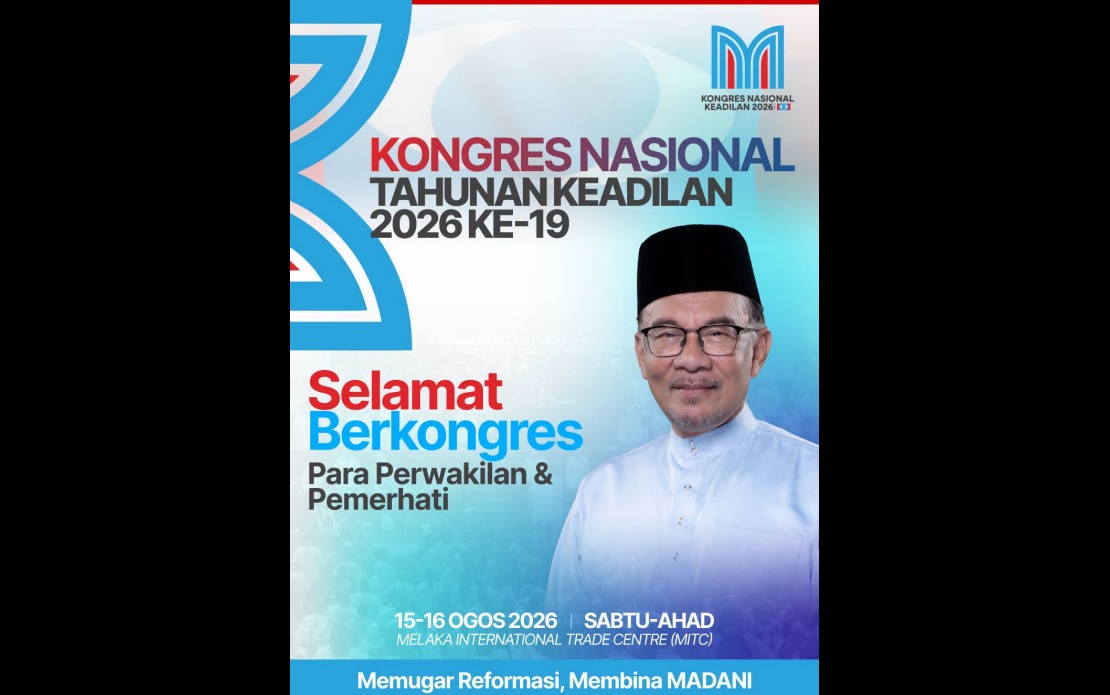
Prime Minister Datuk Seri Anwar Ibrahim has issued a fresh call for Parti Keadilan Rakyat to evolve beyond its role as a political machine designed solely to capture votes, instead positioning itself as a movement genuinely committed to advancing the welfare and trust of ordinary Malaysians. In remarks posted to his social media platforms, the PKR president stressed that the party's core mission should remain anchored to fundamental values including transparency, fairness in distribution of resources, cohesion among diverse communities, and the confidence that citizens place in their leaders.
Anwar's intervention comes as the party prepares to convene its biennial National Congress in Melaka, a gathering traditionally used by major political organisations to reassess their standing and chart direction. The emphasis on principles over pragmatism reflects growing concern within PKR's leadership about the party's trajectory in an increasingly competitive political environment where the temptation to prioritise short-term electoral gains can overshadow longer-term institutional and ethical commitments. His message underscores the tension many political parties in Southeast Asia face between maintaining ideological coherence and adapting to the demands of modern electoral politics.
The National Congress, scheduled to commence tomorrow at the Melaka International Trade Centre in Ayer Keroh, carries the theme "Memugar Reformasi, Membina MADANI," which translates to revitalising the reformasi movement while constructing the MADANI vision for Malaysia's future. This dual emphasis suggests PKR intends to reconnect with the reform impulse that gave birth to the party during Malaysia's political upheaval two decades ago, whilst simultaneously engaging with the government's contemporary policy framework. For Malaysian voters and regional observers, this balancing act matters considerably, as PKR remains the largest component of the ruling coalition and thus bears significant responsibility for translating reform rhetoric into tangible policy outcomes.
Anwar will formally open the congress and deliver a policy address that is expected to articulate PKR's strategic priorities moving forward. Such keynote speeches typically serve multiple purposes: rallying party faithful, signalling direction to coalition partners, and communicating the party's vision to the broader public. The timing and content of Anwar's remarks will be closely watched not only by PKR members but by observers monitoring the stability and coherence of Malaysia's governing coalition, which has repeatedly confronted internal fractures and competing agendas among its constituent parties.
The underlying concern flagged by Anwar touches on a persistent challenge facing political movements that transition from opposition activism to government participation. Once a party assumes responsibility for implementing policy, maintaining the ideological purity and grassroots energy that fuelled its rise becomes considerably more difficult. PKR's journey from the streets to ministerial offices has necessarily involved compromises, coalition-building with parties of differing ideological hues, and the unglamorous work of administration. These realities can erode the moral conviction that inspired the original reformasi generation.
For Malaysian readers, the substance of this message holds particular relevance given the country's ongoing democratic maturation and the persistent questions about governance standards. Anwar's insistence that PKR function as a movement rather than merely a vote-gathering apparatus reflects the view that political parties ought to serve pedagogical and civic functions beyond elections. A party conceived as a mass movement theoretically remains closer to grassroots concerns, more accountable to ordinary members, and more resistant to the tendencies toward patronage and factional infighting that plague many Malaysian political organisations.
The congress also provides an opportunity for PKR to address internal cohesion, a perennial challenge given the party's diverse membership spanning multiple ethnic communities and ideological perspectives. Maintaining unity whilst preserving integrity and commitment to social justice requires skilful leadership and genuine ideological scaffolding. The congress delegates, drawn from party branches across Malaysia, will assess whether the party's national leadership has credibly advanced these principles during its stewardship of government and within the coalition framework.
In the broader context of Southeast Asian politics, Anwar's exhortation carries implications for how regional democracies manage the evolution of political movements. Many parties across the region have struggled with similar transitions, and the tension between remaining true to founding principles and adapting to electoral realities remains unresolved. PKR's example will be instructive for other reform-oriented movements in the region contemplating entry into government or coalition arrangements.
The invocation of divine blessing in Anwar's statement, whilst culturally appropriate for Malaysian political communication, also signals the deeply moral framework within which he perceives PKR's mission. This framing suggests that the party's legitimacy ultimately rests not on electoral victories alone but on its fidelity to ethical principles and its ability to deliver material improvements in citizens' lives. Whether this aspirational vision can be sustained as PKR navigates the competing pressures of governance, coalition politics, and the perpetual cycle of electoral competition remains the central question for the party's future trajectory and relevance.

