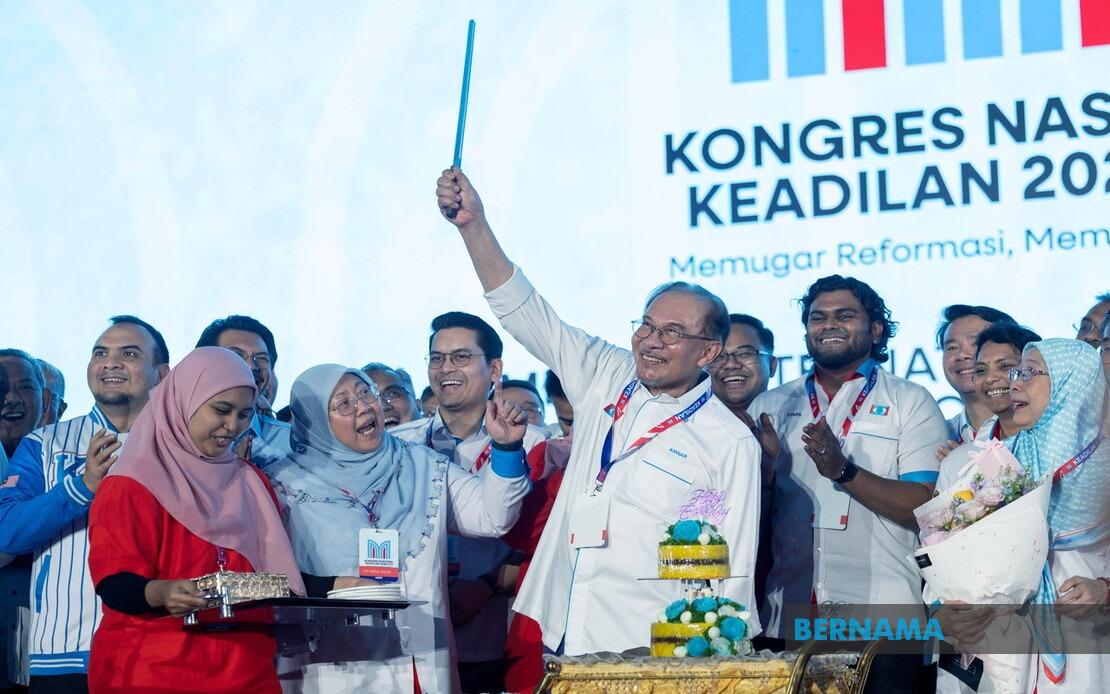
The PKR National Congress 2026 concluded in Melaka with the party's leadership articulating a carefully calibrated position: sustaining the fragile political equilibrium that underpins Malaysia's current governance structure whilst simultaneously preserving the transformative ideals that originally animated the party's founding mission. This balancing act represents perhaps the central challenge facing PKR as it navigates the complexities of coalition politics at the federal level.
Party president Datuk Seri Anwar Ibrahim used his closing address to underscore his personal commitment to the Unity Government framework, positioning political stability and economic advancement as preconditions for national prosperity. The Prime Minister's remarks appeared designed to reassure coalition partners, particularly those within UMNO and Barisan Nasional, about PKR's reliability as a long-term governing partner. However, Anwar carefully attributed any future trajectory of the cooperation to the strategic choices made by BN leadership, effectively distributing responsibility for the coalition's longevity beyond his party's unilateral control.
A significant theme permeating the congress centred on the perceived tension between holding ministerial office and maintaining organisational identity. Deputy president Nurul Izzah Anwar articulated this challenge directly, insisting that the reform mandate could not be suspended simply because PKR had transitioned from opposition to government. She pointed to the successful repeal of the Universities and University Colleges Act 1971 as tangible evidence that substantive policy change remained achievable within the current political architecture. This legislative victory carries particular resonance within Malaysia's student activist community and represents a landmark achievement for civil liberties advocates who have long opposed restrictions on campus organising.
The government's position on student activism and AUKU warrants close examination for Malaysian observers. Anwar's assurance that no replacement legislation would emerge to curtail student movements, coupled with his assertion that existing criminal law suffices to address misconduct, signals a deliberate recalibration of state-student relations. By framing students as equal citizens subject to standard legal provisions rather than as subjects requiring special restrictive statutes, the administration positions itself within a more permissive governance framework than its predecessors. Whether this represents genuine philosophical shift or tactical positioning ahead of potential electoral contests remains an open question.
PKR's institutional emphasis on organisational readiness without waiting for parliamentary dissolution or candidate nominations demonstrates sophisticated political management. The party appears to be preparing internal structures and messaging frameworks to respond swiftly to any electoral opportunity that may emerge, whether through anticipated elections or unexpected political shifts. This preparedness suggests PKR leadership recognises the provisional nature of current governing arrangements and seeks to maintain competitive advantage should the political landscape shift suddenly.
Gendered representation within party structures and government decision-making emerged as a priority concern voiced by PKR Wanita leadership. Education Minister Fadhlina Sidek's call for expanded space for women in leadership positions reflects both principled commitment to equity and pragmatic recognition that women constitute approximately half the party's membership. Her simultaneous emphasis on institutional openness to criticism—a notable appeal given occasional contentions within government circles regarding dissenting voices—suggests PKR seeks to model deliberative governance practices that could distinguish its approach from more centralised decision-making styles.
The generational dimension featured prominently through Angkatan Muda Keadilan's contributions to congress proceedings. AMK's focus on Bumiputera participation in emerging technology sectors—particularly artificial intelligence, semiconductors, and biotechnology—reflects both economic priorities and social inclusion concerns. These are precisely the high-value industries where Malaysia seeks greater domestic technical capacity and entrepreneurial participation. By connecting youth empowerment to technological advancement, PKR positions itself as forward-looking on economic modernisation whilst maintaining attention to distributive justice concerns central to Bumiputera policy frameworks.
AMK's identification of gig economy recognition, enhanced social protection mechanisms, skills development pathways, and mental health services as generation-defining issues speaks directly to anxieties confronting young Malaysians navigating labour market transformation. The gig economy has expanded substantially across Southeast Asia, yet regulatory frameworks and social safety nets have lagged considerably behind technological and commercial changes. PKR's parliamentary focus on these matters could shape how coalition partners address workforce transitions and social vulnerability in upcoming budget allocations and legislative priorities.
The congress's overall tenor suggested PKR leadership believes the party can maintain organisational coherence and activist credibility whilst functioning as a central pillar of federal governance. This represents an ambitious claim given the historical pattern whereby Malaysian parties in government gradually shed their transformative edges. Whether PKR constitutes an exception to this trajectory or merely delays inevitable institutional accommodation remains to be determined by subsequent policy execution and leadership choices across coming years. The party's willingness to champion controversial causes like student freedoms and gig worker protections will provide measurable tests of these commitments.

