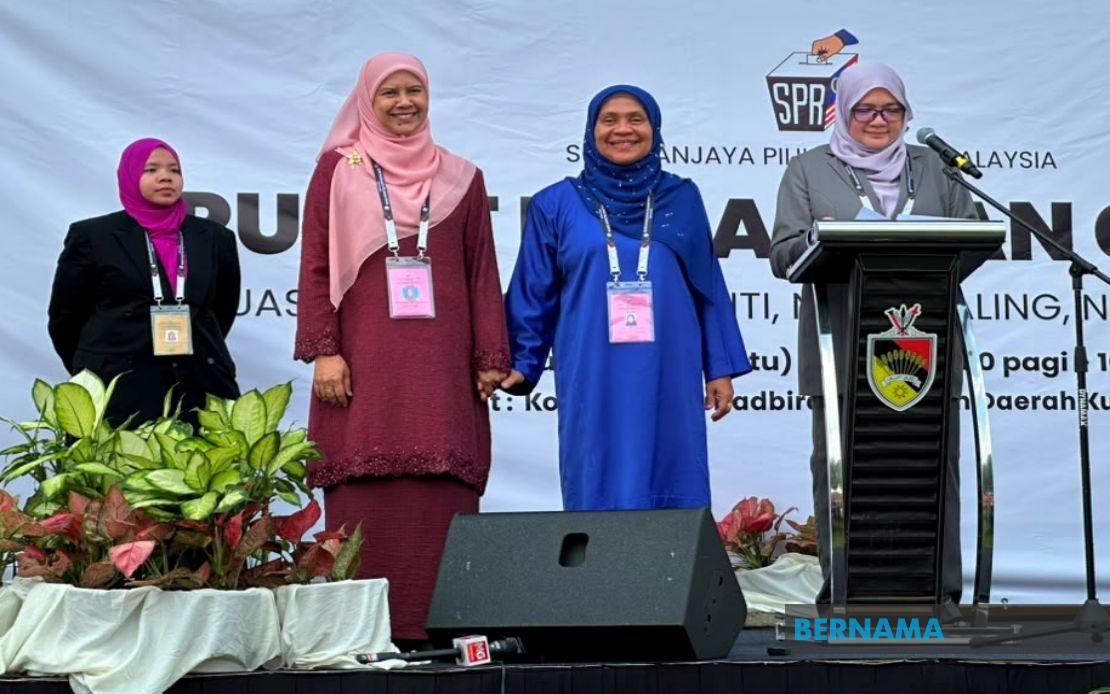
Negeri Sembilan's Pilah state constituency will make electoral history as the battleground for a straight contest between two women candidates in the 16th state election, marking a significant moment for female political representation in the state. Incumbent Datuk Noorzunita Begum Mohd Ibrahim from Pakatan Harapan will defend her seat against Barisan Nasional's S. Leza Md Yasin, with both candidates having filed their nomination papers on July 18 at the Kuala Pilah District and Land Office. The nominations were processed by returning officer Nawal Mohammed Amin, with Noorzunita Begum submitting her documentation at 9.03 am followed by S. Leza nine minutes later, confirming the two-candidate lineup for what observers anticipate will be a closely watched race in the state assembly polls.
The Pilah contest represents one of several competitive dynamics taking shape across Negeri Sembilan's constituencies, with the state election featuring a mixed pattern of contest formats that reflect the current political fragmentation in Malaysia. Alongside the headline-grabbing all-female matchup in Pilah, the election commission has confirmed that three other constituencies—Juasseh, Seri Menanti, and Senaling—will witness three-cornered contests involving representatives from Pakatan Harapan, Barisan Nasional, and Bersatu. The Johol seat will remain a two-candidate affair between PH and BN. This distribution indicates that Bersatu's presence as a third force has penetrated select areas of the state, potentially fragmenting the opposition vote and creating unpredictable electoral scenarios.
In Juasseh, the contest will involve Mohd Aidil Abdullah representing Pakatan Harapan, incumbent Datuk Ismail Lasim defending his Barisan Nasional seat, and Bersatu's Mohd Zuhami Md Yusof competing for the constituency's support. This configuration presents a particular challenge for PH in a seat currently held by BN, as vote-splitting between the coalition and Bersatu could prove decisive. The Seri Menanti three-way race pits PH's Mohd Kamarul Arifin Mohd Wafa against sitting assemblyman Muhammad Sufian Maradzi of BN and Bersatu's Datuk Seri Megat D. Shahriman Zaharuddin, introducing an element of unpredictability into a traditionally competitive area. Similarly, Senaling will see Mohd Hanis Mohd Alimin from PH, Mohamad Qayyum Abd Jalil from BN, and Bersatu's Mohd Izzafi Khan competing for the seat.
The Johol straight fight between PH's Mohd Zailan Mohd Munawar and incumbent Datuk Saiful Yazan Sulaiman of Barisan Nasional represents a more traditional two-horse race format that still characterises several constituencies. This configuration offers clearer pathways for either coalition to secure victory without the complication of vote fragmentation, though the outcome will depend heavily on ground sentiment and local campaign dynamics. The mix of straight fights and three-cornered contests across Negeri Sembilan underscores the shifting political landscape in which traditional two-coalition dominance has begun to yield to multi-party competition in select constituencies.
Pakatan Harapan's campaign efforts received visible high-level support as PKR Wanita chief Fadhlina Sidek, who holds the position of Education Minister, personally accompanied PH candidates through the nomination process. Her presence signals the coalition's commitment to the state contest and reflects broader efforts to mobilise government figures for campaign activities. Alongside Sidek, Angkatan Muda Keadilan vice-chief Dr Mohammed Taufiq Johari, who serves as Youth and Sports Minister, lent his support to the nomination proceedings. Deputy Investment, Trade and Industry Minister and Bayan Baru MP Sim Tze Tzin also attended, demonstrating the breadth of federal-level backing for the coalition's Negeri Sembilan campaign. Such ministerial presence at the nomination stage typically serves to energise grassroots supporters and signal confidence in the candidates fielded.
Barisan Nasional marshalled similarly prominent political figures to support its candidates during the nomination process, with Deputy Home Minister and UMNO Supreme Working Council member Datuk Seri Dr Shamsul Anuar Nasarah playing a leading role. Perak Menteri Besar Datuk Seri Saarani Mohamad, who also chairs Perak UMNO, travelled to Negeri Sembilan to accompany BN candidates, indicating cross-state coordination and the significance attributed to the state polls within the broader UMNO organisational structure. The deployment of high-ranking figures from both coalitions underscores the competitive importance of the Negeri Sembilan election in the current political calendar.
The electoral timeline established by the Election Commission creates a compressed campaign window, with early voting scheduled for July 28 and polling day set for August 1. This compressed schedule—occurring just weeks after nomination day—requires candidates to maximise their campaign efforts across a short timeframe, placing particular pressure on ground organisation and voter outreach. The early voting provision allows registered voters unable to cast ballots on the main election day to participate several days earlier, a mechanism that has become standard practice in recent Malaysian state elections aimed at improving voter participation and convenience.
From a broader Malaysian perspective, the Negeri Sembilan state election carries significance beyond the state's boundaries as a potential barometer of voter sentiment in a mid-tier state. As a relatively smaller state assembly with limited seats, Negeri Sembilan nonetheless reflects electoral dynamics relevant to the wider region, particularly concerning the performance of PH and BN after various coalition realignments and policy disagreements. The competitive nature of multiple constituencies suggests neither coalition can take the state for granted, a pattern increasingly evident across Malaysian states as voter volatility and tactical voting have become more pronounced.
The presence of Bersatu candidates in multiple constituencies introduces an additional variable to the traditional PH-BN bipolar contest. Bersatu's positioning and electoral performance in Negeri Sembilan will provide insights into the party's capacity to establish itself as a meaningful third force beyond strongholds in other states. The three-cornered contests, particularly if they result in narrow victories driven by vote-splitting dynamics, could inform broader strategic calculations about coalition formation and electoral cooperation in future polls. For Malaysian observers tracking the evolution of the country's political landscape post-2022, the Negeri Sembilan results will offer valuable data points on voting patterns and inter-coalition competition.
The historic nature of the all-female contest in Pilah also carries symbolic weight within Malaysian politics, where women's representation in state assemblies remains relatively limited. The fact that this milestone occurs through competitive electoral processes—rather than through affirmative action or quota mechanisms—reflects genuine political mobilisation by female candidates within both major coalitions. The outcome of the Pilah race will likely influence discussions about women's political participation and candidacy patterns in future state elections, potentially encouraging both PH and BN to field more female candidates in upcoming contests. This electoral moment thus transcends the immediate question of who will represent Pilah and speaks to longer-term questions about gender representation in Malaysia's state-level politics.

