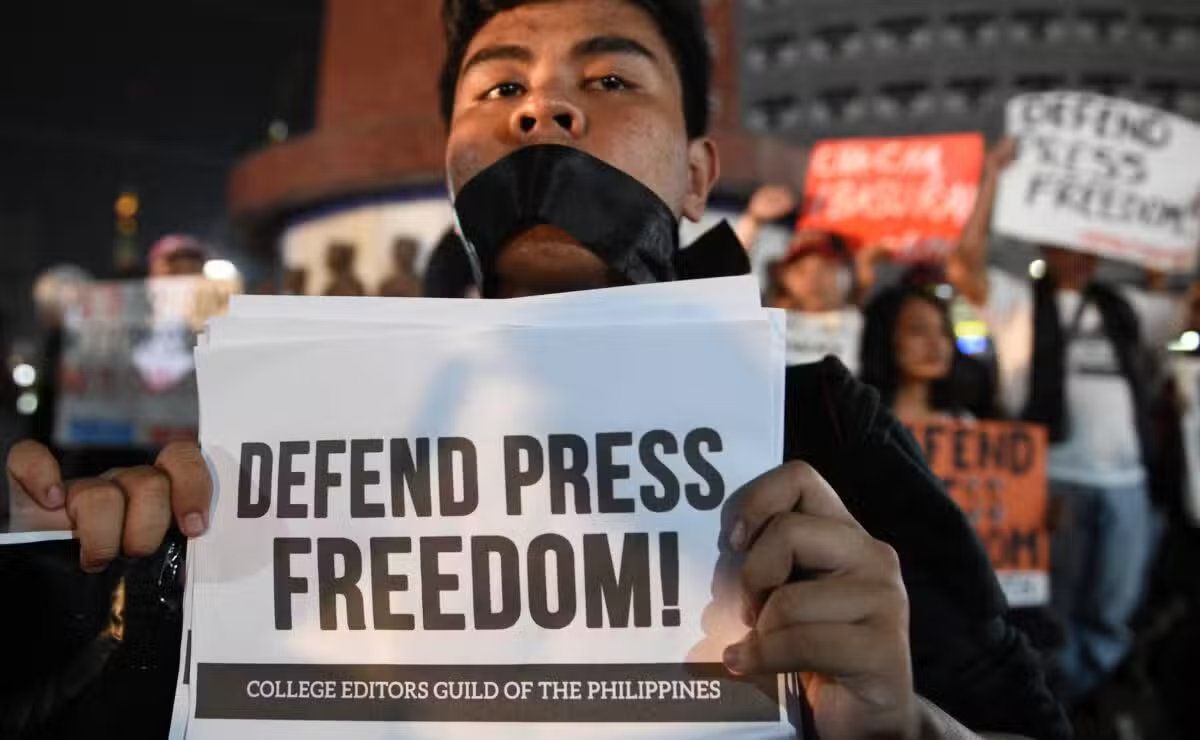
Nearly five years into President Ferdinand Marcos Jr.'s presidency, the National Union of Journalists of the Philippines (NUJP) has documented approximately 260 cases of violence and harassment directed at media practitioners. This spike in incidents reveals a troubling pattern that extends beyond raw numbers: the most vulnerable members of the journalism profession are increasingly becoming targets. The situation raises urgent questions about the health of press freedom in Southeast Asia's second-largest economy and the sustainability of independent news gathering in the country's far-flung regions.
The statistics mask a deeper crisis within Philippine journalism. Of the recorded attacks, more than 180 targeted journalists employed by local newspapers, community radio stations, independent media ventures, and campus-based publications. This concentration exposes a structural vulnerability in the nation's information ecosystem: those working furthest from major metropolitan newsrooms lack the institutional resources, corporate backing, and established legal support systems that protect journalists in the country's largest news organisations. The disparity between risks undertaken and compensation received creates a precarious situation where community journalists often operate on minimal budgets whilst facing threats that rival those experienced by their better-resourced counterparts in Manila.
Journalists working in provincial areas operate in fundamentally different circumstances than their urban colleagues. They report from communities where personal relationships blur professional boundaries, where the subjects of their investigations are neighbours and classmates, and where local political and business elites exert concentrated influence over daily life. This proximity creates what might appear to be an advantage—deeper community knowledge and access—but it simultaneously magnifies personal vulnerability. Without the protective buffer of large newsrooms, institutional legal teams, and broader publicity that might deter potential attackers, provincial journalists become isolated targets. Yet despite these formidable obstacles, community media workers persist in documenting stories that larger outlets overlook, often proving essential to holding local power structures accountable.
Jay Lavapiez, a 48-year-old radio broadcaster and station manager of Baskog Radyo in Roxas City, Capiz, embodies both the commitment and the peril facing community journalists. Last June, Lavapiez survived an assassination attempt when two men on a motorcycle blocked his vehicle and fired four bullets from a 9mm pistol. This violent incident did not emerge in isolation but rather as an escalation of harassment that began the previous year when he and his wife India, also a journalist, reported on a cemetery owned by a local official alongside broader allegations of administrative abuse and corrupt practices. Since those initial reports, multiple cyberlibel and libel cases have been filed against the couple and their staff across three separate jurisdictions—Manila, Muntinlupa, and Capiz—creating a grinding legal burden that adds financial strain to their already modest provincial salaries.
The weaponisation of the legal system against journalists represents a particularly insidious form of press suppression. Lavapiez articulates the multifaceted nature of threats facing community media: defamation lawsuits, online harassment campaigns, direct intimidation, anonymous threats, coordinated smear operations, and armed violence. Each of these tactics serves to narrow the space within which journalists can operate safely. The cumulative effect creates what researchers term a "chilling effect"—where journalists self-censor or abandon important stories to avoid the cascade of consequences. For provincial journalists, this calculation becomes uniquely painful because they cannot simply relocate to safer terrain. Unlike journalists in major cities who might transfer to different assignments or news organisations, community journalists are embedded in their localities. They walk the same streets daily, shop at the same markets, and encounter the people they cover in ordinary social contexts.
The economic dimension of this crisis cannot be overlooked. Provincial journalists typically earn modest salaries that do not reflect the heightened risks they assume. Lavapiez notes this disparity explicitly, emphasising that compensation rarely approaches the level appropriate for the dangers undertaken. This creates a troubling dynamic where those least able to afford expensive legal defence or security measures face the greatest threats. Conversely, larger news organisations can distribute risk across multiple journalists and access institutional resources unavailable to smaller outlets. This economic asymmetry means that press freedom becomes a luxury increasingly available only to well-capitalised news organisations based in major cities, whilst community journalism—arguably the most vital form of accountability journalism—becomes progressively more precarious.
The human cost of this deteriorating environment crystallises in individual cases. Community journalist RJ Ledesma was killed in April whilst conducting community work and investigating the impacts of renewable energy projects on agricultural communities in Toboso, Negros Occidental. He died as one of 19 people killed during a military operation that an independent fact-finding mission condemned for serious violations, including alleged indiscriminate fire despite supposedly having clear visibility of the scene. Ledesma's death represents not merely a tragedy but an indictment of the environment in which community journalists labour. His work investigating renewable energy initiatives positioned him as a chronicler of development projects affecting ordinary Filipinos—precisely the function that community journalism should perform in a healthy democratic society.
Lavapiez articulates what motivates journalists to persist despite the dangers: community journalism is fundamentally about obligation rather than financial reward. The driving force is the conviction that someone must pose difficult questions when public resources are deployed, and ordinary citizens lack platforms for their concerns. This civic commitment remains powerful precisely because it stems from genuine connection to place and community. Yet Lavapiez also highlights the profound irony embedded in this position: the closer journalists remain to their communities, the more vulnerable they become, because everyone knows where they work, live, and spend their time. This visibility, which creates reporting opportunities, simultaneously creates security vulnerabilities.
The situation for community journalists in the Philippines carries implications extending across Southeast Asia. As authoritarian pressures increase across the region, independent journalism retreats toward major urban centres where some institutional protections persist. This geographic concentration of press freedom means that vast provincial areas lose independent news coverage precisely when such scrutiny becomes most vital to constrain abuse. The Philippines' experience demonstrates how attacks on journalists function not simply as random violence but as a calculated strategy to suppress accountability mechanisms in areas beyond central state capacity. When provincial journalists are silenced, entire regions effectively lose access to independent information about governance, corruption, and abuse.
What makes the Philippine situation particularly concerning is that these attacks occur not under an explicitly authoritarian regime but under a democratic government that nominally respects press freedom. This suggests that threats to journalism can flourish even within formal democratic structures when institutional protections remain weak and political will to enforce them is absent. The Marcos administration has not systematically outlawed journalism or implemented formal censorship, yet the permissive environment for violence and harassment achieves similar suppressive effects. Journalists are not prohibited from reporting—they are simply made to fear the consequences of doing so.
Lavapiez's fundamental request is striking in its modesty: journalists simply seek the freedom to work without facing threats, harassment, prosecution designed to silence, or physical harm for asking questions. This basic demand reflects an understanding that press freedom represents a precondition for all other freedoms. Without journalists able to investigate and report without fear, accountability mechanisms cease to function, corruption flourishes unchecked, and ordinary citizens lose the information necessary for informed democratic participation. The fact that this elementary request remains unfulfilled in the Philippines—a self-described democracy—reveals how profoundly threatened press freedom has become in parts of Southeast Asia.
The path forward requires both immediate protection measures for journalists under threat and systemic reforms to restore institutional accountability. In the shorter term, the Philippine government must demonstrate serious commitment to prosecuting those who threaten, harass, or attack journalists. The filing of multiple libel cases against the same journalists for reporting truthfully on matters of public concern represents harassment rather than legitimate legal action and should be recognised as such by courts and authorities. Longer term, the Philippines requires strengthened legal protections for journalists, reformed defamation laws that align with international standards, and a cultural shift among local officials recognising that scrutiny represents a normal feature of democratic governance rather than a personal attack warranting retaliation. Without such reforms, community journalism will continue to hollow out, leaving vast regions of the Philippines effectively beyond the reach of accountability journalism.

