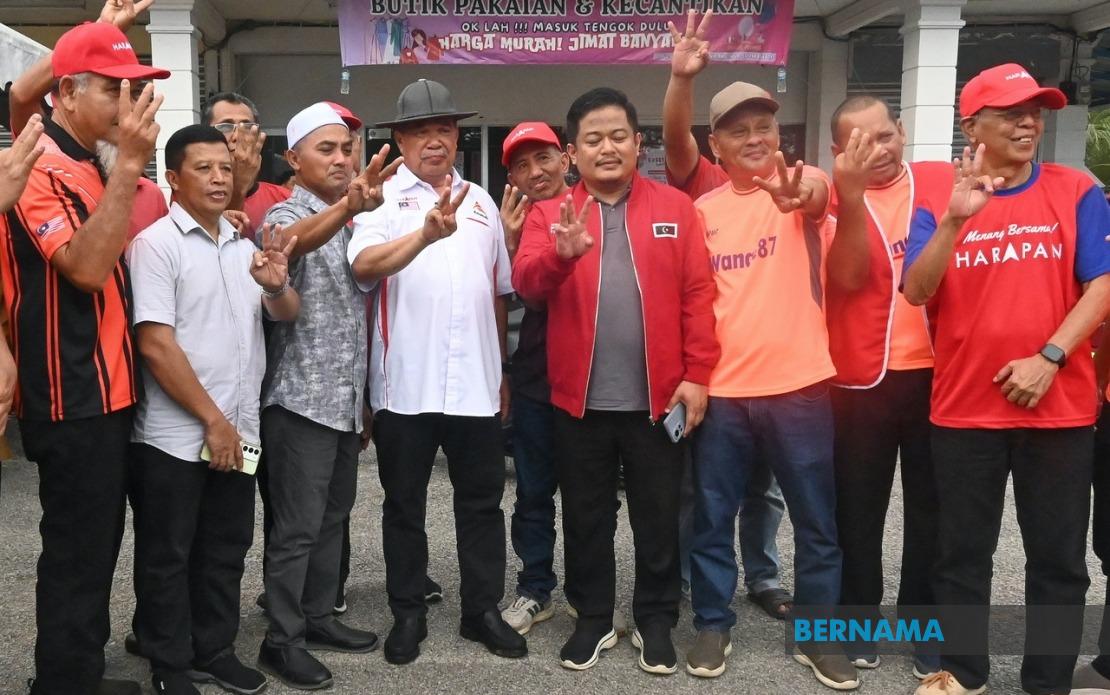
With the Johor state election scheduled for Saturday, July 12, Pakatan Harapan leaders are making a final push to convince voters that supporting the coalition's candidates is essential to transforming campaign promises into lived reality. Amanah president Datuk Seri Mohamad Sabu, speaking in Batu Pahat on July 6, framed the election as a critical test of the opposition's credibility, directly countering opposition claims that the PH manifesto is merely repackaged rhetoric rather than authentic policy commitment. The minister of agriculture and food security emphasised that manifestos are only meaningful when they reach implementation stage, and that voters must provide PH with a state government mandate to prove the coalition's sincerity on delivering tangible change across Johor's constituencies.
The timing of Mohamad Sabu's remarks underscores the intensity of the final campaign week, with early voting for security forces already underway and polling day mere days away. His address followed the Johor Tour with Bang Mat grassroots engagement programme in Rengit, suggesting that PH is doubling down on direct voter contact in local communities rather than relying solely on media messaging. The choice of venue—a market town in the southern state—reflects a strategic focus on reaching rural and semi-urban populations, demographics that have historically favoured BN governments and where PH faced significant challenges during the 2018 general election cycle.
Crucially, Mohamad Sabu acknowledged that the PH manifesto was developed through extensive consultation with communities across Johor, positioning the document as responsive to grassroots grievances rather than centrally designed policy. He argued that the coalition spent considerable time in the field gathering feedback on pressing local concerns—economic opportunities, infrastructure gaps, and service delivery deficiencies—and that the manifesto reflects these accumulated community inputs. This framing attempts to shift the narrative from abstract political ideology to practical problem-solving rooted in lived experience, a messaging strategy designed to appeal to voters prioritising tangible improvements over party loyalty or historical voting patterns.
The minister's confidence about implementation timelines is notably specific. He pledged that should PH succeed in the Johor polls, the coalition would begin translating manifesto commitments into governmental action by July 12 itself, the election date, signalling urgency and determination to avoid the paralysis of post-election administrative transitions. This immediate-action messaging addresses a vulnerability that opposition coalitions often face: voter scepticism about whether campaign promises survive the transition from campaigning to governing, particularly in states where the incoming administration inherits bureaucratic structures and budgetary constraints established by the previous government.
An important subtext to Mohamad Sabu's campaign remarks is PH's apparent perception of improving electoral momentum in rural Johor. The minister noted a marked shift in public reception compared to 2018, when the coalition remained relatively unknown in village and countryside constituencies. He described qualitative improvements in voter engagement, including spontaneous greetings and requests for photographs, suggesting growing familiarity and possibly reduced partisan resistance. This narrative of expanding acceptance has psychological weight in campaign contexts, as voters often respond to perceptions of rising support by joining perceived winning coalitions—a phenomenon known as bandwagon effects in electoral research.
The 2023 Johor election carries particular significance for Malaysian politics beyond the state itself. The state remains economically important and strategically located opposite Singapore, making its governance performance visible to neighbouring countries and international investors. For Pakatan Harapan, capturing Johor would represent a historic breakthrough in a state that has been a BN stronghold for decades, fundamentally reshaping the national political balance and validating the coalition's claim to represent a durable alternative government. Conversely, failure to make substantial gains would undermine PH's momentum heading into future federal electoral contests and reinforce narratives about the coalition's regional limitations.
The opposition's criticism that the PH manifesto amounts to mere copying reflects deeper questions about political differentiation in Malaysian elections. Opposition parties have challenged whether PH's policy positions genuinely differ from established BN governance approaches or merely rebrand familiar initiatives under new messaging. Mohamad Sabu's response—that substance emerges through implementation rather than document design—sidesteps this critique somewhat, essentially arguing that voters should judge PH on execution rather than comparative textual analysis. This is a shrewd rhetorical move because it shifts evaluation criteria away from areas where the coalitions may have overlapping positions toward demonstrable performance, where incumbent parties always carry disadvantages.
The agriculture minister's emphasis on the manifesto originating from listening to ordinary residents also serves a democratisation purpose within PH's own coalition politics. By framing the document as bottom-up rather than elite-driven, Mohamad Sabu legitimises it across the ideologically diverse coalition members, from Amanah's reform-oriented faction to DAP's urban progressives to PKR's broad-based tent. This internal cohesion matters because voters frequently punish coalitions perceived as fractious or internally divided, and presenting unified purpose around a community-derived manifesto helps project stability and seriousness to swing voters.
The road to July 12 will likely see intensified focus on whether PH can overcome traditional Johor voting patterns, particularly in constituencies where generational change may be accelerating. Younger voters, who lack strong historical memories of PH's 2018-2020 federal tenure and may judge parties primarily on current proposals, could prove pivotal. Rural voters increasingly exposed to non-traditional media sources and social networks may also be more receptive to coalition messages than previous electoral cycles suggested. Mohamad Sabu's insistence that the manifesto represents genuine commitment to implementation is ultimately an appeal for voters to take a calculated risk on an alternative, armed with the assurance that the coalition will be held accountable by delivering on specific promises.

