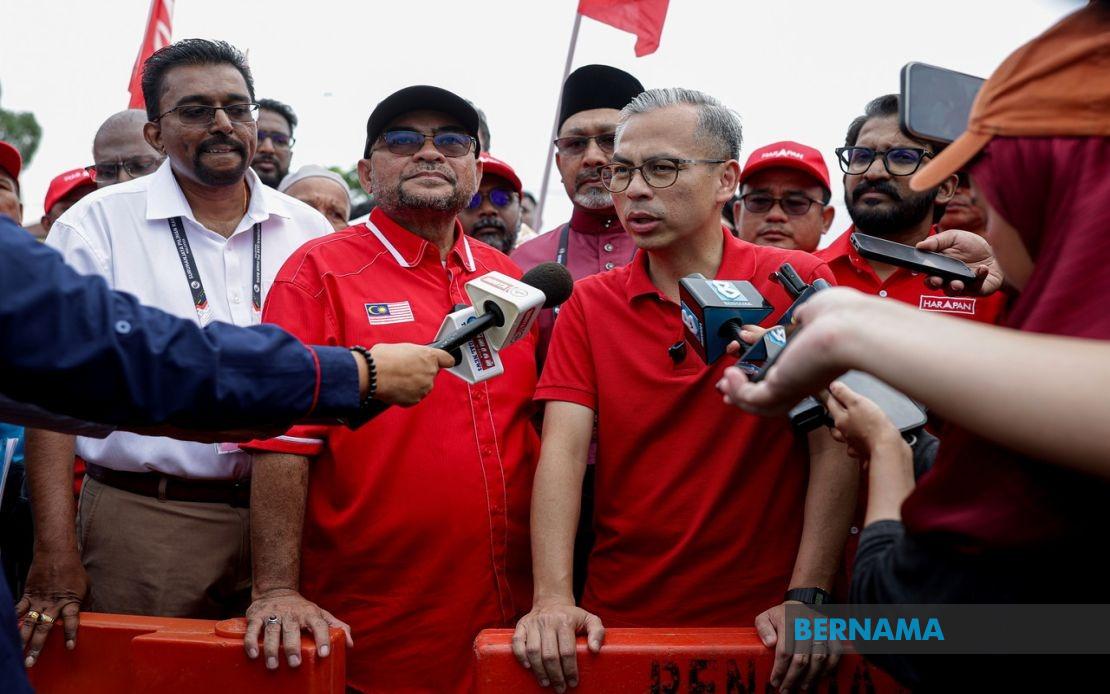
Pakatan Harapan is charting a focused campaign strategy for the upcoming Negeri Sembilan state election, anchored squarely on the administration's economic record and the leadership of Menteri Besar Datuk Seri Aminuddin Harun. PH Communications director Datuk Seri Fahmi Fadzil unveiled the coalition's approach following the candidate nomination process for four state constituencies under the Jempol parliamentary area, signalling that the campaign narrative will emphasise stability and proven governance rather than populist pledges or oppositional attacks.
The coalition's central argument revolves around tangible economic outcomes delivered during Aminuddin's tenure since taking office in 2018. Fahmi pointed to several measurable achievements: increased zakat collections reflect enhanced state revenue management, the state government's improved revenue collection demonstrates fiscal competence, and the consistent attraction of foreign direct investment—including a new port development—signals investor confidence in Negeri Sembilan's economic trajectory. These metrics serve as the cornerstone of PH's pitch to voters that continuity under the current administration offers the surest path to sustained prosperity.
This emphasis on continuity rather than transformation reflects a broader calculus within PH's electoral positioning. In a state where the ruling coalition has demonstrated administrative effectiveness, the party faces less pressure to promise radical change and more incentive to convince voters that disrupting the current arrangement poses unnecessary economic risks. For Malaysian voters increasingly focused on cost-of-living pressures and employment prospects, such messaging carries weight—economic performance becomes the primary lens through which governance is evaluated, transcending ideological or partisan considerations.
The election will test this strategy across diverse constituencies with distinct demographic compositions. In Jeram Padang, where PH fielded G. Manivannan, a lawyer serving as political secretary to Prime Minister Datuk Seri Anwar Ibrahim, the campaign will pivot toward employment and economic opportunity for younger voters. This targeted approach acknowledges that a four-way contest—featuring BN's incumbent Datuk Mohd Zaidy Abdul Kadir, Bersatu's R. Sri Sanjeevan, and independent Orang Asli candidate Dayana Dal—demands nuanced messaging beyond broad state-level narratives. Youth employment, particularly in emerging sectors, becomes the local battleground where national economic policy meets constituency-level concerns.
The candidate slate itself reflects PH's broader strategic calculations. Fielding someone with direct access to the Prime Minister's office signals the coalition's commitment to translating Negeri Sembilan's priorities into the federal decision-making apparatus. This interconnectedness between state and federal leadership—with Manivannan positioned as a bridge between Jempol constituents and Kuala Lumpur's power structures—subtly reinforces the continuity message. Voters are implicitly told that maintaining a PH state government ensures their voices carry weight in Putrajaya's corridors.
Across the other constituencies, contest configurations vary significantly. Serting and Palong feature three-way contests, while Bahau presents a direct confrontation between PH's incumbent Teo Kok Seong of DAP and BN's Chong Fui Ming of MCA. These differing dynamics require calibrated messaging—three-way contests demand clear differentiation from splinter competitors, while straight fights allow PH to concentrate fire on a single opponent. The nomination process itself proceeded without incident, suggesting organizational discipline within PH's machinery, a factor that may translate to smoother campaign execution in the coming fortnight.
Fahmi's role as Communications Minister adds institutional weight to PH's campaign oversight while simultaneously positioning the federal government as invested in the state election's outcome. This dual capacity—party communicator and government minister—exemplifies how Malaysian electoral politics frequently blurs the boundary between state and party machinery. The minister's explicit reminder to all stakeholders to maintain campaign decorum, particularly regarding sensitive subjects touching on Religion, Race, and Rulers, reflects awareness that regional elections increasingly occur within polarized national contexts where local contests become proxies for broader ideological battles.
The two-week campaign window, culminating in polling on August 1 following early voting on July 28, compresses the timeframe for voters to absorb competing narratives. In such compressed cycles, campaigns built on easily communicated themes—like economic continuity—possess inherent advantages over those requiring extensive explanation or ideological persuasion. PH's decision to make Aminuddin's track record the campaign centrepiece reflects recognition that voters processing information rapidly will gravitate toward straightforward, results-oriented messaging.
For Southeast Asian observers and Malaysian business stakeholders, this election carries implications extending beyond Negeri Sembilan's borders. The state's economic performance—particularly regarding FDI attraction and port development—contributes to Malaysia's regional competitiveness narrative. PH's emphasis on these achievements suggests the coalition anticipates using the state election as evidence of federal-level economic competence, potentially influencing national perceptions as the government heads toward federal elections. Negeri Sembilan thus becomes a laboratory where PH's economic governance narrative is tested at the ballot box.
The presence of Bersatu and independent Orang Asli candidates complicates the electoral landscape beyond a simple binary PH-versus-BN contest. Bersatu's participation, despite its coalition history with PH, reflects the party's attempts to maintain political space and relevance in state-level politics. The fielding of an Orang Asli candidate in Jeram Padang specifically addresses indigenous representation, a constituency that Malaysian political parties have historically marginalized in campaign messaging. These multi-cornered contests signal an increasingly fragmented electoral marketplace where swing voters face genuine choices beyond the traditional two-coalition framework.
Fahmi's commitment to monitoring media practitioner welfare throughout the campaign period underscores awareness of press freedom issues during electoral cycles. This attention to journalistic conditions, emanating from the Communications Minister himself, potentially signals government responsiveness to international and domestic criticism regarding media independence. However, the simultaneous emphasis on avoiding fake news and slanderous reporting creates tension—while legitimate safeguarding misinformation, such framing can become justification for restricting critical coverage depending on implementation.
Looking ahead, the Negeri Sembilan election will yield insights into voter appetite for continuity versus change in post-2022 Malaysian politics. The federation's economic trajectory, shaped significantly by state-level governance, makes regional electoral outcomes consequential for national policy. If PH's continuity-focused campaign succeeds decisively, it strengthens the coalition's claim that competent administration resonates with voters more forcefully than oppositional populism, potentially informing national electoral strategy. Conversely, should significant gains accrue to BN or splinter parties, it would suggest voter appetite for change even in relatively well-performing states, complicating PH's electoral calculus as it prepares for future contests.

