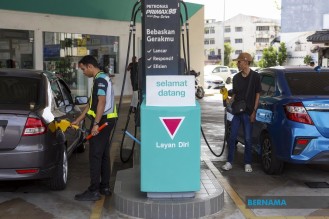
Fuel availability across Malaysia's Petronas petrol station network will remain adequate and stable through August, according to a statement by Datuk Seri Azalina Othman Said, Minister in the Prime Minister's Department (Law and Institutional Reform), delivered following deliberations at the National Economic Action Council (MTEN) on June 25. The reassurance comes as the government seeks to calm concerns about potential supply disruptions in the coming months, particularly given the volatile geopolitical situation affecting global energy markets.
Petronas Dagangan Bhd, the publicly listed subsidiary responsible for the retail distribution arm, oversees approximately half of Malaysia's domestic fuel consumption through its nationwide station network. This commanding market share underscores the critical importance of maintaining uninterrupted supply through the company's distribution channels. The stability forecast extends through the northern hemisphere summer and into early autumn, providing a concrete timeline for both consumers and businesses to plan their energy expenditure.
The government's confidence in fuel availability rests on official communications received directly from Petronas, which was tabled during the weekly meeting of MTEN. However, the timeline clarification proves significant—while earlier statements from Petronas had indicated supply guarantees only through June 2026, the ministerial statement now extends that horizon by two additional months. This extension suggests either improved supply arrangements or revised assessments of drawdown rates and inventory positions.
Recognising the complexity of global energy dynamics, particularly the instability stemming from the West Asia conflict, Malaysia's government has taken a proactive institutional approach. The establishment of a dedicated Crisis Management Task Force (PPPK) operating under MTEN signals serious intent to manage energy security comprehensively. This specialised unit goes beyond passive monitoring, positioning itself as an active coordinator of government responses to potential supply interruptions or price volatility.
The task force's mandate encompasses multiple dimensions of energy security. Beyond tracking fuel, petroleum, and energy supplies across the nation, it bears responsibility for maintaining supply resilience in subsequent months while simultaneously managing retail price pressures. Equally important are its enforcement functions—preventing fuel smuggling and other illicit activities that could drain legitimate supply channels or create parallel markets that undermine official price structures. For Malaysian consumers, this multi-layered oversight represents an effort to prevent the kind of shortages or price spikes that could ripple through the broader economy.
Diversification of crude oil sourcing represents another strategic pillar of Malaysia's energy security approach. Rather than relying heavily on West Asian suppliers, whose production and export decisions remain subject to geopolitical volatility, the government is actively pursuing relationships with crude producers in West Africa and the Americas. This geographic diversification reduces vulnerability to any single region's instability, though it introduces separate considerations around shipping distances, transportation costs, and crude quality specifications that must align with Malaysian refinery capabilities.
The commercial and technical dimensions of crude sourcing deserve closer examination. Not all crude oils are equivalent—their viscosity, sulphur content, and other chemical properties determine compatibility with existing refinery infrastructure. Sourcing from unfamiliar suppliers therefore requires careful quality assurance processes and may necessitate modifications to refinery operations. The government's explicit mention of "suitability of crude oil grades" indicates awareness of these technical constraints, suggesting that energy officials are conducting genuine due diligence rather than pursuing suppliers purely on the basis of availability.
For Malaysian businesses and consumers, the extended assurance period through August carries practical implications. Manufacturing operations reliant on fuel availability can proceed with greater confidence in their supply chains. Transport operators can more reliably forecast operational costs. Consumers face reduced immediate anxiety about fuel rationing or extreme price movements, though persistent global uncertainty means longer-term planning remains prudent. The two-month extension from the earlier June deadline also provides additional runway for the government to solidify alternative supply arrangements or respond to any unforeseen developments.
The geopolitical backdrop cannot be overlooked. The West Asia conflict continues to create significant uncertainty for global energy markets, with potential for further disruptions should the situation escalate. Malaysia's deliberate strategy to reduce exposure to this region's volatility reflects hard-learned lessons from previous oil crises and demonstrates strategic maturity in energy planning. By actively cultivating relationships with alternative suppliers now, rather than waiting for acute supply crises, the government aims to maintain stable prices and availability even if conditions in the Middle East deteriorate further.
The parliamentary question from Khairil Nizam Khirudin (PN–Jerantut), which prompted the ministerial response, reflected legitimate public concern about energy security contingency planning. The government's detailed response, addressing both the supply outlook and institutional mechanisms for managing crises, signals responsiveness to legislative oversight. However, the revelation that Petronas had previously indicated supply guarantees only through June 2026—a much shorter horizon than the August extension now promised—suggests that supply situations remain fluid and subject to revision as circumstances evolve.
Looking forward, the August deadline itself will likely prompt reassessment and fresh planning. Whether supplies beyond that point will prove adequate depends on factors partially beyond Malaysia's control, including global crude prices, production decisions by supplier nations, and the trajectory of geopolitical tensions. The government's establishment of permanent monitoring and coordination structures suggests recognition that energy security management cannot be episodic but must remain an ongoing operational priority throughout the coming years.

