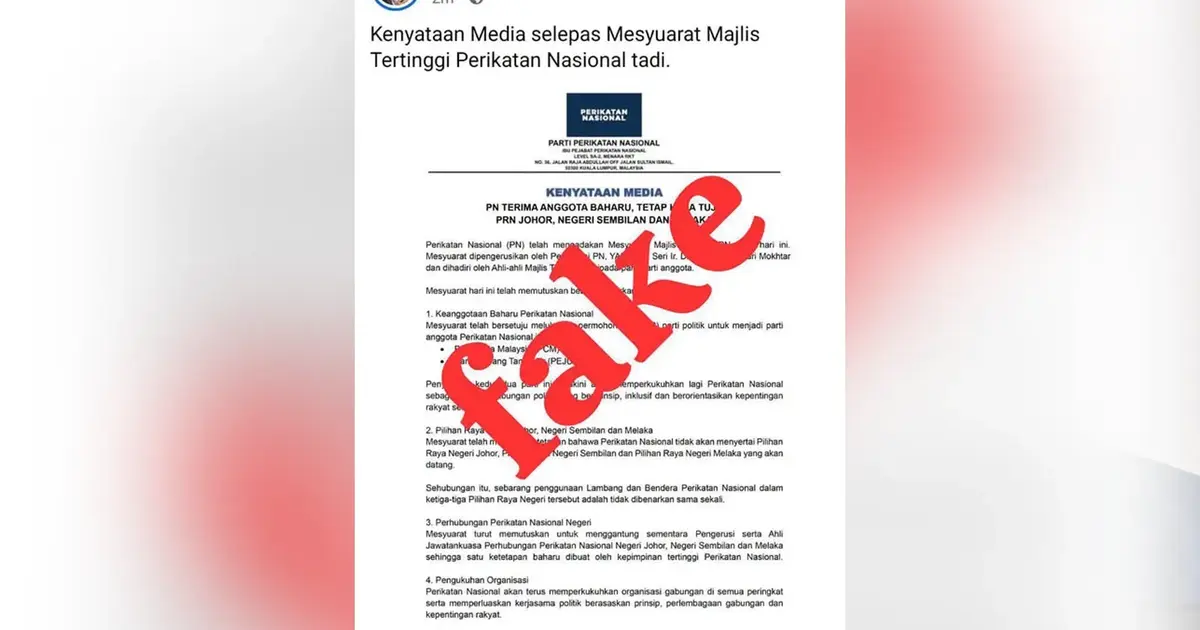
Perikatan Nasional moved swiftly to counter a fraudulent statement circulating online that alleged the political coalition intended to abstain from contesting three state elections, declaring the account wholly misleading and devoid of factual foundation. The denial underscores growing concerns about disinformation spreading through digital channels in Malaysia's political landscape, where unverified claims can quickly gain traction among voters and party supporters alike.
The emergence of such fabricated statements reflects a broader pattern of misinformation that has become increasingly prevalent during electoral cycles across Southeast Asia. Political opponents, fringe actors, and coordinated networks sometimes weaponize false narratives to undermine public confidence in political organisations and distort the electorate's understanding of parties' strategic directions. By issuing a prompt and categorical denial, PN aimed to neutralise potential damage to its credibility and reassure its base that leadership decisions remain authentic and uncompromised.
For Malaysian readers following domestic politics, the incident highlights how easily false claims can proliferate without proper verification mechanisms in place. Social media platforms, messaging applications, and online forums have become conduits for unvetted information, creating an environment where distinguishing between credible political statements and manufactured content has grown considerably more challenging. This dynamic places heightened responsibility on political parties to communicate directly with supporters and the media to prevent misinformation from taking hold.
PN's swift response reflects standard political crisis management, where denial must be accompanied by clear messaging about the party's actual intentions regarding electoral participation. In Malaysian politics, state elections carry significant weight as they determine control of regional governments and shape the balance of power within larger national coalitions. Any suggestion that a major coalition would voluntarily withdraw from such contests would represent a dramatic strategic shift warranting serious explanation and extensive party deliberation—precisely the kind of decision unlikely to be announced through unverified online statements.
The timing of such false claims often proves telling, frequently emerging at moments when political narratives are already contested or when electoral campaigns are approaching. Voters in affected states would logically be concerned about whether their preferred coalition intended to contest, making this type of misinformation particularly disruptive during periods of heightened political activity. By promptly labelling the statement inaccurate, PN sought to prevent confusion that might influence voting patterns or party recruitment efforts.
From a regional perspective, Malaysia's experience mirrors challenges facing democracies throughout Southeast Asia, where technological connectivity has outpaced institutional capacity to manage information flows responsibly. Countries including Thailand, Philippines, and Indonesia have encountered comparable waves of political disinformation, prompting some governments to invest in digital literacy initiatives and platform regulation. The Malaysian context differs in several respects, with a competitive media landscape and vocal civil society organisations that sometimes help expose fabrications, though systematic verification systems remain underdeveloped.
The perpetrators of such false statements may operate from various motivations: partisan competitors seeking to weaken PN's electoral prospects, domestic malcontents testing messaging strategies, or external actors interested in amplifying discord within Malaysian politics. Without forensic investigation into the statement's origin, PN and observers can only speculate about authorship. Nevertheless, the coalition's response assumes that forthright denial, coupled with a distinction between false and authentic communication channels, will suffice to restore accuracy in public discourse.
For party members and sympathisers, confusion introduced by fabricated statements can dent morale and create internal friction about leadership transparency. Conversely, critics might leverage such incidents to argue that PN's communication strategy remains vulnerable to manipulation or that the coalition has failed to establish sufficiently secure channels for official pronouncements. These secondary effects of misinformation often prove as consequential as the original false claim itself, affecting party dynamics and public perception beyond the specific factual dispute.
Moving forward, PN and other Malaysian political organisations face persistent pressure to adopt robust strategies for verifying and distributing official communications, whether through dedicated mobile applications, verified social media accounts, or partnerships with established news organisations. While technological solutions offer partial protection, cultivating a culture of critical evaluation among supporters and the broader public remains essential. Malaysian voters must develop reflexes for questioning unverified claims, particularly those making extraordinary assertions about party decisions without accompanying official sources or credible corroboration.
The incident also serves as reminder that electoral periods create heightened vulnerability to coordinated disinformation campaigns. Political campaigns, by their nature, generate contested narratives and competing claims about candidates' positions and parties' strategies. In such environments, distinguishing between legitimate political disagreement and deliberate falsehood becomes increasingly important. PN's statement, while categorical, represents merely one voice in a complex information ecosystem where multiple actors compete to shape perceptions and influence outcomes.
Ultimately, the coalition's rejection of the fabricated statement reflects necessary defensive action in contemporary Malaysian politics, where digital channels have become battlegrounds for narrative control. However, such reactive responses, however timely, cannot fully address the underlying structural challenges posed by misinformation. Comprehensive solutions would require collaborative efforts involving political parties, media institutions, technology platforms, and educational institutions working to strengthen information literacy and institutional safeguards across Malaysian society.

