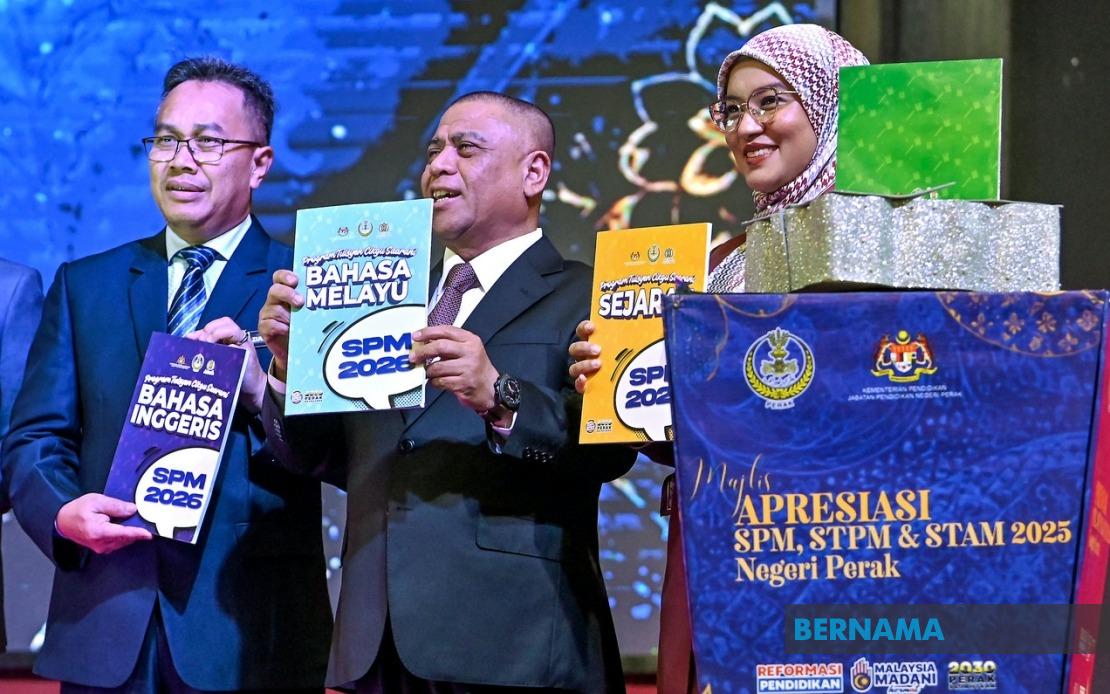
Perak's education system has reached a milestone not seen since 2012, achieving its best performance in the Sijil Pelajaran Malaysia (SPM) examination over a thirteen-year period. The state recorded a State Average Grade (GPN) of 4.49 in this year's results, marking the continuation of an upward trajectory that has now sustained for three consecutive examination cycles. The achievement underscores the effectiveness of strategic investments and coordinated efforts across the state's education sector to enhance learning outcomes across all communities.
Menteri Besar Datuk Seri Saarani Mohamad attributed the exceptional results to the collective commitment of educators, administrators, parents, and the broader school community in Perak. During the 2025 Appreciation Ceremony for SPM, Sijil Tinggi Persekolahan Malaysia (STPM), and Sijil Tinggi Agama Malaysia (STAM) students held in Ipoh, Saarani emphasised that these figures represented more than statistical success—they reflected a genuine transformation in how the state approaches educational quality and equity.
One of the most compelling aspects of Perak's performance lies in the narrowing of the achievement disparity between students in urban centres and those in rural areas. The gap between these two cohorts has shrunk to just 0.04 grade points, a remarkable convergence that suggests the state's initiatives to distribute educational resources and opportunities more equitably are bearing fruit. This differential is particularly significant for a state with Perak's geographic diversity, where rural students historically faced greater barriers to accessing quality instruction, modern learning materials, and extracurricular enrichment programmes.
Beyond the SPM examination, Perak's education system demonstrated strength across other qualification pathways. The state's STPM cohort achieved a Cumulative Grade Point Average (CGPA) of 2.91, surpassing the national average of 2.88. This performance is especially noteworthy as STPM results directly influence university admissions and are considered a strong indicator of a state's capacity to produce graduates prepared for higher education. The differential, while modest in absolute terms, reflects consistent above-average performance that compounds over cohorts and establishes Perak as a consistently high-performing state in this critical qualification stream.
Among the 1,336 students nationwide who attained a perfect CGPA of 4.00 in STPM, 116 originated from Perak—a proportion that exceeds the state's share of Malaysia's student population and indicates exceptional academic excellence at the upper end of the achievement distribution. Similarly, Perak's STAM results revealed a GPN of 3.03, with 36 candidates earning the coveted Mumtaz grade. The Mumtaz distinction, representing the highest attainment level in Islamic studies examinations, reflects both rigorous scholarship and the integration of religious education into Perak's broader quality agenda.
The Menteri Besar's remarks at the ceremony carried an important philosophical dimension beyond celebration of statistical achievement. Saarani stressed that examination results, while important, represent only one dimension of educational success. He called upon recipients to recognise that their individual accomplishments were interconnected with sacrifices made by teachers who prepared them, parents who supported them, and entire school communities that fostered their development. This framing is particularly relevant in the Malaysian context, where collective responsibility and acknowledging contributions from all stakeholders remain central to social cohesion.
The state's three-year upward trend in SPM performance is unlikely to be coincidental or attributable to single factors. Educational improvement typically emerges from sustained policy consistency, adequate resource allocation, professional development for educators, curriculum alignment, assessment refinement, and systemic support for struggling learners. That Perak has maintained this trajectory suggests institutional maturity and an embedded commitment to continuous improvement rather than ad hoc interventions. The state's performance also indicates that rural-urban equity in education—a persistent challenge across Malaysia—can be meaningfully addressed through determined action.
For Malaysian policymakers and education administrators nationwide, Perak's experience offers instructive lessons. The state demonstrates that narrowing achievement gaps between demographic groups is achievable without compromising overall performance—a result that refutes the false choice sometimes presented between equity and excellence. The fact that Perak simultaneously improved its state average while reducing the urban-rural differential suggests that targeted interventions for disadvantaged communities need not dilute standards elsewhere.
The recognition ceremony honoured 266 recipients including students, educators, schools, and District Education Offices (PPD), distributing credit widely across the system. This inclusive approach to acknowledgment reinforces the message that educational achievement emerges from ecosystem-wide contributions. Perak's sustained improvement also has implications for the state's economic development prospects. A population with stronger educational credentials and more equitable skill distribution enhances workforce quality and competitiveness in regional and global markets.
Looking forward, maintaining and building upon this trajectory will require continued investment and attention. Educational systems can plateau or regress if reform efforts lose momentum or funding becomes constrained. Perak's success over thirteen years since its previous peak suggests the state has developed institutional mechanisms and a culture of accountability that may sustain performance even through budget pressures or administrative transitions. Whether other Malaysian states can replicate Perak's three-year upward trend while simultaneously improving equity will be an important indicator of whether educational improvements are truly systemic and transferable.

