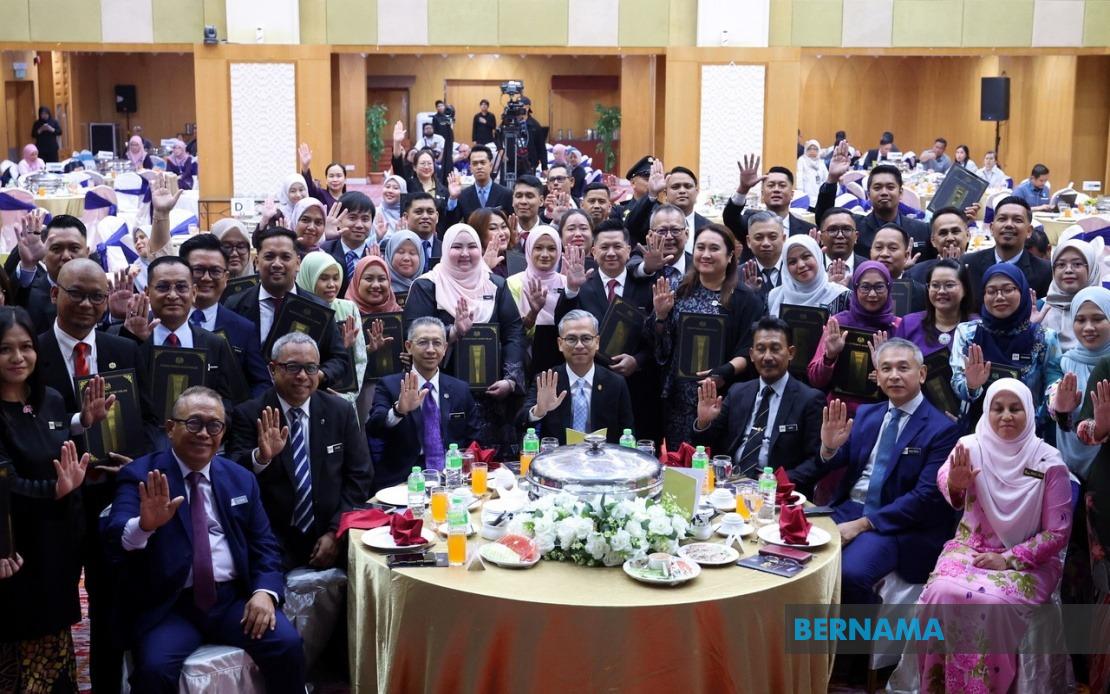
The MADANI Government remains steadfast in its commitment to the 'people's economy'—a philosophy centring on how national economic achievements translate into concrete improvements in citizens' everyday lives rather than remaining abstract statistics. Communications Minister Datuk Seri Fahmi Fadzil articulated this vision while addressing attendees at the Communications Ministry's Sabah and Labuan Zone Excellent Service Awards ceremony in Kota Kinabalu on Saturday, emphasising that strong macroeconomic fundamentals alone do not constitute success if ordinary Malaysians fail to experience the corresponding benefits.
The distinction Fahmi drew reflects a growing recognition within government circles that favourable national indicators—robust investment flows, healthy reserves, GDP expansion, and brisk trade volumes—can obscure the lived realities of citizens struggling with affordability and access. While both national and state-level economic metrics have demonstrated encouraging momentum, the minister underscored that policymakers must calibrate their assessments based on whether such growth actually improves household finances and quality of life. This reorientation signals a subtle but important shift in how the administration evaluates policy effectiveness, moving beyond conventional economic measurements towards a more granular understanding of distributional outcomes.
Fahmi illustrated this philosophy through the example of targeted subsidy programmes, particularly the diesel subsidy retargeting initiative branded as BUDI MADANI. He highlighted how such policies carry vastly different implications depending on geographic context and local circumstances. In states like Sabah and Sarawak, where substantial distances separate towns and districts, residents face unique challenges in accessing subsidised fuel compared to urban populations in more densely settled areas. These structural disparities demand that policymakers account for regional variations when designing and implementing economic programmes, a principle that Prime Minister Datuk Seri Anwar Ibrahim and his Cabinet apparently emphasise during deliberations.
The emphasis on people's economy represents more than rhetorical positioning; it reflects substantive concerns about whether development gains accrue equitably across Malaysia's diverse geography and demographic segments. Rural and semi-rural populations, particularly in East Malaysian states, have historically experienced slower benefit transmission from national economic growth owing to infrastructure limitations, transportation costs, and service delivery challenges inherent to dispersed settlement patterns. By explicitly naming these realities, Fahmi acknowledged that excellence at the national level requires corresponding excellence in implementation at the local and community level, where bureaucratic systems actually interface with citizens.
Crucially, Fahmi connected economic policy to the broader governmental responsibility for clear communication and public understanding. He argued that ministries and government agencies bear a duty to explain policies comprehensively and accurately, preventing misinterpretation or confusion that could undermine public confidence or programme effectiveness. This dimension proves particularly important for targeted subsidy schemes, which inherently involve complex eligibility criteria and implementation mechanics that ordinary citizens must understand to navigate successfully. Poor communication around such initiatives can create perception gaps between policy intent and perceived reality, potentially generating resentment even when programmes function as designed.
The sentiment expressed at the Sabah and Labuan zone awards ceremony aligns with broader MADANI administration messaging that distinguishes its approach from predecessors by prioritising distributional fairness and citizen experience. Rather than celebrating aggregate economic indicators in isolation, this framework insists that government evaluate success through the lens of whether citizens perceive concrete improvements in their purchasing power, service access, and economic security. For a government navigating complex ethnic, religious, and regional sensitivities, this people-centric approach offers potential political benefits by demonstrating responsiveness to tangible concerns rather than abstract metrics.
The regional focus on Sabah and Sarawak carries particular significance given historical grievances about development disparity and resource distribution between peninsula and East Malaysia. By specifically acknowledging the challenges faced by residents traversing long distances between districts and the corresponding complications for subsidy implementation, Fahmi signalled governmental awareness of these dynamics. Such acknowledgement, particularly from a senior federal minister, can help reinforce perceptions that the central government takes East Malaysian concerns seriously, though sustaining this sentiment requires consistent policy delivery and resource allocation over time.
The inclusion of various ministry officials and department heads at the awards ceremony—including the ministry secretary-general, senior division secretaries, directors-general from broadcasting and information departments, and deputy directors-general from related entities—underscores the whole-of-government nature of this people's economy initiative. Communications and information dissemination form critical components of ensuring that economic policies actually reach and benefit intended populations, requiring coordination across multiple institutional layers and organisational hierarchies. The ceremony itself, recognising excellent service standards, implicitly reinforced the connection between quality government delivery and effective policy implementation.
Moving forward, the challenge for the MADANI Government lies in translating this philosophical commitment into sustained action. People's economy principles require more than symbolic attention; they demand budget allocation prioritising equitable distribution, regulatory frameworks preventing unintended consequences in geographically dispersed regions, and bureaucratic reforms ensuring service delivery matches policy ambitions. For Malaysian citizens and regional observers evaluating government performance, the test will be whether this emphasis on felt economic benefits produces measurable improvements in household incomes, subsidy effectiveness, service access, and overall economic participation across all segments and regions, not merely in aggregated national statistics.

