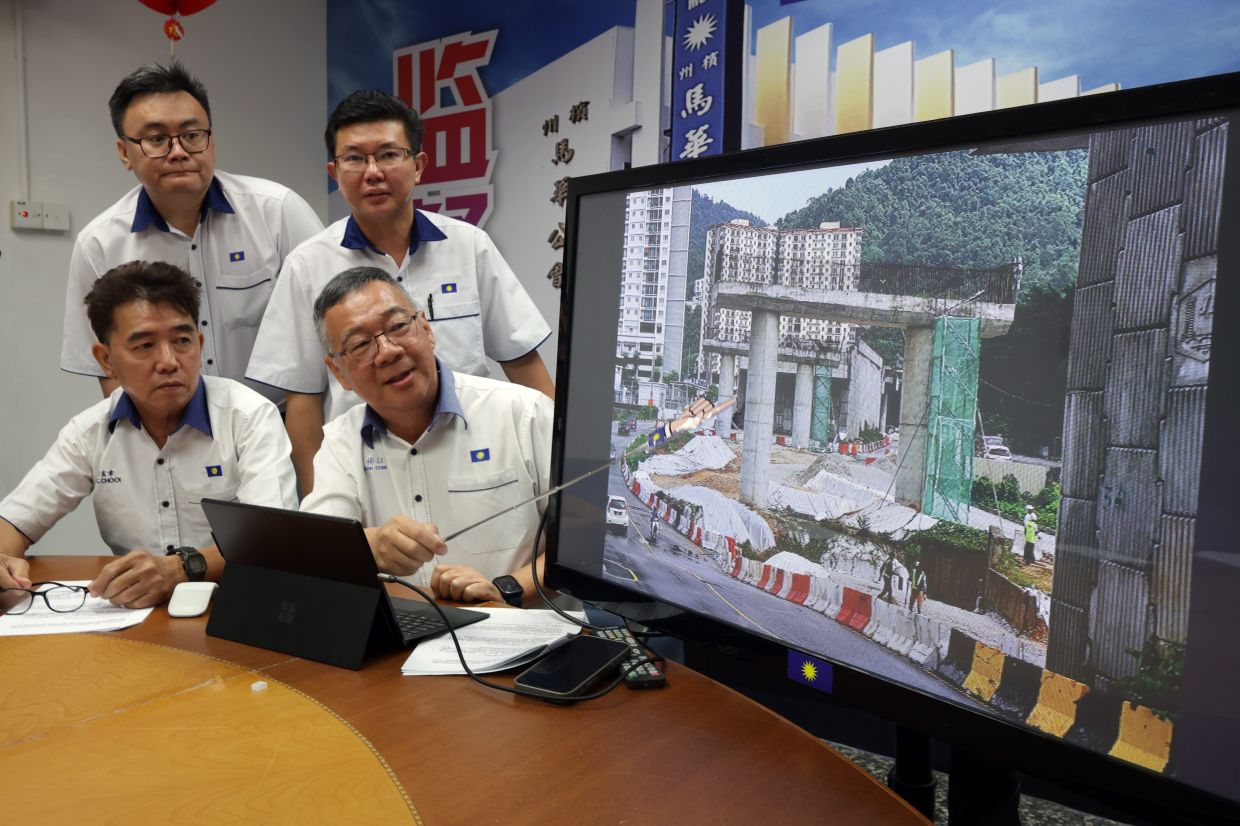
The Penang chapter of the Malaysian Chinese Association has escalated pressure on the state government over the contentious Air Itam-Tun Dr Lim Chong Eu Expressway bypass project, alleging significant inconsistencies between officially reported completion rates and the actual state of construction work visible on site. Party secretary Yeoh Chin Kah has issued a direct challenge to state authorities, demanding release of payment records, consultant certification documents and comprehensive project assessments within a week or face escalation to national anti-corruption bodies.
The dispute centres on competing narratives about project advancement. Government representatives characterised the undertaking as being in a "final sprint" phase, with completion jumping from 80 percent in May to 89 percent by December of the previous year. However, Yeoh's team conducted a site inspection on July 1 that revealed extensive gaps in actual construction, particularly across Valley Road, Changkat Tembaga and Jalan Thean Teik. The gap between stated progress and observable work has become the focal point of a mounting accountability row that extends beyond simple schedule management.
What Penang MCA observed during their field assessment paints a picture substantially at odds with official figures. While bridge structural supports—the piers—have been installed, critical components remain absent or incomplete. Bridge beams and decking have not been deployed across all sections, road surfacing continues unfinished, and essential safety infrastructure including guardrails and acoustic barriers are nowhere near completion in numerous areas. Mechanical and electrical systems integral to the expressway's functionality, along with connecting feeder roads, similarly lag behind schedules in many locations. These observations suggest the construction progression is considerably less advanced than the nearly 90 percent completion rate would suggest.
Yeoh framed the confrontation as fundamentally about public trust rather than logistical delays. Explaining delays is manageable—restoring confidence in government institutions when their assertions appear contradicted by observable reality is substantially more challenging. His ultimatum to furnish documentation carries weight because transparency becomes increasingly critical when there are questions about whether public resources have been efficiently deployed and properly accounted for throughout the project cycle.
The underlying infrastructure project itself represents significant regional ambition. The 6-kilometre toll-free expressway, formally designated Package Two of the broader Penang undersea tunnel and complementary road network initiative, will connect Lebuhraya Thean Teik in Bandar Baru Air Itam with the Tun Dr Lim Chong Eu Expressway through an engineered combination of elevated structures, underground passages and conventional roadways. For the approximately 300,000 residents distributed across Air Itam, Bandar Baru Air Itam and Paya Terubong, this infrastructure could materially reduce commute times and alleviate persistent traffic pressures that characterise the region.
However, the project's timeline has proven persistently optimistic. Original completion targets projected 2024 delivery, but the undertaking has since required two formal extensions, pushing the anticipated opening to April 12, 2027. These successive delays have inevitably eroded public confidence and heightened scrutiny from political actors representing affected constituencies. When Penang MCA threatens to lodge formal complaints with both the National Audit Department and the Malaysian Anti-Corruption Commission, they are signalling that conventional political dialogue has become insufficient.
Responding to the criticism, Paya Terubong assemblyman Wong Hon Wai offered a somewhat more optimistic assessment, indicating the project has actually achieved 91 percent completion and remains positioned for the April 2027 deadline. According to Wong, construction teams have committed to launching twelve bridge beams on the Gelugor section between the current month and August, with remaining structural elements scheduled for the final quarter. All bridge beams for the Bandar Baru Air Itam side have reportedly already been deployed, though Wong cautioned that construction completion will not automatically trigger immediate public access.
The distinction Wong drew between construction completion and actual opening is procedurally important. Subsequent to construction finishing, government agencies must conduct comprehensive Road Safety Audits, a standard protective measure for major infrastructure. Only following those evaluations can the Public Works Department advise on an appropriate opening date. This phased approach, while procedurally sound, introduces additional uncertainty into timelines and may frustrate residents already experiencing extended construction periods.
The fundamental challenge here reflects broader governance tensions in Malaysian infrastructure delivery. When official progress metrics and ground-level reality diverge substantially, public institutions face credibility deficits that extend beyond particular projects. Yeoh's demand for documentary evidence and Penang MCA's willingness to escalate disputes to federal oversight agencies indicates that local politics increasingly intersect with national integrity frameworks. For Malaysian readers following this saga, the outcome will signal how effectively anti-corruption mechanisms function when political opposition parties challenge government claims.
The controversy also highlights how infrastructure projects of regional significance become flashpoints for political accountability. Unlike technical delays that can be explained through engineering complexity or supply chain disruptions, discrepancies between reported progress and observable conditions suggest potential broader governance issues. Whether the gap represents intentional misrepresentation, inadequate monitoring systems, or simply differing assessment methodologies will determine how severely the reputational damage impacts the state government and whether federal oversight bodies become formally involved in investigating the project's management.
For the residents of Air Itam and surrounding neighbourhoods who have endured construction disruption for years, political disputes over completion percentages matter primarily insofar as they either delay opening further or ensure greater transparency about when relief will actually arrive. The April 2027 target now appears uncertain, and public confidence in official timelines has plainly deteriorated. Penang MCA's intervention suggests that without substantive transparency improvements, political pressure will only intensify, potentially complicating final project delivery.

