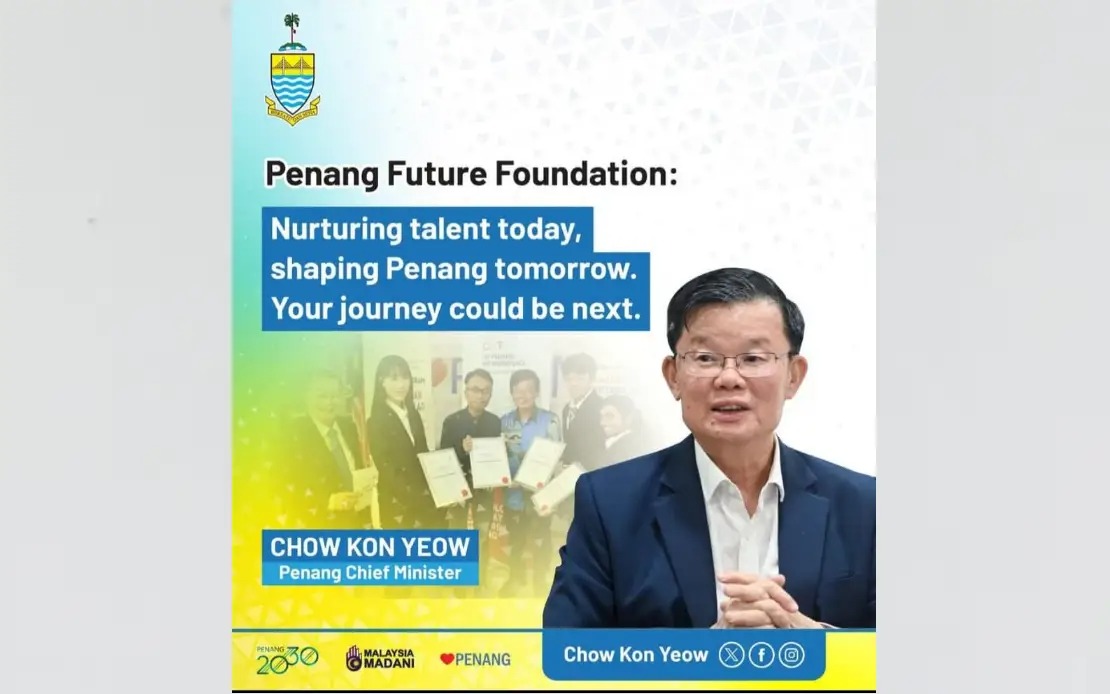
The Penang Future Foundation, an initiative established by the Penang state government over a decade ago, has channeled nearly RM47.7 million into supporting talented Malaysian students through approximately 863 scholarship awards since its launch in 2015. Operating through a combination of public and private sector funding, the foundation has become an important mechanism for identifying and nurturing academic excellence across the country, with particular emphasis on fields critical to Malaysia's economic development and digital transformation agenda.
Chief Minister Chow Kon Yeow underscored the foundation's growing significance in the state's broader economic strategy, noting that as Penang positions itself for the next half-century of development, the ability to attract and retain top-tier talent has become increasingly vital. The competitive landscape for skilled professionals has intensified across Southeast Asia, making talent retention a strategic priority for regional hubs seeking to maintain their edge in attracting multinational corporations and fostering local innovation ecosystems. Penang's deliberate investment in scholarship programmes reflects this understanding, creating a pipeline of qualified graduates who can contribute to the state's knowledge-based industries.
Last year demonstrated the programme's expanding reach and scope, with 58 students receiving PFF scholarships across multiple disciplines. The foundation's focus on Science, Technology, Engineering, Mathematics, Accountancy, and Finance reflects current market demands where Malaysian employers face persistent shortages in these specialised fields. By directing resources toward these sectors, the foundation addresses a critical gap between educational output and industry requirements, a challenge that has long plagued Southeast Asian economies seeking to move up the value chain.
The foundation operates two distinct scholarship tiers designed to accommodate students across different academic achievement levels. The PFF Penang Scholar programme targets high achievers with a cumulative grade point average of 3.67 and above, recognising and rewarding exceptional academic performance. Complementing this is the PFF Mutiara Scholar scheme, which extends opportunities to students with CGPAs between 3.00 and 3.66, broadening the foundation's accessibility and ensuring that capable students who may not be top-tier performers still have pathways to financial support.
This two-tiered structure carries important implications for Malaysian higher education policy. Rather than concentrating resources exclusively on the highest performers, the foundation acknowledges that academic potential and promise exist across a spectrum of achievement levels. This inclusive approach helps democratise access to sponsored education, reducing barriers for talented students from less privileged backgrounds who may face competing demands that affect their academic records but do not diminish their capacity for professional excellence.
The foundation actively seeks applications from Malaysian students nationwide, signalling that merit-based selection prioritises academic excellence and professional potential over geographic location. This nationwide recruitment strategy potentially works to Penang's advantage by creating networks of alumni across Malaysia who maintain connections to the state and may eventually return as professionals, entrepreneurs, or investors. Such talent circulation strengthens regional economic ecosystems and builds valuable social capital across the country's knowledge sectors.
Opening its 2026 application window from July 15 to August 5, the foundation has established clear timelines that allow prospective applicants adequate preparation time. Students interested in pursuing funded education must navigate to the foundation's website at www.penangfuturefoundation.my to access detailed eligibility criteria, programme information, and submission procedures. This digital-first approach reflects contemporary educational administration practices and reduces geographic barriers to information access.
The scale of the foundation's commitment—nearly RM48 million distributed across nearly 900 recipients—translates to average awards of approximately RM55,000 per student, a meaningful contribution toward tertiary education costs in Malaysia. While this may not fully cover university expenses, such support significantly reduces financial pressure on recipients and their families, potentially enabling talented students from middle and lower-income households to access quality education that might otherwise remain financially inaccessible.
From a broader Southeast Asian perspective, Penang's investment in human capital through targeted scholarship programmes represents a strategic response to regional competition for talent. As countries across ASEAN compete to attract and develop skilled workforces, state and provincial governments increasingly recognise that education investment yields long-term returns through enhanced productivity, innovation capacity, and economic competitiveness. Penang's sustained commitment to this foundation over 11 years demonstrates such strategic thinking.
The emphasis on STEM and professional disciplines within the foundation's awards reflects global trends in skills demand. Malaysia, like many developing economies, faces structural shifts toward technology-intensive industries where traditional skill sets prove insufficient. By sponsoring education in these fields, the Penang Future Foundation contributes to building Malaysia's human capital in sectors essential for future economic security and middle-income country transitions.
Looking forward, the foundation's continued growth and expansion suggest Penang's recognition that talent development represents a competitive advantage as durable as physical infrastructure or regulatory frameworks. As artificial intelligence, advanced manufacturing, and digital services reshape economic geography, regions that successfully cultivate and retain qualified professionals will likely maintain investment appeal and business dynamism. Through systematic scholarship distribution, the foundation operates as both a social mobility instrument and an economic development tool.

