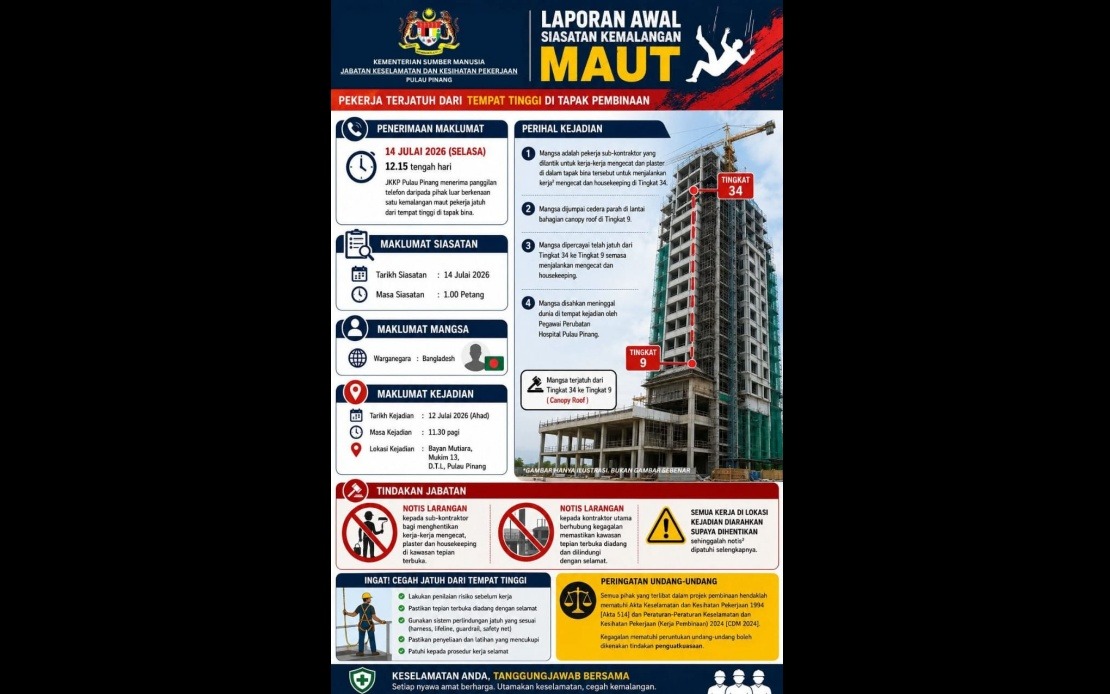
Penang's occupational safety authorities have launched a formal investigation into the death of a Bangladeshi migrant worker who sustained fatal injuries in a fall at a high-rise construction project in Bayan Mutiara, with the incident highlighting ongoing workplace safety concerns within Malaysia's building sector. The worker, whose identity has not yet been disclosed, fell from the upper levels of the site before being discovered critically injured on a canopy structure several storeys below. Penang Department of Occupational Safety and Health (DOSH) director Hairozie Asri confirmed that the department received notification of the incident at 12.15 pm on July 14, prompting an immediate deployment of investigating officers to the location.
The available evidence suggests a significant height differential between where the worker was last known to be and where he was ultimately discovered. According to preliminary findings from the investigation team, the victim was engaged by a subcontractor that specialises in finishing work including painting, plastering, and housekeeping duties. The worker is thought to have been carrying out his assigned tasks on the 34th floor of the building when the accident occurred. His body was subsequently located on the canopy roof structure at Level 9, indicating he had fallen through multiple levels of the incomplete structure. Medical personnel from Penang Hospital arrived at the scene and pronounced the worker deceased at the location.
The nature of subcontracting arrangements within Malaysia's construction industry often creates complex accountability structures that can blur responsibility lines. Subcontractors like the one that employed this worker typically handle specialized finishing tasks rather than major structural work, yet they remain bound by the same safety regulations as primary contractors. These arrangements are standard across the industry, allowing main contractors to delegate specific work packages while maintaining overall site responsibility. However, this structure can sometimes result in safety protocols being inadequately communicated or enforced across different work teams operating simultaneously on the same site.
Fall-related incidents constitute one of the most prevalent categories of construction fatalities across Southeast Asia and Malaysia specifically. Workers engaged in finishing work at height face particular vulnerability, as their tasks often require them to operate on scaffolding, temporary platforms, or incomplete structural elements without the protection afforded by completed floors and permanent installations. The 34th-floor location in this case suggests the building was in a relatively advanced stage of construction, yet safety measures for workers at height may not have been comprehensively implemented or adequately maintained.
In response to the incident, Penang DOSH has moved decisively to prevent further potential accidents at the site. A prohibition notice was issued to the subcontractor, immediately halting all painting, plastering, and housekeeping activities in any areas with open edges or exposed heights. Additionally, the main contractor responsible for overall site management received its own prohibition notice. The department has mandated a complete suspension of all work activities related to the accident area until the subcontractor and main contractor have fully complied with every requirement outlined in the respective prohibition notices. This approach ensures that work cannot resume until comprehensive remedial measures have been demonstrated and verified.
The regulatory framework governing construction site safety in Malaysia is administered through DOSH, which operates under the Occupational Safety and Health Act 1994. This legislation imposes stringent obligations on both principal contractors and subcontractors to maintain safe working conditions, provide appropriate personal protective equipment, and implement fall prevention measures. Despite these legal requirements, construction remains one of Malaysia's highest-risk occupational sectors for fatal and serious injuries. The prohibition of work until compliance is achieved represents a standard enforcement tool available to DOSH, though critics argue that penalties and enforcement could be more stringent to deter unsafe practices.
The involvement of a migrant worker in this incident reflects broader patterns within Malaysia's construction workforce. Bangladeshi workers constitute a significant portion of the migrant labour force engaged in building projects across the country, often filling roles in finishing and general construction tasks. Language barriers, varying familiarity with Malaysian safety standards, and potential gaps in training can create additional risk factors for this workforce segment. Advocacy groups have raised concerns that migrant workers sometimes lack adequate briefing on site-specific hazards and may feel pressured to work without appropriate safety measures.
The incident at Bayan Mutiara will likely prompt renewed scrutiny of safety practices across Penang's active construction sites. Bayan Mutiara has seen substantial development in recent years, with multiple high-rise residential and commercial projects at various stages of completion. Developers and contractors operating in the area may face increased inspection activity from DOSH officials keen to ensure comprehensive compliance with fall prevention requirements. The fatality serves as a sobering reminder that even routine finishing work at significant heights carries severe consequences if proper precautions are not meticulously observed and enforced.
The investigation by Penang DOSH will seek to determine precise causal factors in the incident, including whether fall protection equipment was available and properly used, whether the worker received adequate safety training, and whether the site's overall safety management systems functioned effectively. Such investigations typically examine physical conditions at the accident location, documentary evidence of safety protocols in place, and interviews with site supervisors and workers who witnessed the event. The findings may inform future enforcement actions and could contribute to industry guidance on preventing similar incidents.
This fatality adds to Malaysia's construction sector accident toll and underscores the persistent challenge of translating occupational safety regulations into consistent workplace practice. While legal frameworks exist and regulatory bodies possess enforcement authority, ensuring that safety measures are properly implemented across hundreds of active construction sites remains an ongoing struggle. The incident also raises questions about whether current penalties and enforcement mechanisms sufficiently incentivize contractors to prioritize worker safety, particularly for migrant workers whose circumstances may make them particularly vulnerable to pressure to work under unsafe conditions.

