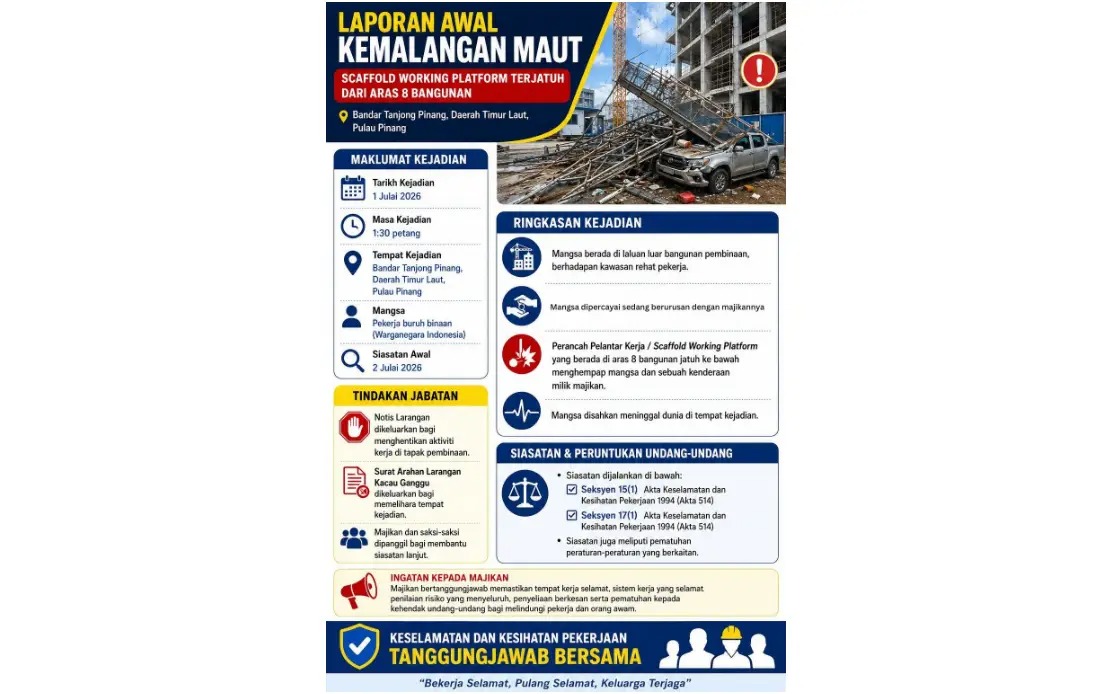
The Department of Occupational Safety and Health (DOSH) Penang branch has moved swiftly to impose a prohibition notice on a Bandar Tanjong Pinang construction site following a fatal workplace incident that claimed the life of an Indonesian migrant worker. The deadly accident, which unfolded on July 1 at 1.30 pm, has prompted immediate investigations and raised fresh concerns about safety compliance at high-rise building projects across Malaysia's industrial heartland.
According to DOSH Penang's official statement, the victim was positioned on an external walkway at a lower level of the building, near the workers' rest area, when a scaffolding working platform detached from the eighth floor and plummeted downward. The impact struck both the worker and a vehicle belonging to his employer, underscoring the indiscriminate danger posed by improperly secured temporary structures on active construction sites. The incident occurred during routine work operations, suggesting that standard safety measures may have proven inadequate under the prevailing conditions.
The regulatory response has been characterised by urgency and procedural rigour. Beyond the immediate stop-work order, DOSH has imposed a non-disturbance order to preserve the accident scene in its original state, facilitating thorough forensic analysis and evidence gathering. This dual approach reflects the seriousness with which Malaysian authorities are treating construction fatalities, particularly those involving foreign workers who often labour under precarious conditions and limited oversight.
Investigators are now examining the case through the lens of Malaysia's Occupational Safety and Health Act 1994 (Act 514), with particular focus on Sections 15(1) and 17(1), which delineate the statutory duties imposed on employers. These provisions require businesses to ensure, insofar as reasonably practicable, the health, safety, and welfare of all persons at work. The inquiry will assess whether adequate planning, supervision, maintenance protocols, and safety equipment standards were observed at the site prior to the collapse.
For Malaysia's construction sector, which employs hundreds of thousands of foreign workers alongside domestic staff, this incident serves as a cautionary reminder of ongoing vulnerabilities. Scaffolding systems, while ubiquitous on multi-storey developments, remain sources of preventable accidents when installation, inspection, and maintenance procedures are compromised by time pressure, cost-cutting, or inadequate training. The involvement of multiple contractual layers—main contractors, subcontractors, and suppliers—can create accountability gaps that result in slippage on safety standards.
The Bandar Tanjong Pinang incident is particularly significant because it implicates not merely individual negligence but potentially systemic failures across the project hierarchy. DOSH's investigation will examine not only the immediate cause of the scaffolding collapse but also the broader management culture and resource allocation decisions that may have contributed. Employers, developers, main contractors, and subcontractors all face potential liability should violations be substantiated.
Penang, as Malaysia's second-largest state economy and a major construction hub, hosts numerous high-rise residential, commercial, and mixed-use developments. The region's construction boom, driven by rapid urbanisation and infrastructure investment, has intensified competition among builders and developers, creating implicit pressure to accelerate timelines. When safety compliance becomes negotiable in the pursuit of project schedules, workers—especially migrant labourers with limited bargaining power—bear disproportionate risk. The fatality in Bandar Tanjong Pinang exemplifies this structural vulnerability.
DOSH has indicated that employers and eyewitnesses are being systematically interviewed as part of the investigative process. These testimonies will be instrumental in reconstructing the sequence of events and identifying the specific technical or procedural failures that precipitated the collapse. Additionally, investigators will likely scrutinise maintenance logs, inspection certificates, worker training records, and communication protocols to assess whether the site was operating within regulatory parameters.
Enforcement action is explicitly contemplated should the investigation uncover violations of the Occupational Safety and Health Act or related subsidiary legislation. Penalties for serious breaches can include substantial fines and, in egregious cases, criminal prosecution of responsible individuals. This deterrent framework aims to incentivise genuine compliance rather than mere paper compliance among industry actors.
DOSH's statement includes a broader exhortation to the construction industry, reminding all stakeholders that workplace safety requires methodical planning, competent execution, and sustained vigilance. For Malaysian employers and developers, particularly those operating multi-site operations with complex subcontracting arrangements, the Bandar Tanjong Pinang prohibition notice signals heightened regulatory scrutiny. Organisations that rely on cost minimisation as a competitive strategy may find themselves exposed to both reputational damage and regulatory sanction.
The incident also highlights the plight of Indonesian workers in Malaysian construction, a demographic that is often marginalised in safety culture discussions. Language barriers, unfamiliarity with local regulations, social isolation, and dependency on employers for visa sponsorship can inhibit workers from reporting hazards or refusing unsafe tasks. Strengthening protections for migrant labourers—through improved language training, clearer communication of rights, and enhanced oversight mechanisms—remains an unfinished agenda across Southeast Asia's construction sectors.
Moving forward, the investigation's findings will likely influence DOSH's inspection priorities and enforcement strategies across Penang and potentially nationally. High-rise projects utilising temporary structures will face heightened scrutiny, and regulators may demand enhanced documentation and third-party verification of scaffolding integrity. Industry bodies should anticipate revised guidance or tightened standards emerging from this incident, mirroring how earlier construction fatalities have prompted regulatory recalibration.
The death of the Indonesian worker in Bandar Tanjong Pinang represents a preventable loss that underscores the gap between Malaysia's regulatory framework—which is reasonably comprehensive—and actual compliance on the ground. Until construction culture fundamentally prioritises safety over speed and profitability, incidents of this magnitude will continue to mar the sector and claim lives that might otherwise have been preserved through rigorous adherence to established protocols.

