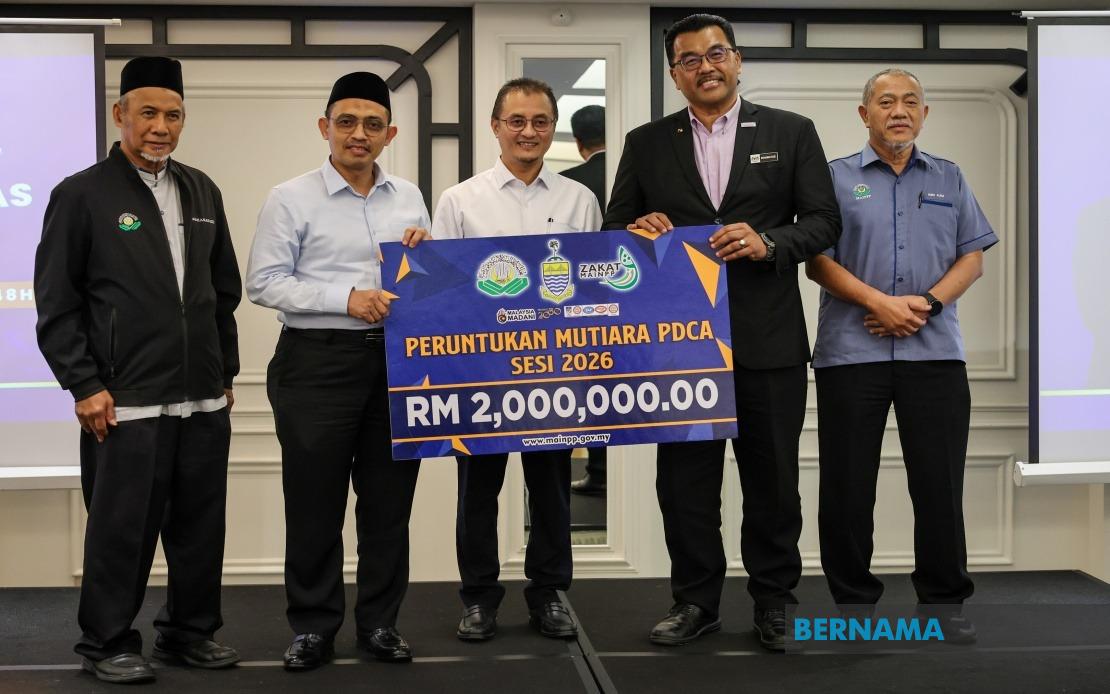
The Penang State Islamic Religious Council (MAINPP) is investing heavily in educational support for disadvantaged students, announcing a RM2 million commitment to its Mutiara Didik Cemerlang Akademik (MPDCA) programme for 2026. Deputy Chief Minister I Datuk Dr Mohamad Abdul Hamid outlined the initiative at a briefing for coordinating teachers in Kepala Batas, emphasizing MAINPP's dedication to ensuring equitable access to quality learning across the state. The funding reflects a broader push to strengthen academic foundations among Bumiputera pupils and students, addressing persistent achievement gaps through targeted, structured interventions delivered within the public school system.
The MPDCA initiative represents a two-decade commitment to educational equity, having operated continuously since its establishment in 2006. Rather than operating as a standalone programme, it functions as a collaborative effort involving the Penang State Education Department (JPNPP), the Penang Bumiputera Participation Coordination Division under the Prime Minister's Department Implementation Coordination Unit, and the Penang Regional Development Authority (PERDA). This institutional architecture ensures coordination across multiple levels of governance and demonstrates how state-level religious councils can partner with federal agencies and local authorities to amplify educational reach and impact.
This year's iteration of the programme will engage 698 coordinating teachers deployed across 71 primary schools and 38 secondary schools, creating a relatively dense support network across Penang's educational landscape. The scale of teacher involvement underscores the labour-intensive nature of effective tutoring and mentoring, suggesting that quality instruction cannot be achieved through technology or minimal human contact alone. By concentrating resources on teacher training and coordination, MAINPP appears to be betting that professional development and systematic curriculum delivery yield superior outcomes compared to less structured approaches.
The curriculum emphasis varies by educational level, reflecting developmental appropriateness and examination requirements. Students in Year Six receive focused support in four foundational subjects: Bahasa Melayu, English, Mathematics and Science. This concentration on core competencies aligns with research indicating that strong performance in these subjects underpins success across other disciplines. For students preparing for the Sijil Pelajaran Malaysia (SPM) examination, the programme expands to thirteen subjects, encompassing humanities, sciences, languages, and religious studies. This breadth acknowledges that comprehensive academic development requires support across multiple knowledge domains rather than narrow subject specialization.
Beyond secular academic subjects, the programme accommodates the distinctive educational pathways of government-aided religious schools, incorporating three Integrated Dini Curriculum subjects: Dini-Lughatul Arabiyyah Mu'asirah (LAM), Dini-As Syariah and Dini-Usuluddin. This inclusion recognizes that for a significant cohort of students in Penang, Islamic education represents a central component of their academic identity and future pathways. By integrating religious subjects into a comprehensive support framework, MAINPP ensures that students pursuing dual secular-religious educational tracks do not face artificial resource constraints or reduced support for components of their studies.
The pedagogical approach emphasizes structured, evidence-based learning materials rather than ad hoc tutoring. Mohamad highlighted that the 2026 allocation would fund learning modules, academic seminars, and examination technique workshops designed to systematically build student competencies. Hartina Arjan, a Bahasa Melayu teacher at SK Permai Indah, noted that the programme's systematically developed modules have demonstrably improved student mastery, with particular emphasis on speaking, reading and writing skills essential for Classroom-Based Assessment (PBD) and formal examinations. This modular approach also democratizes access by reducing dependence on individual teachers' instructional preferences, creating consistency across schools and student cohorts.
One of the programme's most significant dimensions involves its accessibility to economically disadvantaged families. Sadiah Roslan, teaching at Sekolah Rendah Islam Al-Masriyah Halimatun in Bukit Mertajam, emphasized that for students whose families cannot afford private tuition—itself a growing expenditure burden for Malaysian families—the MPDCA provides free, professionally delivered instruction. This is particularly consequential in a context where private tuition markets have become increasingly stratified, with quality instruction increasingly concentrated among families with disposable income. By providing equivalent support through state mechanisms, MAINPP addresses a significant equity gap that threatens to entrench intergenerational inequality.
Teacher feedback indicates that interactive, quiz-based learning approaches integrated into updated modules have enhanced student engagement and classroom participation. Rather than relying on passive lecture formats, the programme appears to leverage contemporary pedagogical understanding about active learning and formative assessment. This methodological sophistication distinguishes the MPDCA from earlier-generation tutoring models and suggests that MAINPP has invested in professional development alongside resource allocation. The emphasis on participation and engagement also addresses a frequently overlooked dimension of educational equity: ensuring that disadvantaged students develop the confidence and habit of intellectual participation, not merely absorbing transmitted content.
Beyond the immediate MPDCA allocation, MAINPP's broader 2026 educational investment totals approximately RM34.66 million, distributed across higher education support, early schooling aid, and school uniform assistance. The RM22.36 million allocation for Higher Education Bursaries reflects a commitment to enabling progression beyond secondary school, critical for breaking cycles of poverty. The RM3 million allocation for Early Schooling Aid recognizes that educational disadvantage often begins before formal schooling, while the RM3 million for School Uniform Aid addresses a frequently overlooked but significant barrier to school attendance among low-income families. This diversified investment approach acknowledges that academic achievement depends on addressing multiple layers of deprivation simultaneously.
The institutional data accumulated by JPNPP since 2006 demonstrates measurable positive impacts from sustained participation, suggesting the programme has achieved its intended effects over two decades. For Malaysian education policymakers, the MPDCA provides a tested model of how specialized support can be delivered at scale through existing educational infrastructure rather than requiring entirely parallel systems. The programme demonstrates that coordinated investment by state religious councils, combined with systematic teacher deployment and curriculum development, can generate meaningful achievement gains for targeted student populations. As Malaysia continues grappling with achievement disparities rooted in socioeconomic status, the MPDCA's two-decade track record offers evidence that intensive, professionally managed support can mitigate these gaps.
For Southeast Asia more broadly, Penang's approach demonstrates how religious institutions can contribute substantively to secular educational equity objectives through collaborative governance arrangements. Rather than religious institutions operating in isolation from state education systems, the MPDCA model shows institutional integration where religious councils leverage their community relationships and resource bases to amplify reach of evidence-based educational support. This institutional innovation may offer lessons for other Muslim-majority countries and regions navigating the integration of religious institutions into broader development agendas. As Malaysia continues advancing its human capital development objectives, sustained investment in programmes like MPDCA—combining targeted tutoring, professional teacher coordination, and systematic curriculum development—appears essential for ensuring that disadvantaged students can achieve their academic potential.

