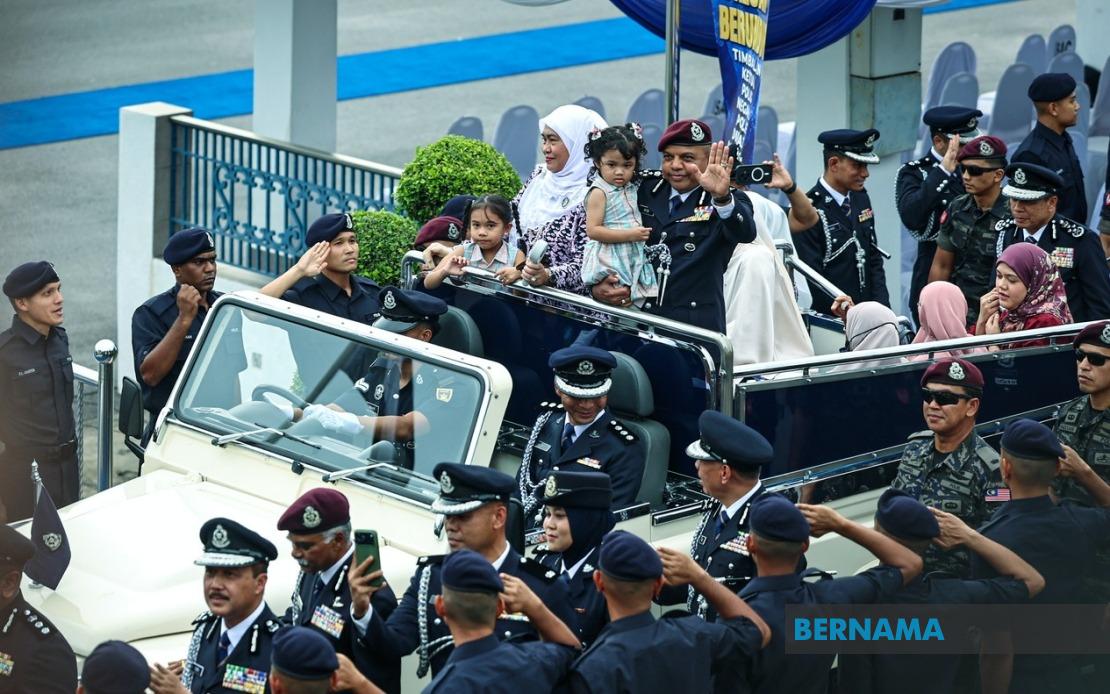
Malaysia's police force cannot aspire to international standards unless it consistently applies the law regardless of who breaks it, according to Tan Sri Ayob Khan Mydin Pitchay, the country's outgoing Deputy Inspector-General of Police. Speaking at the handover ceremony at the Kuala Lumpur Police Training Centre, Ayob Khan underscored that impartial law enforcement forms the cornerstone of a respected and trusted police institution. His remarks arrive at a significant moment for the PDRM, as Datuk Seri Ibrahim Darus took over as Acting Deputy Inspector-General following Ayob Khan's transition into retirement after nearly 35 years of service.
The principle of equal application of law stands as a persistent challenge for Southeast Asian police forces, many of which face recurring questions about political impartiality. Ayob Khan's emphasis on this issue reflects broader concerns about institutional independence that extend beyond Malaysia's borders. In the region, where questions about the separation of law enforcement from political pressure regularly surface, his statement carries particular weight. The PDRM, as the nation's premier law enforcement agency, occupies a crucial position in maintaining public confidence in the justice system. Without demonstrated consistency in applying legal standards, no police force can credibly claim world-class status, regardless of its technical capabilities or training programmes.
During the press conference, Ayob Khan articulated a stark principle: "We don't care who, government party or opposition party. If you cross the line of the law, arrest." This seemingly straightforward statement belies the complexities that police forces across Asia regularly navigate, where political considerations often intersect with law enforcement decisions. His framing suggests that earning public respect depends fundamentally on eliminating any perception of preferential treatment based on political allegiance. For Malaysian citizens and observers, this message addresses longstanding concerns about whether the police force operates as an independent institution or remains subject to political influence.
When questioned about allegations of political interference throughout his career, Ayob Khan referenced his tenure as head of the Counter Terrorism Division in 2019 as concrete evidence of his commitment to impartial enforcement. During that period, his division arrested approximately 14 or 15 individuals suspected of involvement with the Liberation Tigers of Tamil Eelam (LTTE), including two State Assemblymen from the governing coalition at the time. The inclusion of sitting politicians in these arrests demonstrated, in his view, that his division pursued cases based on evidence and legal considerations rather than political calculations. This example serves as a litmus test for institutional independence—the willingness to investigate and prosecute individuals regardless of their political position or party affiliation represents a fundamental measure of police impartiality.
Ayob Khan's career trajectory through various sensitive positions positioned him uniquely to speak about these dynamics. Beyond his counter-terrorism work, he directed the Narcotics Criminal Investigation Department and served as Johor police chief, roles that inherently involve navigating politically charged situations. His appointment as Deputy Inspector-General in June 2023 placed him at the apex of the organisation's hierarchy, offering him both the platform and responsibility to establish standards for the entire force. The breadth of his experience across different operational domains within the PDRM provides credibility to his assertions about the necessity of consistency across all enforcement activities.
The transition of leadership also carries significance for how these principles will be implemented going forward. Datuk Seri Ibrahim Darus, assuming the role as Acting Deputy Inspector-General, inherits both the institutional expectations and the operational challenges of maintaining impartial law enforcement. The handover ceremony itself represents a moment where such commitments can be reinforced throughout the ranks. Officers across the PDRM will observe how strictly the incoming leadership adheres to principles of equal application, setting the tone for institutional culture and decision-making at lower levels of the hierarchy.
Ayob Khan's remarks about his post-retirement intentions also shed light on how he views the relationship between law enforcement and politics. He explicitly rejected any interest in entering political life, drawing a distinction between "politicians" and "statesmen." According to his formulation, politicians prioritise the next five-year electoral cycle, while statesmen think in generational terms spanning two decades or more. This articulation reveals his view that the police force should align with statesmanship rather than political calculation, positioning institutional integrity as a long-term investment in national governance. For observers concerned about the PDRM's independence, such statements suggest a commitment to principles that transcend immediate political considerations.
The Malaysian public has historically grappled with questions about police impartiality, particularly during periods of political transition or intense partisan competition. High-profile arrests of political figures from various parties have sometimes generated accusations of selective enforcement, though attribution of motives remains contested. Ayob Khan's emphasis on the necessity of equal treatment across political lines directly engages these concerns, proposing that transparent, consistent law enforcement serves both democratic governance and institutional legitimacy. When the PDRM is perceived as favouring particular political actors, its broader effectiveness as a law enforcement agency diminishes, regardless of its technical capabilities or investigative resources.
The broader regional context further illuminates the significance of Ayob Khan's message. Many Southeast Asian countries contend with tensions between political leadership and police forces, with varying degrees of institutional independence. Singapore's police force operates under relatively tightly controlled political frameworks, while other nations experience more pronounced contestation over police autonomy. Malaysia occupies a middle ground where democratic institutions coexist with occasional pressure on law enforcement agencies. Against this backdrop, advocating for impartial law enforcement represents a statement about the type of police force Malaysia should aspire to become—one aligned with democratic principles and professional standards rather than political contingencies.
Ayob Khan's retirement after nearly 35 years represents a significant transition point for the PDRM's leadership. The officer who departs has positioned himself as an advocate for institutional independence and impartial enforcement, establishing benchmarks against which his successors will be measured. Whether the incoming leadership under Datuk Seri Ibrahim Darus sustains and strengthens these commitments will substantially influence public perception of the police force's integrity. The challenge extends beyond any single individual to encompass the entire institutional culture, training systems, and oversight mechanisms that either facilitate or impede impartial law enforcement across the organisation's breadth.
For Malaysia's aspirations toward world-class policing standards, the gap between stated principles and consistent practice remains the critical measure. Ayob Khan's emphasis on equal enforcement across political lines identifies the core requirement for achieving this goal. Malaysian citizens and international observers will monitor whether the PDRM institutionalises and operationalises these principles throughout its ranks, or whether political considerations continue to shape law enforcement decisions in ways that undermine public trust and institutional credibility in the years ahead.

