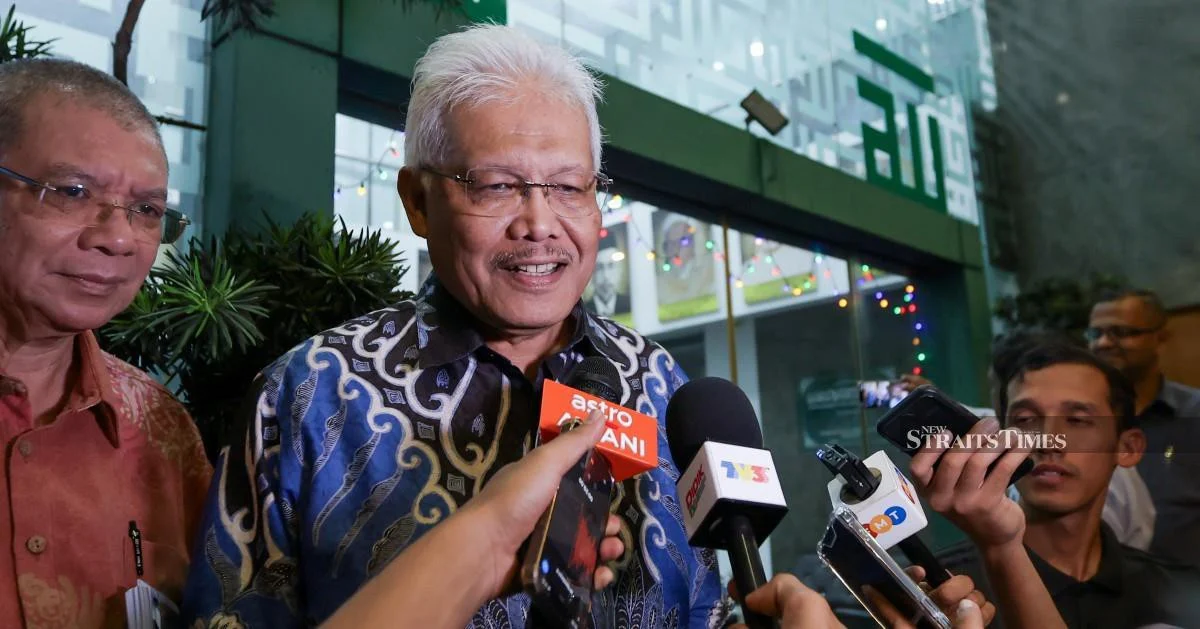
Datuk Seri Hamzah Zainudin is set to reclaim the opposition leader's front bench position in the Dewan Rakyat this coming Monday, according to the latest parliamentary seating arrangement. The move will see Bersatu president Tan Sri Muhyiddin Yassin relinquish the seat and relocate to a position further back along the government opposition benches, marking a significant shift in the chamber's hierarchy and visibility.
The seating arrangement in Parliament carries substantial symbolic weight in Malaysian politics, as the opposition leader's front-row desk is positioned directly across from the Prime Minister and his cabinet members. This prominent placement carries both ceremonial and practical significance, allowing the opposition leader prime sightlines during parliamentary proceedings and elevating their political profile during televised sessions and media coverage. The shift therefore represents more than a mere administrative adjustment—it signals a recalibration of leadership recognition within the opposition coalition.
Hamzah's return to the opposition leader's chair reflects evolving dynamics within Malaysia's fractured opposition bloc, which has struggled to maintain unified messaging and clear structural authority since the 2022 general election. The opposition remains divided between multiple factions, including the Democratic Action Party, Amanah, portions of Umno, and various other smaller parties, each competing for prominence and influence. The formal reinstatement of Hamzah signals an attempt to crystallise leadership within this fragmented landscape.
Muhyiddin's displacement from the opposition leader's seat comes at a pivotal moment for Bersatu, which has occupied an ambiguous political position in recent parliamentary sessions. The party, which was instrumental in the Sheraton Move of 2020 and the subsequent government configurations, has maintained significant parliamentary representation but has faced internal and external pressures regarding its coalition allegiances and strategic direction. His relocation down the bench, while remaining in opposition ranks, may reflect broader conversations about the party's role in the opposition's future strategy.
The significance of this seating transition extends beyond personal or party positioning. It illustrates how Malaysian opposition politics continues to reorganise itself in response to the coalition's marginal numbers in Parliament and the absence of any clear, unified command structure. With the government maintaining a narrow majority, every gesture that strengthens opposition cohesion or clarifies its leadership becomes politically consequential. Hamzah's return to the front bench may signal an effort to project stronger opposition unity to both parliament and the broader electorate.
Hamzah's political trajectory has been marked by considerable shifts in fortune and positioning. His return to the formal opposition leader's seat restores him to a position of institutional prominence that carries real influence over parliamentary agenda-setting, question time priorities, and the opposition's public messaging strategy. The front bench position enables direct engagement with government ministers and provides a consistent platform for articulating opposition arguments during the most high-profile parliamentary moments.
Muhyiddin, despite his retreat from the front bench, remains a significant political figure with considerable influence within his party and broader opposition circles. Bersatu's parliamentary strength ensures that his strategic voice will continue to carry weight in opposition deliberations and coalition-building exercises. The seating adjustment should not be interpreted as a diminishment of his political relevance, but rather a recalibration of formal institutional roles within the opposition's structure.
For Malaysian observers, this adjustment underscores the ongoing realignment of the country's political landscape following the dramatic shifts of recent years. The opposition remains geographically fragmented, ideologically diverse, and strategically uncertain about whether to pursue confrontation or negotiation with the government. The clarification of the opposition leader's position through seating arrangements may help provide some organisational coherence to these fractious elements.
The timing of the seating change carries additional implications for parliamentary dynamics. With a government holding a precarious majority, the opposition's ability to present a unified front through clear leadership becomes particularly important. Enhanced visibility and institutional authority for the opposition leader could amplify scrutiny of government policies and increase pressure on wavering coalition members. Conversely, it also places greater responsibility on Hamzah to articulate a coherent opposition vision that appeals across the coalition's diverse membership.
The parliamentary seating arrangement, while seemingly procedural, ultimately reflects deeper structural questions about how Malaysia's opposition will organise itself in the coming years. Whether this formal restoration of Hamzah to the opposition leader's seat represents the beginning of sustained opposition consolidation or merely a temporary adjustment remains uncertain. What is clear is that the opposition continues searching for effective mechanisms to maximise its limited parliamentary strength and present itself as a credible alternative to voters.

