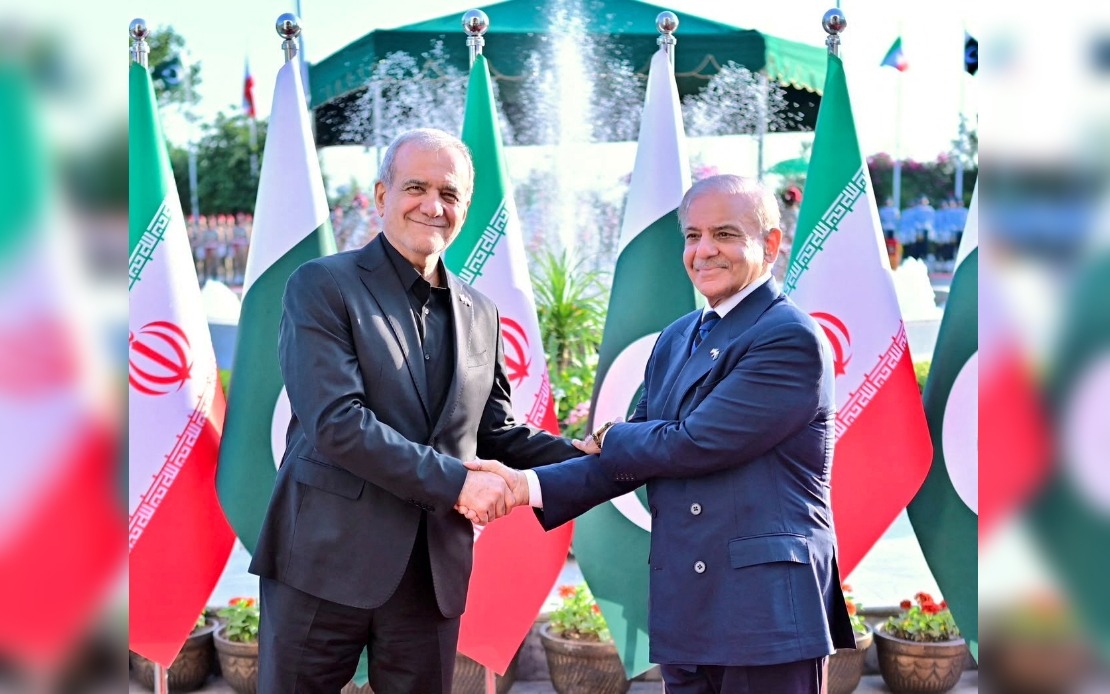
Pakistan has positioned itself firmly alongside Iran in defending Tehran's right to develop and maintain ballistic missiles, with Prime Minister Shehbaz Sharif declaring that weapons capabilities should not be subject to discriminatory international standards. The statement came during talks with Iranian President Masoud Pezeshkian and his delegation in Islamabad on Tuesday, marking a significant show of solidarity between the two neighbours as regional tensions persist.
Shehbaz emphasized that the Iranian missile programme formed no part of the memorandum of understanding signed between Iran and the United States on June 17, which Pakistan had played a central role in facilitating. He stressed this distinction repeatedly, noting that ballistic missiles were never discussed or included on the negotiating agenda. The Pakistani leader's argument centres on the principle that if other nations maintain such arsenals without restriction, denying Iran equivalent capability constitutes an unfair double standard in international relations.
Iran views its missile arsenal as fundamental to national security, particularly following the February 28 strikes launched jointly by Israel and the United States against Iranian military installations. This defensive posture has become increasingly central to Tehran's strategic calculations as it navigates a hostile regional environment. The weapons programme therefore represents not an offensive ambition but rather a deterrent against potential future attacks on Iranian territory and interests.
Pakistan's mediation role has expanded significantly over recent months. Beyond facilitating the June agreement, Islamabad had previously helped broker a temporary ceasefire between Iran and the US in April, demonstrating its growing influence as a neutral intermediary in the conflict. Shehbaz credited Iranian leadership for trusting Pakistan's sincerity and honesty in these negotiations, with support from Foreign Minister Ishaq Dar and Chief of Army Staff Field Marshal Syed Asim Munir proving instrumental to the process. The prime minister pledged that Pakistan would remain a steadfast partner to Iran going forward.
Shehbaz also acknowledged that international opponents to the peace agreement continue their efforts to undermine it. He identified what he termed "spoilers" operating globally who seek to sabotage the nascent understanding between Washington and Tehran. This reference appears aimed at regional actors and allies of the United States who view improved Iran-US relations as contrary to their interests. The warning suggests that the fragile agreement faces considerable headwinds despite its formal establishment.
Israel emerged as the primary obstacle to regional peace in the Pakistani premier's assessment, with ongoing military operations in Lebanon and the occupied Palestinian territories generating casualties and displacement on a massive scale. The scale of destruction and loss of life continues to inflame tensions throughout the Middle East, complicating any lasting diplomatic resolution. These actions underscore the complex security environment in which Iran operates and justify, in the eyes of both Islamabad and Tehran, the necessity of maintaining credible defensive capabilities.
US President Donald Trump has privately acknowledged Iran's entitlement to ballistic missile capabilities, recognising the asymmetry in allowing other nations such weapons while denying them to Iran. Trump remarked to journalists in Paris on June 17 that permitting other countries to possess ballistic missiles while prohibiting Iran similar access constitutes an unfair arrangement. His statement provided tacit American validation for the position that Pakistan and Iran were advancing regarding weaponry parity.
At the joint press conference, Iranian President Pezeshkian articulated an uncompromising stance on his nation's defensive arsenal. He contended that without these missiles, Israel and America would have invaded and conquered Iran with the same ruthlessness displayed toward Gaza, showing no mercy to civilian populations regardless of age. This framing positions the missile programme as essential protection against existential threats, justifying its non-negotiable status in any international discussions. Pezeshkian's language reflects Tehran's conviction that military strength represents the only reliable guarantee of national survival in the current regional context.
The ceremonial aspects of Pezeshkian's visit underscored the warmth of bilateral relations and Pakistan's symbolic commitment to the Iranian alliance. Pakistani Air Force fighter jets escorted the Iranian president's aircraft upon arrival in Islamabad, while Prime Minister Shehbaz and President Asif Ali Zardari welcomed him with full state honours including a twenty-one-gun salute. Such pageantry carries diplomatic weight, signalling to international audiences the strength and importance Pakistan ascribes to its partnership with Iran.
For Malaysia and other Southeast Asian nations observing regional developments, Pakistan's explicit backing of Iran's military capabilities carries broader implications for global non-proliferation frameworks and power balance calculations. The stance reflects how major powers increasingly interpret security through the lens of capability parity rather than absolute arms reduction. Pakistan's successful mediation also demonstrates how strategically positioned middle powers can exercise disproportionate influence in resolving major international disputes, a lesson relevant to ASEAN's aspirations for regional stability and conflict resolution mechanisms.

