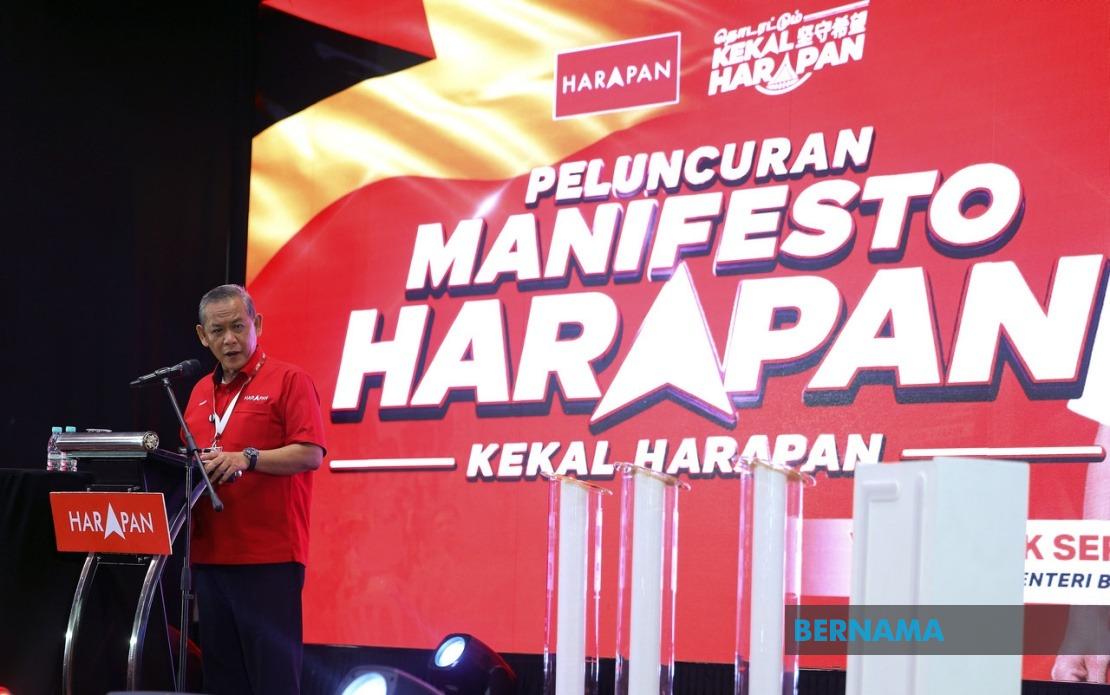
Pakatan Harapan has launched its campaign platform for the 16th Negeri Sembilan state election, framing its political pitch around stability, inclusivity and economic opportunity. The manifesto, unveiled in Seremban by Negeri Sembilan PH chairman and Menteri Besar Datuk Seri Aminuddin Harun, carries the tagline 'Negeri Sembilan Kekal Harapan' — signalling the coalition's intent to retain control of the state administration and consolidate its governance record since 2018.
The 10-point platform represents a comprehensive attempt to address voter concerns across multiple domains, from immediate economic needs to longer-term social infrastructure. At its core lies a commitment to maintaining stable, clean and people-centric government — a foundational pledge that reflects PH's positioning as an alternative to patronage-driven politics. This framing is particularly significant in Negeri Sembilan, where electoral competition has traditionally centred on personal networks and state-level resource distribution rather than policy platforms.
Job creation emerges as the manifesto's economic centrepiece, with PH committing to generate 30,000 high-income employment opportunities during its next term. This target speaks directly to youth unemployment and underemployment concerns that have grown across Malaysia, particularly in smaller states like Negeri Sembilan where manufacturing and service-sector opportunities remain concentrated. The emphasis on 'high-income' positions the pledge as addressing quality of employment rather than mere job quantity — a distinction that matters to voters anxious about wage stagnation and career progression.
The housing commitment to construct 20,000 affordable units acknowledges the mounting affordability crisis affecting young families and first-time buyers throughout the country. Negeri Sembilan, while less expensive than Selangor or the Klang Valley, has nonetheless experienced property price inflation that outpaces median income growth. Coupled with a pledge to resolve outstanding land-related issues, this component suggests PH recognises that housing insecurity remains a primary electoral concern among working-class and middle-income voters.
Strenthening the 'Skim Sejahtera Rakyat' or People's Wellbeing Scheme reflects commitment to social safety nets and targeted assistance programmes. As Malaysia's social security systems face pressure from demographic ageing and economic uncertainty, state-level programmes that complement federal welfare architecture have become critical. For Negeri Sembilan voters, a reinforced SSR signals that PH intends to supplement federal provisions and direct additional resources toward vulnerable populations — a particularly relevant messaging point given competition for votes among pensioners, informal-sector workers and lower-income households.
Education quality and healthcare service delivery represent essential infrastructure components of the manifesto. These sectors directly affect household wellbeing and have emerged as consistent voter priorities across recent Malaysian elections. By explicitly pledging quality education for all and strategic healthcare improvements, PH attempts to address perceptions that smaller states receive inadequate educational and medical resources compared to larger, wealthier jurisdictions. This resonates particularly in rural Negeri Sembilan districts where school infrastructure and clinic accessibility remain concerns.
Youth empowerment, women's advancement and family support programmes indicate PH's recognition that political success increasingly depends on mobilising and addressing specific demographic constituencies. Malaysia's young and female voters have demonstrated greater receptiveness to policy-based campaigning and social issues than previous generations. By explicitly committing to these groups rather than relying on generic appeals, PH signals awareness that electoral coalitions must be actively constructed and maintained.
The manifesto's sectoral commitments — including tourism and cultural heritage development, agriculture modernisation, and food security strengthening — reflect Negeri Sembilan's economic composition and regional positioning. As a state with significant agricultural land, heritage tourism potential, and proximity to Kuala Lumpur, these pledges address genuine economic development opportunities. Modernising agriculture particularly speaks to smallholder farmers and rural communities who constitute an important voter bloc and have experienced commodity price volatility and labour shortages.
The FELDA Development Plan implementation commitment addresses a specific constituency — plantation workers, estate smallholders and communities dependent on agricultural enterprises. This signals PH's intent to maintain engagement with rural, traditionally-aligned voters and to demonstrate competence in managing established federal-state development schemes. Interfaith unity promotion, meanwhile, reflects Malaysia's plural society and PH's broader efforts to position itself as a coalition committed to social cohesion and inclusive governance.
Taken collectively, the manifesto represents an attempt to construct a broad-based coalition by addressing multiple voter concerns simultaneously — economic opportunity, housing security, social protection, quality services and inclusive community building. For Malaysian observers, the platform indicates how state-level politics is increasingly driven by concrete service delivery promises rather than abstract ideology. The effectiveness of PH's campaign will ultimately depend on voter perception of the coalition's implementation record since 2018 and its credibility in delivering these commitments against fiscal and administrative constraints.
The manifesto launch itself carries strategic timing implications for the broader Malaysian political landscape. As the nation approaches potential federal-level electoral contests, state elections serve as testing grounds for political messaging, coalition cohesion and voter sentiment. Negeri Sembilan's result will provide valuable signals regarding voter receptiveness to PH's governance narrative and the coalition's capacity to maintain support in non-Selangor contexts. For regional observers, the campaign offers insights into how Malaysian parties are adapting to voter expectations for evidence-based policymaking and performance-oriented governance.

