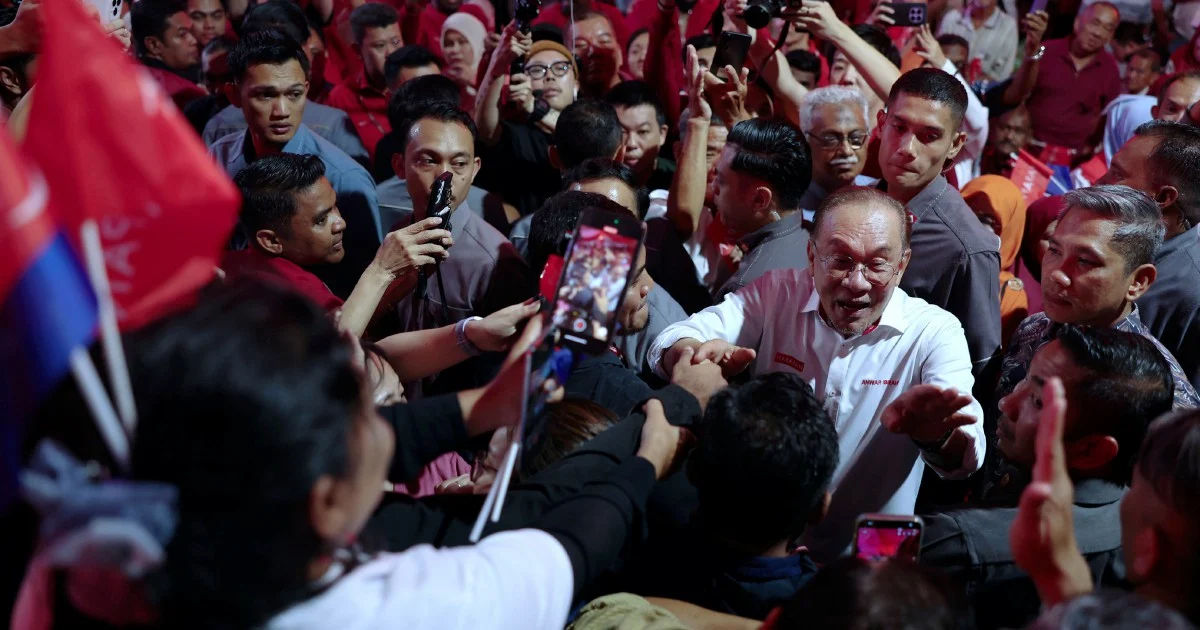
Pakatan Harapan moved to consolidate its political standing in Johor on Tuesday, with coalition chairman Datuk Seri Anwar Ibrahim formally presenting the opposition's comprehensive roster of 56 candidates vying for control of the state legislature. The announcement, made in Tangkak, represents a significant strategic pivot as the coalition seeks to disrupt Barisan Nasional's longstanding grip over one of Malaysia's most economically important regions.
The unveiling comes as Johor braces for its first state election in four years, scheduled for July 11. For Pakatan Harapan, the timing offers a critical opportunity to expand its footprint beyond the peninsular strongholds of Selangor and Penang, where the coalition has already demonstrated electoral competitiveness. Johor, with its large electorate spanning both urban centres and rural constituencies, represents untapped ground where PH believes it can replicate the political momentum that reshaped Malaysia's political landscape in 2018.
Anwar's decision to personally lead the candidate announcement underscores the coalition's commitment to the contest and the symbolic weight the party places on Johor's outcome. The personal involvement of the Prime Minister signals that this is not a secondary concern but rather a crucial component of PH's broader strategy to consolidate power and demonstrate that its 2022 election recovery was not merely a momentary surge. The coalition has clearly invested considerable organisational effort into identifying and vetting candidates across the 56 state assembly constituencies.
The composition of PH's candidate slate reflects careful calibration across its three primary components: Anwar's PKR, Lim Guan Eng's Democratic Action Party, and Amanah. This multi-party structure, while sometimes cumbersome in negotiations, has proven effective at projecting an image of inclusive governance and broader representation than the monolithic BN structure. The distribution of candidacies among coalition partners typically reveals power dynamics within PH and hints at which constituencies the bloc views as winnable or strategically significant.
Johor's political dynamics differ substantially from other states where PH has achieved recent success. The state has historically been a Umno stronghold with deeply entrenched patronage networks and grassroots organisation that remain formidable even as federal BN's grip has loosened elsewhere. Economic interests tied to the state apparatus, particularly in sectors like port operations, gaming franchises, and land development, have historically aligned with BN continuity. PH's challenge involves persuading voters that an opposition-controlled Johor would deliver superior governance and economic benefits.
The opposition coalition's efforts in Johor must navigate the broader context of Malaysia's evolving political landscape. Recent changes in federal dynamics, including the formation of the current unity government, have created both opportunities and complications for PH's state-level ambitions. Voters in Johor are scrutinising how PH performs as a governing coalition at the federal level, since credibility and administrative competence at Putrajaya directly influence perceptions of what PH could achieve at the state capital in Johor Bahru.
Regional economic considerations loom large in this contest. Johor's position as an industrial hub with substantial cross-border trade ties to Singapore makes economic management a paramount voter concern. The state's vulnerability to global supply chain disruptions, coupled with domestic infrastructure challenges, means that electoral messaging will inevitably centre on economic revitalisation and job creation. PH candidates will need to articulate convincing platforms addressing these concerns while highlighting specific policy differences from BN's historical approach.
The candidate slate announcement also reflects PH's assessment of demographic shifts occurring across Johor. Younger voters, increasingly concentrated in urban and semi-urban constituencies, have demonstrated greater receptivity to opposition messaging in recent elections. Meanwhile, rural constituencies require distinct messaging focused on agricultural support, rural development allocations, and preservation of traditional economic activities. The 56-candidate roster must reflect strategic choices about where PH believes it can build winning coalitions.
One significant dimension of the upcoming contest involves the relationship between state and federal politics. Should Johor fall to PH, the coalition would control four states alongside the federal government, substantially amplifying its political leverage nationally. Conversely, a BN victory would demonstrate that Umno retains decisive influence over one of Malaysia's most politically important regions. This state-level contest therefore carries implications extending well beyond Johor's borders, influencing calculations about Malaysia's political direction heading toward potential federal elections.
The opposition coalition's capacity to translate its candidate slate into legislative seats depends heavily on grassroots mobilisation, campaign financing, and the ability to neutralise incumbent advantage. BN's administrative machinery, established over decades in Johor, provides considerable structural advantages that PH must overcome through superior campaign execution and voter persuasion. The coming weeks will reveal whether Pakatan Harapan's ambitions for Johor reflect political reality or optimistic projection.
As Malaysia's political landscape continues its extended transition from decades of one-party dominance, contests like the Johor election serve as crucial barometers of ongoing voter sentiment. The stakes extend beyond who controls the state assembly to encompass fundamental questions about Malaysia's democratic trajectory and whether voters are prepared to experiment further with power-sharing arrangements that break historic patterns of political hegemony.

