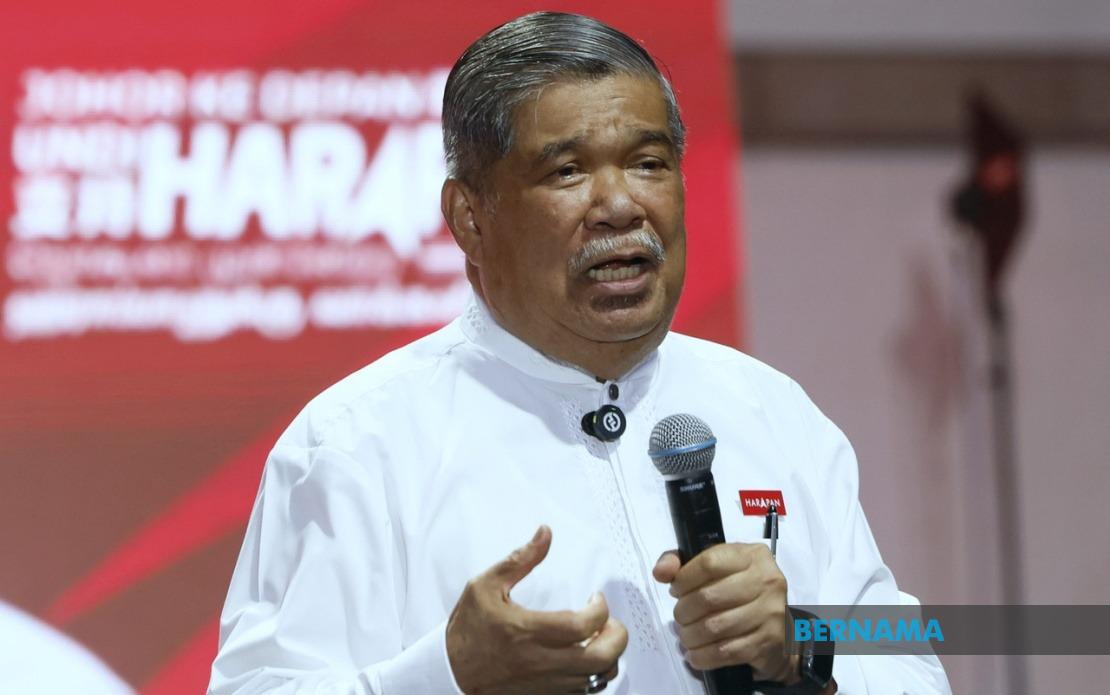
Pakatan Harapan's campaign machinery remains resolute in the face of PAS's strategic move to steer its supporters toward Barisan Nasional candidates in uncontested seats during the Johor state election. Amanah president Datuk Seri Mohamad Sabu, who doubles as Minister of Agriculture and Food Security, made clear on July 1 that such tactics would not disrupt the coalition's electoral push. Speaking at a campaign event in Permas Jaya, Mohamad told journalists that PH would forge ahead with its planned activities and would not allow itself to be sidetracked by the opposition's manoeuvres.
The PAS directive represents a calculated attempt to consolidate anti-PH votes across contested seats, creating a coordinated challenge to a coalition that has governed federally since 2018. By instructing its base to support BN where PAS itself is not fielding candidates, the Islamist party aims to avoid vote-splitting between itself and BN while maximising their combined vote share. This tactic underscores the complex, shifting landscape of Malaysian politics, where formal opposition alliances frequently blur as parties pursue seat-specific calculations. For PH, the challenge lies not merely in counteracting such signals but in convincing voters that its message transcends narrow partisan interest.
At the heart of PH's counter-argument sits its multiracial and multi-religious coalition structure, which senior figures argue provides the most stable foundation for Malaysia's political economy. Mohamad emphasised that this diversity reflects the country's constitutional values and serves as the engine for sustained economic development. The implicit critique here targets both PAS's religious positioning and BN's historical reliance on communal appeals. PH's leadership contends that Johor voters should evaluate candidates on merit, experience, and commitment to equitable governance rather than succumb to identity-based mobilisation. This framing attempts to elevate the campaign beyond zero-sum sectarian competition.
Governance alignment between state and federal administrations has become a central plank of PH's Johor pitch. The coalition argues that administrative coherence facilitates the rapid rollout of major infrastructure and economic initiatives. Mohamad identified public transport transformation, improvements to border facilities, and investment attraction as concrete priorities where unified governance would accelerate delivery. This argument holds particular resonance in Johor, a state historically managed by BN but now facing federal leadership from a rival camp. The synchronisation message appeals to voters weary of inter-governmental friction while positioning PH as the party of pragmatic development.
Yet beneath this optimistic framing lies a harder electoral calculus. Liew Chin Tong, DAP's strategic director and Deputy Finance Minister, identified voter participation—especially among younger citizens—as the election's decisive variable. His analysis of the 2022 Johor state contest reveals how structural factors can reshape outcomes. That election saw low voter turnout disproportionately benefit BN, a trend magnified by travel restrictions that prevented Johor workers based in Singapore from returning to cast votes. With coronavirus travel barriers now lifted, both coalitions will invest heavily in mobilisation to bring back such voters, whose preferences historically lean toward change-oriented parties.
The economic dimension animating Liew's campaign focus reflects genuine pain points in Johor's labour market. A significant portion of the state's working-age population commutes across the Causeway to employment in Singapore, a pattern that signals underperformance in local job creation. PH's campaign strategy pivots directly on this reality, promising high-quality, well-remunerated positions that would anchor young Johoreans within the state rather than driving them abroad. The narrative argues that only coordinated federal-state effort, with PH governing both levels, can generate the policy coherence and investment momentum required to reverse this outflow. Such appeals resonate powerfully with middle-class families concerned about their children's futures.
Beyond employment, PH's policy prospectus encompasses a range of service-delivery issues that define voters' daily experience. Public transport reliability, flood management, drainage maintenance, river conservation, elderly care infrastructure, and childcare facilities constitute the unglamorous but consequential portfolio that determines whether government delivers tangible improvement. Liew's insistence that the second campaign phase emphasise such bread-and-butter matters rather than partisan theatre reflects a strategic judgment that Johor voters, particularly in the state's smaller towns and rural areas, prioritise function over ideology. This pivot also allows PH to deflate the temperature of sectarian rhetoric by redirecting conversation toward shared material concerns.
The Johor-Singapore Special Economic Zone emerges as PH's centrepiece development vision for the state. This transnational corridor framework promises to leverage Johor's geographical proximity to Singapore and its position as a regional commerce hub, channelling investment into advanced manufacturing, financial services, and knowledge-intensive sectors. PH's case rests on the premise that such ambitious cross-border cooperation requires unified governance at both federal and state levels—precisely what the coalition offers if voters grant it a majority. The argument thus transforms the election into a referendum on whether voters believe PH or BN possesses superior capacity to cultivate Singapore's resources and expertise for Johor's benefit.
The structural setup of this electoral contest sees both PH and BN contesting all 56 state seats, eliminating any informal seat-sharing arrangement that might have traditionally divided the battleground. This full-spectrum competition creates space for three-way contests where PAS, despite its directive, retains organisational presence and voter loyalty independent of BN's campaign. The complexity this introduces complicates BN's reliance on consolidated anti-PH voting. Polling day, scheduled for July 11 with early voting on July 7, will reveal whether either coalition's mobilisation outreach proves decisive or whether the fractured opposition genuinely enables a PH breakthrough in a state that has eluded its grasp in the post-2018 environment.
For Malaysian observers, this contest illuminates broader tensions within the opposition ecosystem. PAS's pivot toward BN, codified through voter directives, represents a strategic choice to prioritise Islamist representation and religious positioning over broader ideological challenge to PH's governance model. This realignment reflects PAS's assessment that its electoral future lies in consolidating the conservative-religious vote rather than participating in a multiethnic, secular-inclined coalition. For PH, the election offers a chance to demonstrate that its diversity model can overcome sectarian appeals and that competent, aligned governance delivers material results voters value. The Johor campaign thus transcends local significance, testing whether Malaysian politics can sustain competition along developmentalist and competence-based lines or whether identity and sectarian divides will persistently structure electoral choice.

